Codex moves to mobile as the new remote control for coding agents
OpenAI is bringing Codex into the ChatGPT mobile app, turning phones into a review, approval, and steering surface for long-running coding agents.
- What happened: OpenAI is bringing
Codexinto the ChatGPT mobile app as a preview.- The rollout covers iOS and Android, supported regions, and all plans including Free and Go.
- Why it matters: The phone becomes a review, approval, and steering surface for long-running coding agents.
- Files, credentials, and permissions stay on the execution machine while state, diffs, test results, and approvals flow to mobile.
- Developer impact: Agentic development is starting to look less like IDE autocomplete and more like a remote work queue with operational controls.
- Watch: Mobile approval can reduce latency, but unattended execution still needs tests, policy, sandboxing, and clear approval tiers.
OpenAI announced on May 14, 2026 that Codex is coming to the ChatGPT mobile app. Read narrowly, this sounds like a product surface expansion: a coding tool now fits on a phone. The more important change is not the screen size. It is the operating model around coding agents that can run for minutes, tens of minutes, or longer while waiting for a human to review a result, approve a command, or redirect the task.
OpenAI said Codex now has more than four million weekly users. In the same announcement, it framed the product problem around "small moments of intervention." A coding agent can read a repository, run tests, reproduce a bug in a browser, generate a diff, and then stop because it needs permission or judgment. Does the developer have to be sitting at a desk for every one of those pauses? OpenAI's answer is to make Codex reachable from the phone, where a user can answer questions, scan progress, approve next steps, switch models, or add a new idea without reopening the full desktop environment.
This connects directly to the recent devlery piece on the Codex Windows sandbox, but it is a different layer of the same shift. The Windows sandbox story was about the local security boundary. The mobile preview is about the control surface for long-running work. AI coding competition is no longer only about which model writes the best patch in one shot. It is also about which platform can keep work running safely, return judgment points to humans at the right time, avoid mixing remote convenience with local credentials, and let team policy sit inside the execution loop.
The phone is a control surface, not a mobile IDE
OpenAI does not describe Codex mobile as a remote desktop. The announcement says users can connect to the laptop, dedicated Mac mini, or managed remote environment where Codex is running, and then bring that live state into the mobile app. From there, they can move through active threads, approvals, plugins, and project context. In other words, the phone is not trying to clone the development environment. It is trying to expose the state and decision points of an agent session already running somewhere else.
That distinction matters. Reviewing a large refactor on a phone is uncomfortable. A small screen, a moving context, and short attention windows all work against careful software review. But a phone is well suited to decisions such as: should the agent continue, should it choose approach A or B, should it dig into this test failure, or should it receive a specific permission? While Codex keeps the task moving, the human reduces decision latency.
OpenAI's examples follow that pattern. Start a bug investigation while waiting for coffee. Pick between two refactor directions during a commute. Ask Codex to assemble a customer briefing from Slack, email, docs, and browser-based tools before walking into a meeting. These are not scenes of a developer writing code on glass. They are scenes of a running agent waiting for short, targeted intervention.
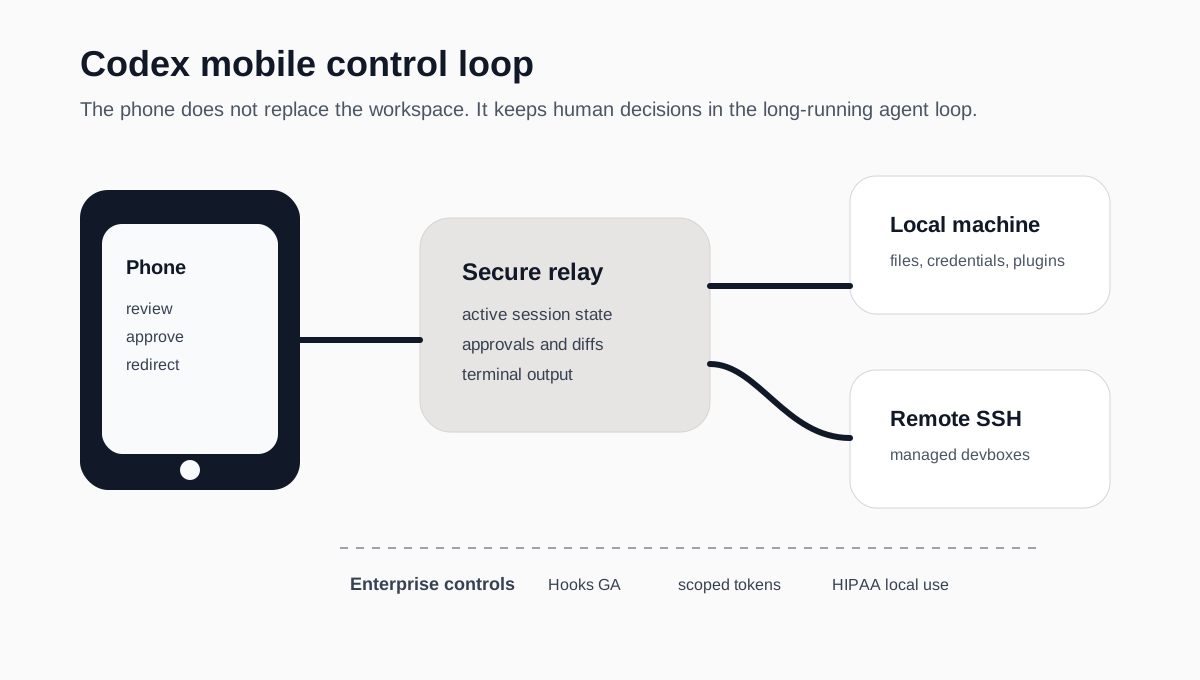
That makes Codex mobile different from the older idea of a mobile IDE. Past mobile coding products usually tried to make code editing tolerable on a tiny screen. Codex mobile shifts the center of gravity away from typing and toward supervising an agent-generated state. The developer is not coding on the phone as much as moving the agent past a blocked point.
The secure relay sentence carries the security model
One of the most important phrases in the announcement is "secure relay layer." OpenAI says Codex can be accessed from authorized ChatGPT devices without exposing the trusted machine directly to the public internet. It also says files, credentials, permissions, and local setup stay on the machine where Codex runs, while the phone receives screenshots, terminal output, diffs, test results, approvals, and other updates.
That is more than product copy. Once a coding agent can touch a local file system, private repositories, browser sessions, deployment credentials, and internal tools, the execution location becomes part of the security model. Sending everything to a cloud workspace can be convenient, but enterprise development is full of approved dependencies, credential stores, network policies, and audit trails. Keeping everything local protects more of that environment, but it makes remote continuity harder.
Codex mobile is OpenAI's product answer between those poles. Execution authority remains on the machine. Human judgment and state review move to mobile. The relay is therefore not just a transport detail. It becomes part of the trust boundary. Which device is authorized, which session state is synced, which output is exposed, and which approval is valid from the phone are now core platform questions.
Why Remote SSH and Hooks belong in the same announcement
The mobile preview was not the only Codex update. OpenAI also mentioned Remote SSH general availability, programmatic access tokens, Hooks general availability, and HIPAA-compliant local Codex use for eligible ChatGPT Enterprise workspaces. That bundle is not accidental. Mobile control only matters if the agent has a stable place to run and the organization has a policy layer it can tolerate.
Remote SSH fits how many teams already work. Development often happens on managed devboxes, internal bastions, cloud VMs, or GPU-backed remote machines rather than on an unconstrained personal laptop. According to OpenAI, the Codex desktop app can detect hosts from SSH configuration and create projects and threads inside a remote machine as if it were local. Once connected, that environment can be reached from authorized ChatGPT devices through the same relay infrastructure.
Hooks add policy and automation around that execution surface. OpenAI's developer documentation describes Hooks as a framework for running deterministic scripts during the Codex lifecycle. A team can inspect prompts for API keys, send events to logging or analytics systems, summarize conversations into persistent memory, or run validation checks when a turn stops. The documented events include PreToolUse, PermissionRequest, PostToolUse, UserPromptSubmit, and Stop.
This is the signal that coding agents are moving from "feature inside a chat app" toward "development runtime." Once an agent runs long enough and requests enough authority, teams will ask who approved which command, which files and sites the agent accessed, which policy blocked an action before execution, and which validation ran after a patch was generated. The mobile app handles the user experience of those questions. Hooks and scoped tokens handle the operational contact points.
| Area | What changed in this announcement | Question for development teams |
|---|---|---|
| Mobile | View Codex sessions, diffs, approvals, and test results inside the ChatGPT app. | Which approvals are safe from a phone? |
| Execution | Connect local machines, Mac minis, managed remote environments, and Remote SSH hosts. | Where should credentials and network authority remain? |
| Policy | Use Hooks GA and scoped programmatic access tokens around Codex workflows. | Where should prompt checks, tool controls, and post-patch validation be enforced? |
| Regulated work | Support local Codex HIPAA-compliant use in eligible Enterprise workspaces. | How does "data stays local" connect to audit and compliance evidence? |
The community sees both productivity and risk
The announcement quickly reached developer communities. Hacker News carried a front-page thread titled "Codex is now in the ChatGPT mobile app," and the Korean GeekNews front page also summarized the same move as remote agentic coding on iOS and Android. The response matters because developers are not treating this as a decorative mobile feature. They are reading it as a workflow change.
The optimistic reaction is straightforward. If agents already run long tasks, then human response time becomes a bottleneck. A quick approval between meetings, during a commute, or over lunch may keep work moving. For users who run several Codex threads at once, notifications and short judgments can reduce dead time.
The skeptical reaction is just as important. The easier it becomes to approve from a phone, the easier it becomes to approve the wrong thing. A small screen is a poor place to understand every line of a diff or every implication of a permission request. Some community reactions argued that Codex mobile only becomes truly useful once Codex itself can be trusted for more unattended work. That is a reasonable condition. Mobile control does not automatically make an agent safer. It lowers the friction around approval, which means policy, tests, sandboxing, and observability have to mature at the same time.
The right boundary is not "decide everything on mobile." It is to separate mobile-safe decisions from decisions that require desktop review. Re-running a flaky test, continuing a read-only investigation, collecting logs, updating documentation, or adding a low-risk test may fit mobile approval. Database migrations, authentication changes, billing logic, production secret access, and large refactors usually do not. Teams that adopt mobile steering need more explicit approval tiers, not fewer.
Competition is moving from model quality to operational surfaces
AI coding tools spent the last few years competing on model quality, SWE-bench scores, IDE integrations, and CLI ergonomics. The newer layer is operational. Anthropic's Claude Code, OpenAI Codex, GitHub Copilot agent workflows, and remote coding-agent services are all pushing the pattern of assigning work and coming back later. In that world, the important product surfaces are queue, notification, review, rollback, policy, and audit.
OpenAI's choice to put Codex inside the ChatGPT mobile app fits that strategy. ChatGPT is already a large consumer and enterprise distribution surface. By putting Codex there instead of launching a separate mobile IDE, OpenAI can reuse account identity, workspace context, plan entitlement, and device authorization. That is a strong distribution advantage. For professional developers, the open question is whether a general ChatGPT surface can support the level of review and control that terminal and IDE users expect.
There is also a third-party bridge angle. Community tools have already tried to expose Claude Code or Codex CLI sessions from a phone. Official mobile integration pulls that demand into OpenAI's own account, relay, and permission model. That does not mean official integration will be the final answer for every team. Some organizations may prefer an internal approval bot, a Slack or Linear workflow, or a custom bridge into existing developer platforms. OpenAI's advantage is broad distribution and tight Codex product integration. Its limitation is that teams will still need to see how much fine-grained policy control is exposed.
What teams should prepare
Treating this announcement as "coding on a phone" misses the point. The practical question is: where does our coding-agent work stop, and who decides what lets it continue? Codex mobile extends those stop points to the phone. That means teams need to break agent work into better-scoped tasks and define which categories can be steered remotely.
First, separate task types. Investigation, test reproduction, documentation updates, and small bug fixes are good candidates for mobile steering. Public API changes, data migrations, permission-model edits, and deployment automation changes deserve a stronger review path. Repository instructions such as AGENTS.md should say where the agent can proceed on its own and where it must call a human back in.
Second, automate checks before and after approval. Hooks are relevant here. Even if a user approves from a phone, a repo-local hook can block destructive commands, scan for secrets, run formatting and tests, or require specific validation after a patch. Hooks are not a complete security boundary. OpenAI's own documentation describes limits around what can be intercepted. But they are useful guardrails for the predictable problem that people make worse decisions when they are rushed.
Third, change the agent's reporting style. A mobile-friendly coding agent cannot just dump logs. It has to say what it did, what it found, what choice is now needed, and how risky the next approval is. The user experience of coding agents will depend not only on patch generation, but also on whether the agent can produce a compact operational report that a human can judge while away from the desk.
The new bottleneck is where the human is
Codex in the ChatGPT mobile app is not a new frontier benchmark or a major model launch. It is still an important signal for AI-driven development. As coding agents work for longer stretches, the bottleneck is not only the speed of code generation. It is the moment when a human has to approve, add context, or stop a risky path.
OpenAI is moving that bottleneck to the phone. That is convenient, but it also raises the standard for control. The easier it is to tap approve, the more carefully teams need to define what approval means. Secure relay, Remote SSH, Hooks, and scoped tokens belong in the same announcement because the next phase of coding-agent competition will not live only inside the model window. It will happen across local and remote environments, human judgment, execution policy, and audit evidence.
So the meaning of this news is larger than "Codex now has a mobile app." It does not mean the developer's desk disappears. It means that when a coding agent pauses, a smaller control surface can keep the work moving. As agents enter real team workflows, one tap on that surface can change both development speed and risk.