Codex on mobile turns approval UX into the agent battleground
OpenAI Codex mobile preview shows coding-agent competition moving from model output toward approvals, remote hosts, hooks, and enterprise control.
- What happened: OpenAI added
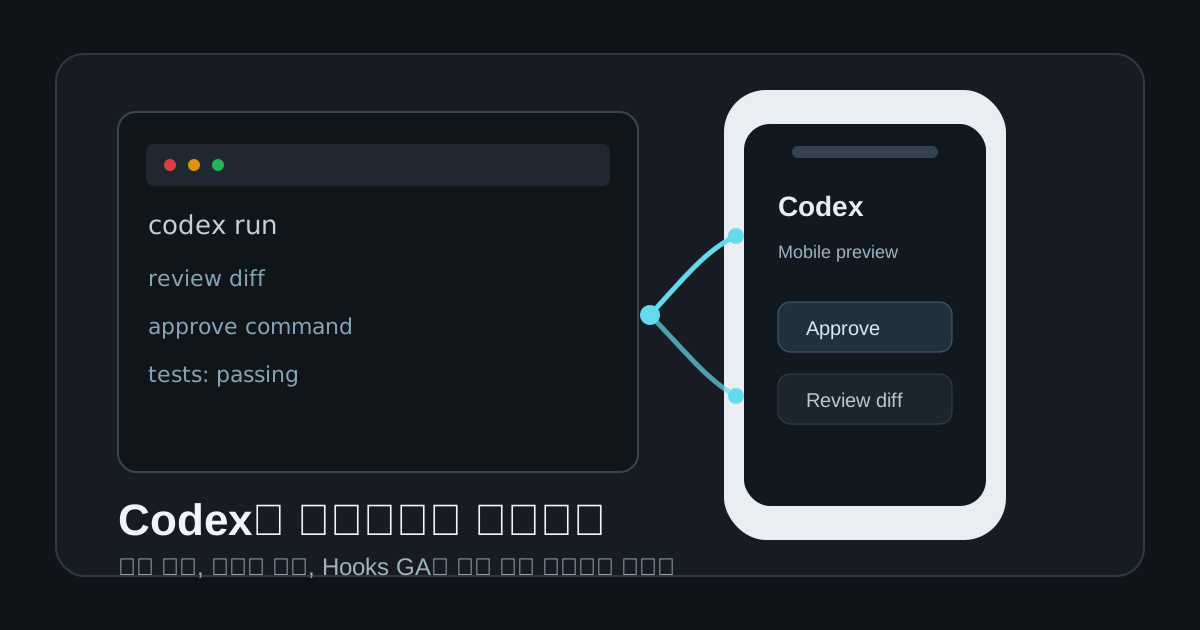
Codexto the ChatGPT mobile app in preview on May 14, 2026.- The rollout covers iOS and Android, including Free and Go plans. For now, the connected execution target is the Codex app running on macOS.
- Why it matters: The coding-agent competition is expanding from code generation into remote approval, live observation, and policy enforcement.
- The mobile app can surface approvals, plugins, screenshots, terminal output, diffs, test results, and project context while longer-running work continues elsewhere.
- Watch: Small-screen approval is both a productivity feature and an operational risk.
- That is why the same announcement bundle matters:
Remote SSH,Hooks, access tokens, and Enterprise controls are all part of the story.
- That is why the same announcement bundle matters:
On May 14, 2026, OpenAI announced a preview of Codex inside the ChatGPT mobile app. The surface-level message is simple: you can now monitor Codex work from your phone, answer mid-task questions, approve commands, and start new work. But reading this as "coding from a phone" misses the more important shift.
The real story is that coding agents are becoming long-running workers. Autocomplete reacts next to the cursor. Chatbots answer inside a conversation. Codex, Claude Code, Grok Build, and similar agents read repositories, run tests, open browsers, prepare diffs, request permission, and wait until a human comes back. In that kind of product, the decisive experience is not just one answer's quality. It is when the agent stops, what it shows, who approves the next action, and which policy checks the action passes.
OpenAI has moved that control surface onto the phone. Codex still runs on a user's laptop, dedicated Mac mini, or managed remote environment. Files, credentials, local settings, and permissions stay on that machine. The ChatGPT mobile app relays the live execution state at moments where human judgment is needed. OpenAI says mobile can handle active threads, approvals, plugins, and project context, while screenshots, terminal output, diffs, and test results stream back in real time. This is not about typing large patches on glass. It is a remote control plane for agents that would otherwise stall.
The phone is an approval device, not an editor
"Mobile coding" carries an old misconception. It is easy to imagine a full IDE on a small screen, with the developer directly writing code from a phone. Some developers do work that way, but for most professional workflows, the phone is a poor editor. The screen is cramped, input is slow, file navigation is awkward, and careful diff review is harder than on a desktop.
The interesting part of Codex mobile preview is that OpenAI is not selling the phone as an editor. Its examples are about starting a bug investigation, choosing a refactor direction during a commute, synthesizing information before a customer conversation, or dropping a fresh idea into a new thread. Those are not long manual editing sessions. They are starts, course corrections, and approvals inside longer-running agent work.
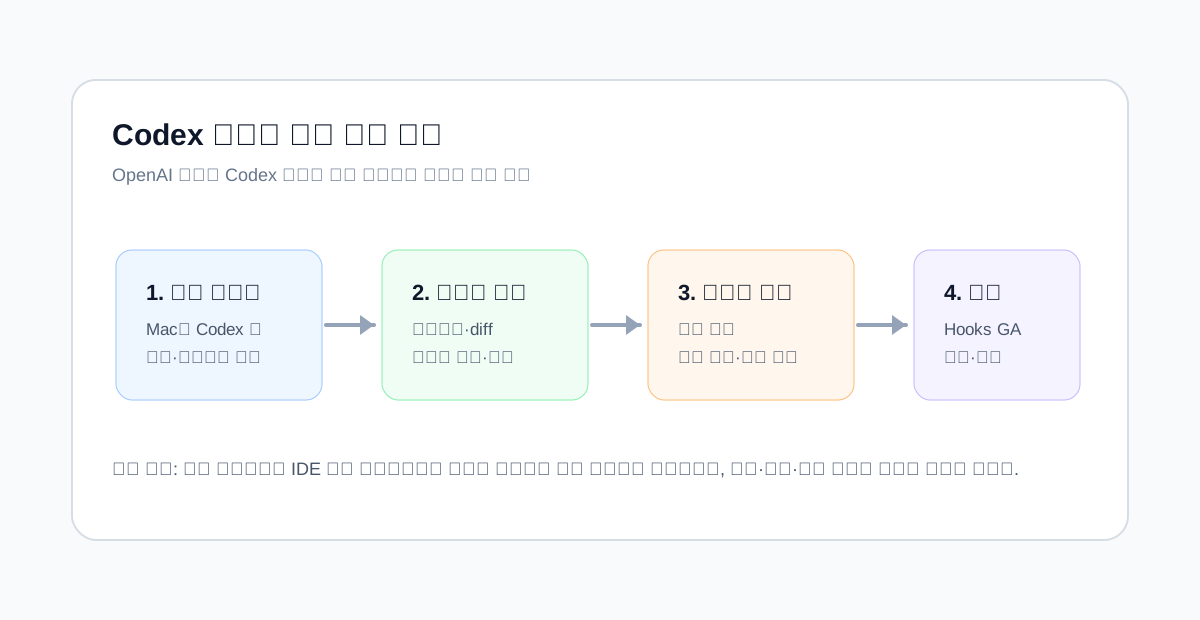
OpenAI's May 14 Help Center release notes point in the same direction. They describe mobile support for starting or continuing threads, answering questions, changing direction, approving actions, reviewing what Codex found, and moving across connected hosts. Setup starts in the Codex App on the host and continues by scanning a QR code in the ChatGPT app. The host must remain awake, online, and running Codex for remote access to keep working.
That constraint is important. Codex is not executing entirely inside the phone. The phone manipulates the state of Codex on a connected Mac host. The unit of productivity shifts from a device to a running agent thread. A developer can start work from a desktop before leaving, approve the next step while moving, and arrive back to a prepared diff and test output.
Three signals OpenAI packaged together
This was not just a mobile preview announcement. OpenAI put Remote SSH, programmatic access tokens, Hooks general availability, and HIPAA-compliant local use in the same product story. That packaging says a lot. Codex is being positioned less as a personal helper and more as an agent runtime that can live inside enterprise development environments.
The first signal is Remote SSH. OpenAI says Remote SSH is generally available. The Codex desktop app can detect hosts from a user's SSH configuration and create projects and threads on remote machines. Many teams already develop on devboxes, managed remote environments, or internal hosts with approved dependencies and credentials. If Codex can run there, the agent becomes part of company-controlled development infrastructure rather than a toy on a personal laptop.
The second signal is programmatic access tokens. OpenAI says Business and Enterprise workspace settings can issue scoped credentials for CI pipelines, release workflows, and internal automation. This narrows the gap between a product a person uses after logging into ChatGPT and a product an organization can invoke repeatedly. If coding agents are going to triage failing tests, draft release notes, propose dependency updates, or prepare security-patch candidates, token ownership and permission scope must be managed.
The third signal is Hooks. OpenAI's developer documentation describes Hooks as an extensibility framework for deterministic scripts inside the Codex lifecycle. The examples are concrete: scan prompts for API keys, run validators, send conversations to logging or analytics systems, summarize conversations into memory, or customize prompts for a specific directory. Hook events attach to real points in the agent loop, including SessionStart, PreToolUse, PermissionRequest, PostToolUse, UserPromptSubmit, and Stop.
Together, those three pieces form one product message. The agent runs in a remote environment, receives approval from mobile, and passes through organizational rules via hooks and token policy. Coding-agent competition is shifting from "who writes code faster" toward "who provides the best controlled long-running worker."
Anthropic opened the path, OpenAI broadened the surface
OpenAI is not the first company to expose this pattern. Anthropic already offers Claude Code Remote Control, which lets users drive a running Claude Code session from claude.ai/code or the Claude mobile app. The Claude Code documentation describes a flow where a user runs claude remote-control and continues a local CLI or VS Code session from another device.
So what is different about OpenAI's move?
First, the feature lives inside the ChatGPT mobile app. Codex is not being split into a separate mobile product. It is becoming one more surface inside an app many users already open every day. That merges a developer tool with a broader consumer and workplace assistant surface. A user can move between general conversation, files, apps, memory, and Codex inside the same product shell.
Second, OpenAI announced mobile remote access alongside enterprise controls. Remote SSH, Hooks GA, programmatic access tokens, and HIPAA-compliant local use all appear in the same story. That framing is closer to "the enterprise agent runtime now has more control points" than to "the phone app became more convenient." Claude Code Remote Control is powerful too, but OpenAI is making a more explicit connection across ChatGPT workspace, Codex app, CLI, IDE, web, and mobile.
Third, the announcement makes the developer-market fight with Anthropic harder to miss. Axios reported in the same week that Sam Altman offered two free months to companies switching to Codex. That does not prove product superiority in either direction. It does show that coding agents have moved beyond feature comparison into price, plan design, switching cost, and organizational rollout.
Small-screen approval is risky by design
Mobile approval UX is appealing. If an agent asks to run a test while the developer is away from the desk, a phone notification can unblock it. If a refactor reaches two plausible approaches, the user can pick one during a commute. If Codex is investigating a customer issue and needs log access, the user can respond between meetings.
The same convenience creates risk. Approval buttons appear on small screens. Users may be moving, multitasking, or reviewing the request without enough diff context. Axios raised this concern directly, noting that approving agents while multitasking on a small screen can increase the chance of mistakes. A coding-agent approval is not a generic notification. Depending on the request, it can lead to network access, file changes, credential-bearing commands, or deployment scripts.
That is why mobile approval cannot stand alone as the product. Good mobile approval needs at least four properties. It must explain why the action is needed. It must show the command and change scope in a reviewable form. It must let organizational policy compensate for human misses. And it must leave an audit trail of approval, denial, and result.
Hooks GA is one of OpenAI's answers to that problem. A PreToolUse hook can run before Bash, file edits, or MCP tool calls. A PermissionRequest hook can participate at the approval point. A PostToolUse hook can inspect output after the command finishes. Hooks are not a complete security boundary. OpenAI's own documentation presents PreToolUse as a guardrail and notes that it does not intercept every shell call or WebSearch case. Still, deterministic scripts inside the agent loop are a meaningful counterweight to human-centered approval failures.
Teams should evaluate the operating model, not the mobile app
The wrong reaction to this announcement is "let's approve from phones too" as the first step. The operating model comes first. Teams need to decide where the agent runs, what permissions it has, which files it may edit, which commands can be auto-approved, which commands always require a person, what context appears in an approval request, and how failed work is stopped.
Codex's current model is host-centered. Files and credentials stay on the local or remote host, while mobile brings back the live context. That may feel more natural to organizations than uploading every development context into a cloud agent. If a company already has approved devboxes or Mac minis with the right dependencies and credentials, an agent can be constrained to that environment. The tradeoff is obvious too: the host must stay awake and online. If a personal laptop sleeps, the agent stops with it.
Remote SSH reduces part of that friction. Running Codex in a company-managed remote development environment makes the workflow less dependent on an individual device. But it raises larger security questions. Credential scope, network egress, repository write access, CI tokens, and production access on the remote host all become part of agent policy. Mobile approval has to sit on top of that policy. If approval gets faster without policy, risky work simply gets faster too.
For development teams, three preparations matter. First, repository rules and automated checks need to be legible to agents: AGENTS.md, test commands, lint commands, dangerous paths, migration rules, and deployment constraints. Second, hooks or wrapper scripts should make forbidden commands and mandatory checks explicit. Third, teams need a review habit built around small diffs. The longer an agent runs, the more dangerous it becomes to accept a huge final change set without intermediate review.
Codex is becoming a ChatGPT surface
The larger OpenAI strategy is visible. Codex now spans CLI, web, IDE extension, desktop app, and mobile. In the earlier Codex app announcement, OpenAI said developers could use the app, CLI, IDE extension, and web through ChatGPT login, with limited access also available to Free and Go users. The May announcement adds ChatGPT mobile as another surface.
That makes ChatGPT look less like a pure conversational assistant and more like an operating hub for multiple work surfaces. ChatGPT release notes around the same period keep adding file libraries, spreadsheet integration, memory sources, connectors, and apps. Codex is the developer-work surface inside that broader workspace. A user can start in natural-language conversation, reference files, connect tools, hand repository work to Codex, and approve from mobile.
This direction is powerful, but it adds complexity. When one app holds many contexts and permissions, users may struggle to understand which data is being used where. OpenAI emphasizes that files, credentials, permissions, and local setup remain on the host for Codex mobile. That distinction is central to trust. The ChatGPT app is not carrying the entire development environment. It is relaying live state from an approved host.
Users and administrators still need to keep the surfaces separate. A general ChatGPT conversation, a Codex thread, a connected host, workspace settings, training-data controls, app connectors, and programmatic tokens all carry different risks. The enterprise question is not simply whether Codex is allowed. It is which surface gets which permission under which policy.
The next fight in coding agents
The coding-agent market in May 2026 is converging quickly. Anthropic has Claude Code Remote Control. OpenAI has bundled Codex mobile with Remote SSH and Hooks. xAI's Grok Build talks about plan mode, approvals, plugins, hooks, skills, MCP, and subagents. The names differ, but the recurring vocabulary is familiar: approve, diff, remote, hooks, plugins, skills, host, token, and policy.
That vocabulary points to one conclusion. A coding agent is no longer just a model. It is a runtime made of execution environment, permission model, extension points, approval UX, auditability, cost controls, and team rules. Intelligence still matters, but intelligence alone cannot safely operate inside an enterprise codebase. An agent that changes real code must stop at the right moments, ask when risk is high, show enough context when it asks, and leave room for policy to intervene even after a human clicks approve.
OpenAI's Codex mobile preview is small in interface terms but large as a signal. It does not merely add a phone app. It extends the agent runtime across more of the developer's day. During a commute, between meetings, before a customer call, or after leaving the desk, the agent can keep working and the human can intervene only when needed. Used well, that cuts idle time. Used poorly, it compresses risky decisions into distracted approvals.
The next phase of competition will not be about who builds the flashiest mobile screen. It will be about who gives enough judgment context on a small screen, who fits organizational policy naturally into the agent loop, who handles remote hosts and local credentials safely, and who keeps diffs and test results reviewable. Saying Codex has entered the phone does not mean the coding agent is merely in the developer's hand. It means the developer's approval responsibility is there too.