ChatGPT ads reach five markets, and answer trust is the test
OpenAI introduced ChatGPT Ads Manager, CPC bidding, conversion measurement, and a pilot in the UK, Mexico, Brazil, Japan, and Korea. The hard question is where AI answers end and ads begin.
- What happened: OpenAI is turning
ChatGPT adsfrom an experiment into a self-serve advertising platform.- On May 5, 2026, it announced a beta Ads Manager, CPC bidding, a Conversions API, and pixel-based measurement tools.
- On May 7, OpenAI said the ad pilot would expand to the United Kingdom, Mexico, Brazil, Japan, and Korea.
- Why it matters: ChatGPT is no longer only an answer engine; it is becoming an
intent ad surface.- Search ads bought keywords. ChatGPT ads are positioned around the conversational context where users compare, narrow options, and decide what to do next.
- Watch: OpenAI says ads will not influence answers and advertisers will not see user conversations, but the trust test starts now.
- Builder angle: AI product teams need a stricter design language for separating ads, recommendations, sponsored content, and model output.
OpenAI has started moving ChatGPT ads from a limited experiment into a platform. On May 5, 2026, the company announced new ways to buy and manage ChatGPT ads. Advertisers can now create campaigns through partners or through a beta self-serve Ads Manager. They can use CPC bidding in addition to CPM, and OpenAI has also introduced a Conversions API and pixel-based measurement.
Two days later, the update stopped being a U.S.-only story. OpenAI said its ChatGPT ads pilot would expand to the United Kingdom, Mexico, Brazil, Japan, and Korea. If you are outside those five markets, including Singapore and the rest of Southeast Asia, nothing has changed in your ChatGPT yet. What has changed is the odds: the business model for free and lower-cost AI is being tested somewhere, and the results decide what your free tier looks like next.
At the surface level, this is an ad product launch. From an AI product perspective, it is a larger shift. ChatGPT has been a place where users ask questions and receive answers. Now that same space is becoming an advertising surface where users learn about categories, compare alternatives, narrow purchase candidates, and decide what action to take. Search ads bought the intent expressed in a query. ChatGPT ads try to interpret intent from a conversation. That distinction matters.
OpenAI says ads do not influence ChatGPT's answers. It says ads are labeled as sponsored and visually separated from organic answers. Advertisers do not receive a user's chats, chat history, memory, or personal details. They receive aggregate performance information such as impressions and clicks. OpenAI also says ads will not be shown to accounts identified as minors or to users who state that they are minors, and that ads will not appear around sensitive or regulated topics such as health, mental health, and politics.
The real question is how well those promises hold in practice. "Ads do not influence answers" is a product principle. Whether users feel that separation is another matter. In a conversational AI product, users encounter answers, recommendations, links, and ads inside one flow. A small label may not be enough when an ad appears to fit naturally into the user's reasoning process. Whether users can still recognize the ad as a separate commercial message becomes OpenAI's central trust test.
From ad experiment to ad operating system
OpenAI's first ChatGPT ad test began on February 9, 2026. It targeted logged-in adult users in the United States on the Free and Go plans. Plus, Pro, Business, Enterprise, and Education plans were excluded. At the time, OpenAI framed ads as a way to broaden free access and help fund more capable ChatGPT features.
In a March 26 update, OpenAI said early signals were positive. It reported no impact on consumer trust metrics, a low ad dismissal rate, and improving relevance from feedback. It also said it would begin pilots outside the United States in Canada, Australia, and New Zealand.
The May 5 announcement moves one step further. ChatGPT ads are no longer only a limited test operated by OpenAI with a small set of brands. They are becoming a media business with advertiser workflow. OpenAI is working with agency partners such as Dentsu, Omnicom, Publicis, and WPP, plus technology partners including Adobe, Criteo, Kargo, Pacvue, and StackAdapt. Those partners can help with campaign budgets, bidding, creative operations, and management, but OpenAI says its own ad system controls delivery decisions.
The beta Ads Manager is now opening to advertisers in the United States. Inside the portal, advertisers can register, add billing information, set budgets, configure bids and pacing, upload ads, launch and manage campaigns, and review performance. That is the familiar skeleton of a modern ad platform. At this point, ChatGPT ads are not just an in-app card. They are a full advertiser workflow attached to a conversational AI surface.
| Component | What OpenAI announced | What it means for AI products |
|---|---|---|
| Buying | Partners and beta Ads Manager | A shift from limited pilots to a self-serve media surface |
| Bidding | CPM and CPC support | A move from impression testing toward action-based optimization |
| Measurement | Conversions API and pixel-based measurement | A way to connect post-chat purchases, leads, and sign-ups to ad performance |
| Trust | Answer independence, conversation privacy, and user controls | Ad revenue and AI answer trust now share the same interface |
In ad-platform language, the most important word in this release is CPC. The early pilot used CPM, where advertisers pay per thousand impressions. That is useful for proving demand and delivery on a new surface. CPC changes the optimization target. Advertisers pay when a user actually clicks.
OpenAI emphasizes CPC because ChatGPT conversations often happen close to decisions. Users are not only killing time. They are learning a category, comparing options, and deciding what to do next. A click in that context can be a strong signal that the ad connected to a next action. That is similar to why search advertising became so powerful. The difference is that the signal is not just a typed keyword. It is the context of a conversation.
The hard issue is not targeting, but the boundary
OpenAI says ad matching can use conversation topics, previous chats, and past ad interactions. For example, someone researching recipes might see an ad for a meal kit or grocery delivery service. On paper, that may sound close to existing interest-based advertising.
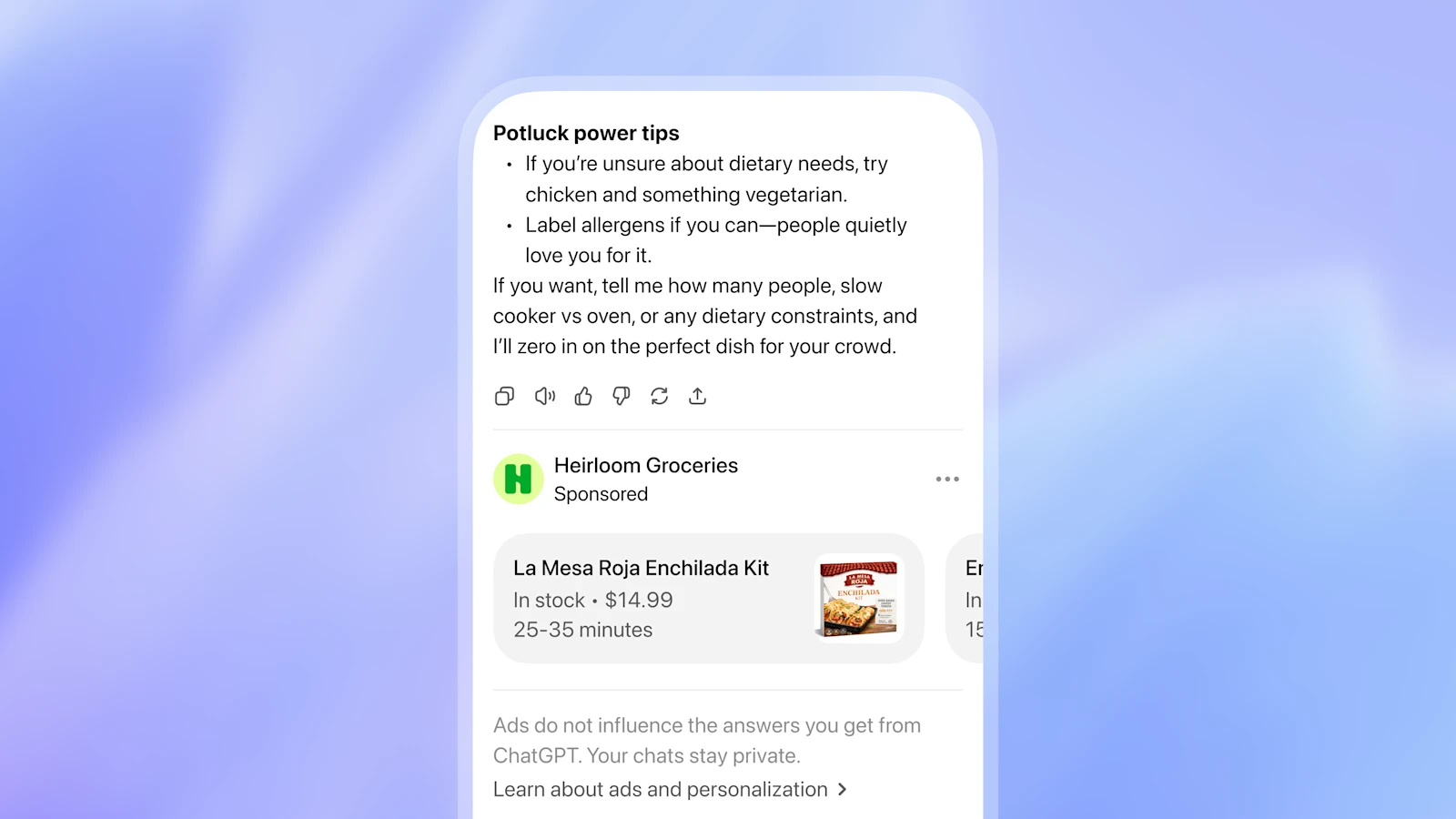
ChatGPT is different because the ad appears inside a user's thinking flow. A user might ask what to bring to a weekend potluck. ChatGPT could consider dietary restrictions, prep time, storage, and group size. Under that answer, a sponsored enchilada kit might appear. Even if the ad did not change the answer, it is present in the same screen where the user is forming a decision.
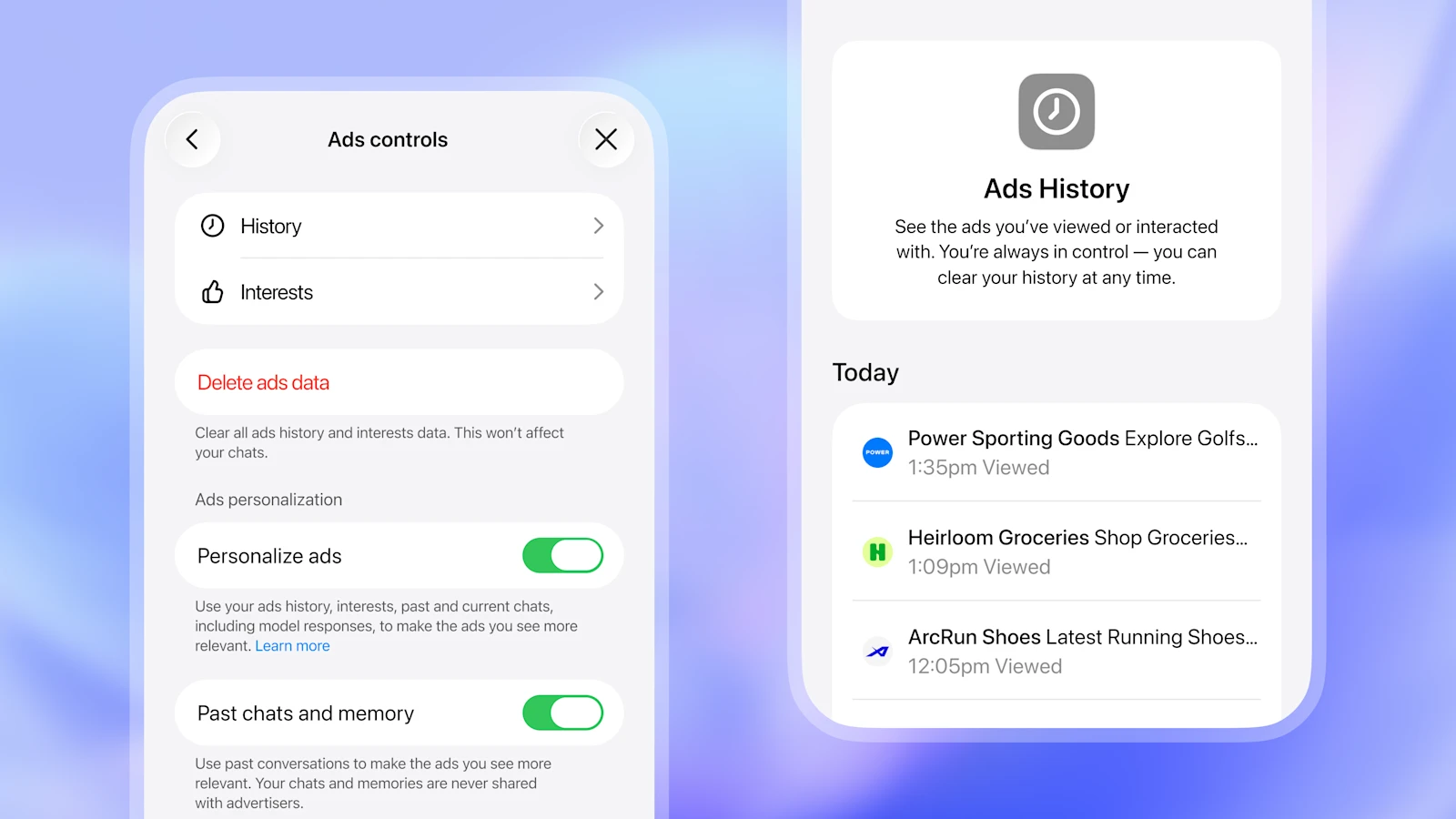
The central issue is not how smart the ad is. It is whether the boundary between ad and answer is stable. OpenAI says ads will be clearly labeled as sponsored and visually separated from answers. Users can hide ads, provide feedback, see why an ad appeared, delete ad data, and manage personalization settings.
Those controls matter. But AI interfaces need a stricter standard. On a normal web page, users expect banners and sponsored placements. In search results, ad labels are an old grammar. ChatGPT users enter a different relationship with the product. They use it for schoolwork, professional tasks, health questions, financial research, legal preparation, hiring, and product comparisons. The same "sponsored" label carries a higher trust cost inside a system that behaves like an adviser.
That is why OpenAI's exclusions around minors, health, mental health, and politics matter. Conversational AI makes it difficult to separate sensitive questions from commercial persuasion. "Recommend running shoes" may be a reasonable ad context. "My ankle hurts; what shoes should I wear?" becomes a health-adjacent context. The user experience flows smoothly, but the ad system has to decide where eligibility stops. If that boundary fails, the problem is not only ad quality. It becomes a safety and trust problem.
Privacy promises will be tested by measurement
OpenAI keeps repeating one key sentence: advertisers do not see users' conversations. Advertisers do not receive chats, chat history, memory, or personal details. They receive aggregate information about ad performance. For conversational advertising, that is the minimum trust condition.
At the same time, OpenAI has introduced a Conversions API and pixel-based measurement. From the advertiser side, that is expected. Brands want to know not only whether someone clicked an ad, but whether the click later led to a purchase, lead, sign-up, or other event. Without measurement, advertisers cannot justify budgets, optimize bidding, or improve creative.
This creates the tension. OpenAI has to provide useful performance measurement without handing over individual conversation data. If it provides too little, advertisers may struggle to understand results. If it provides too much, users may feel that their private chats are being turned into ad-tracking data. OpenAI's phrase "aggregate performance insights" is the intended compromise.
AI builders should pay close attention to this layer. Once an AI product adds advertising, affiliate recommendations, sponsored answers, or commerce links, it is no longer only an answer system. It becomes an operating system for event tracking, consent, personalization controls, attribution, sensitive-topic classification, advertiser review, fraud detection, and audit logs. Better model output is not enough.
The rollout list tells you who is being tested
OpenAI's May 7 update named five markets: the United Kingdom, Mexico, Brazil, Japan, and Korea. That is not an ordinary geographic rollout, and the omissions say as much as the inclusions. The EU is absent, which fits a market where the AI Act's transparency duties and the DSA's rules on advertising and profiling raise the cost of an experiment. The five that are in span very different regulatory regimes, languages, purchasing habits, and incumbent ad ecosystems. OpenAI is testing whether one ad model survives that spread.
Two of the five are in APAC, which is the part that matters if you build there. Japan and Korea are both markets where search and commerce advertising is dominated by strong local incumbents rather than by Google alone, and where users adopted AI quickly for search-like discovery, shopping comparison, and work assistance. Singapore is not in the pilot, but a product tested against Japanese and Korean ad norms is a product being shaped for the region, and Singapore-based teams selling into either market will meet the result before they meet the local rollout.
The question the pilot actually answers is behavioral: will users treat ChatGPT like a search engine, like an adviser, or like an app with ads? That difference changes ad tolerance. In search, advertising is an old norm and users know sponsored results may appear first. In an adviser-like AI, expectations are different, and users expect a higher degree of independence. OpenAI's repeated claim that ads do not influence answers is meant to protect that adviser trust. ChatGPT keeps that role only if ads stay clearly separate from the answer.
Education, finance, health, and employment are the sensitive edges in every one of the five markets. When users ask for study materials, compare insurance or loans, look up health information, or prepare for hiring, the treatment of ads becomes a regulatory question, not a UX one. OpenAI says ads will not appear around sensitive or regulated topics. Whether that classifier holds up in Japanese, Korean, Portuguese, and Spanish conversations, not only in English, is what the pilot is really measuring.
Ads are the price tag of free AI
Read charitably, OpenAI's argument is straightforward. ChatGPT serves hundreds of millions of users. Keeping Free and Go plans fast and useful costs money. Ads can help more people access capable AI without paying for a subscription. OpenAI also says users who do not want ads can upgrade to Plus or Pro, or they may be able to turn off ads in the free tier in exchange for fewer free messages.
That structure is familiar. Internet services have long traded free access for advertising. The difference is what users are trading. In AI, users are not only giving up empty screen space. They are accepting an environment where the context of their questions can become an ad-matching signal. Conversations are longer, more personal, and often closer to decisions than search keywords. The price tag is therefore more complicated.
The split between ad-free paid plans and ad-supported free or low-cost plans may become a basic pattern for AI services. Inference costs will keep falling, but usage is growing faster. Voice, image generation, agents, file analysis, browsing, and personalized memory all increase the cost of a free user compared with the old text-chatbot era. OpenAI testing ads looks less like an exception and more like a direction.
That means the remaining question is not whether ads exist. It is what kinds of ads are allowed, where they appear, what data is used to match them, what users can control, and how the line between answer and ad is audited. The answer will not be OpenAI's problem alone. It will become a product standard for AI apps.
What builders should take away
AI product teams can learn three practical lessons from this release.
First, sponsored content is governance, not just a feature. Adding an ad card is easy. The difficult work is advertiser review, sensitive-topic exclusion, user controls, privacy explanation, performance measurement, and abuse response. OpenAI keeps foregrounding its ad principles because the product risk sits in that operating layer.
Second, visual separation needs to be stronger in AI answer interfaces. A small "Ad" label that works in search results may not be enough in a conversational product. Users need clearer boundaries, better explanations, and easier controls. If a user cannot tell within a second whether something is model judgment or advertiser messaging, trust will weaken quickly.
Third, measurement has to be designed with privacy from the start. Conversions API and pixels are familiar ad tools, but they feel more sensitive around AI conversations. The promise that advertisers do not receive individual conversations or personal details has to hold consistently in the UI, data pipeline, documentation, and audit model.
OpenAI's ChatGPT ad expansion exposes a question the AI industry cannot avoid. Who pays for free AI? Can an answer engine become an ad surface? How far can conversational context become a commercial signal? And when AI behaves like an adviser, how much advertising can users tolerate?
The current answer is provisional. OpenAI says it is testing, expanding markets, adding advertiser tools, and watching user response. But the direction is clear. ChatGPT is becoming not only a subscription service, API platform, app platform, and commerce interface, but also an advertising platform. The most important capability will not be ad yield alone. It will be the ability to operate ads without losing answer trust. The five-market pilot is the next test of that capability.