OpenAI and Anthropic move the model war into deployment
OpenAI and Anthropic are building enterprise AI deployment firms. The bottleneck is moving from APIs to FDEs, integration, and governance.

- What happened: OpenAI announced
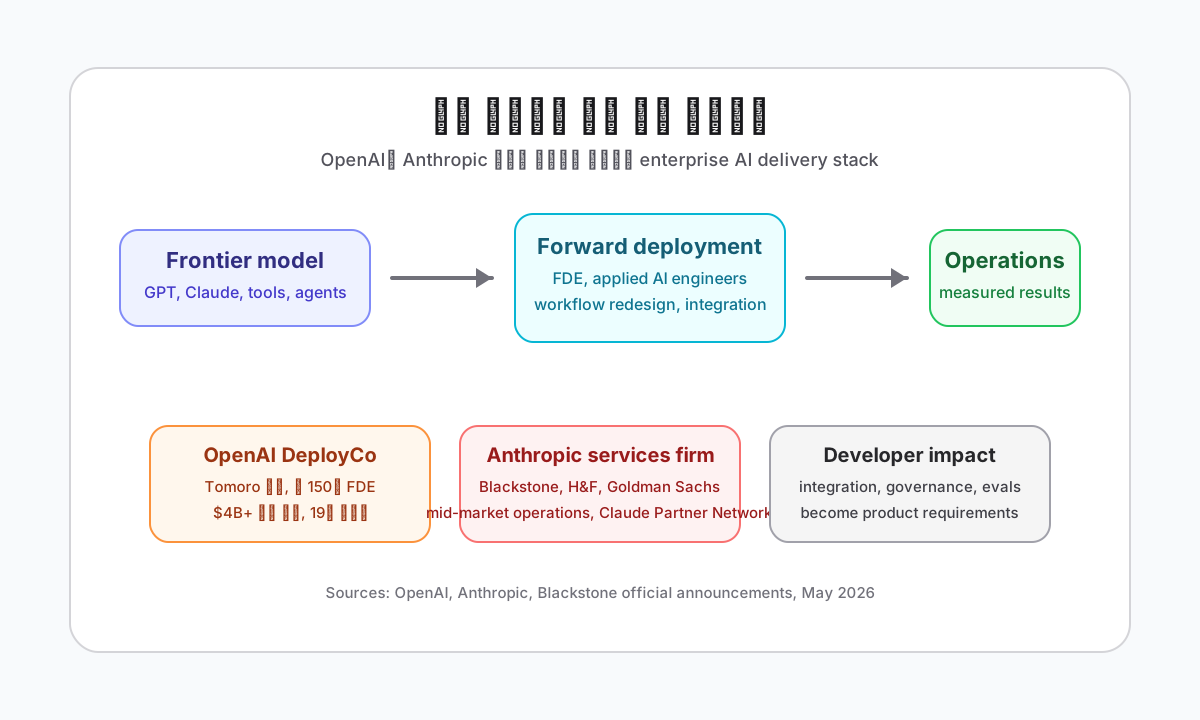
OpenAI Deployment Company, while Anthropic announced an AI services firm with Wall Street partners.- OpenAI is acquiring Tomoro to bring in roughly 150 FDEs and deployment specialists, and says the new company starts with more than $4 billion in initial investment.
- Why it matters: Frontier AI competition is moving from selling model APIs toward on-site deployment, workflow redesign, integration, and governance.
- Developer impact: The hard differentiators are becoming data access, permissions, evaluation, operational logs, and change management, not prompt craft alone.
- When model companies bring their own FDEs into customer organizations, internal platform teams and SI partners will need clearer product requirements and stronger operating standards.
- Watch: This structure can speed up AI adoption, but it may also increase model-vendor lock-in and bring consulting-style costs back into enterprise AI.
OpenAI announced OpenAI Deployment Company on May 11, 2026. A few days earlier, on May 4, Anthropic said it would build a new AI-native enterprise services firm with Blackstone, Hellman & Friedman, and Goldman Sachs. On the surface, both announcements look like enterprise AI consulting launches. The larger signal is more important: frontier model companies no longer want to stop at selling models. They want to own the deployment layer that makes AI work inside customer organizations.
Until now, enterprise AI competition has usually been described through models, chat products, APIs, pricing, context length, coding performance, and agent tooling. But the enterprise field still has an older problem. A model can be smart enough and still fail to create productivity if it is not connected to real systems of work. Teams need to know where customer data lives, who has which permissions, how approval flows change, who is responsible when something fails, and how results should be evaluated. OpenAI and Anthropic are aiming directly at that bottleneck.
OpenAI is absorbing an FDE company
Three numbers stand out in OpenAI's announcement. First, OpenAI has agreed to acquire Tomoro, an applied AI consulting and engineering firm. Through that acquisition, roughly 150 Forward Deployed Engineers and Deployment Specialists will join OpenAI Deployment Company. Second, the new company is launching with more than $4 billion in initial investment. Third, OpenAI describes the partner-backed network as touching more than 2,000 businesses.
OpenAI's FDE is not a normal customer-support engineer. The announcement says these teams will work with business leaders, operators, and front-line teams to identify where AI can have the largest impact, redesign core workflows around intelligence, and turn the result into durable systems. That is not simply "attach an API to this workflow." It is closer to rebuilding the workflow around AI as an operating assumption.
The structure recalls Palantir-style forward deployed engineering. The idea is not to build a strong model centrally and leave customers to figure out the rest. A deployed engineer learns the customer's data, processes, permissions, domain language, and operational constraints, then helps build systems that fit that organization. That also explains why OpenAI is acquiring Tomoro. An FDE organization cannot be created overnight. It needs people who can understand messy customer work while still keeping up with rapid changes in models and tools.
The partner list is also revealing. OpenAI Deployment Company is led by TPG, with Advent, Bain Capital, and Brookfield as co-founding partners. B Capital, BBVA, Emergence Capital, Goanna, Goldman Sachs, SoftBank Corp., Warburg Pincus, and WCAS are also named as founding partners. Consulting and systems-integration firms such as Bain & Company, Capgemini, and McKinsey & Company are in the mix too. OpenAI is not merely trying to sell another AI product. It is trying to create a repeatable deployment playbook through private equity and consulting networks.
Anthropic is widening mid-market deployment capacity
Anthropic's announcement landed one week before OpenAI's. Anthropic, Blackstone, Hellman & Friedman, and Goldman Sachs said they would create a new AI services company to deploy Claude into core enterprise operations. Blackstone's release describes it as an independent company and says Anthropic engineering and partnership resources will be embedded with the team. General Atlantic, Leonard Green, Apollo Global Management, GIC, and Sequoia Capital are also named as part of the sponsoring consortium.
Anthropic is not only pointing at the largest global enterprises. Its official announcement uses examples such as community banks, mid-sized manufacturers, and regional health systems. These organizations can benefit from AI, but many do not have the engineering capacity to design and operate frontier AI deployments on their own. Anthropic's new company is meant to fill that gap.
The important nuance is that Anthropic does not frame the new firm as a replacement for the Claude Partner Network. Large partners such as Accenture, Deloitte, and PwC already run major enterprise transformation programs. Anthropic describes the new company as a way to expand delivery capacity. In other words, it is using large SI partners, consulting firms, and private equity networks at the same time to put Claude more deeply into more companies.
One of Anthropic's core points is that Claude's capabilities can change monthly or weekly, which creates a different engineering problem from traditional software deployment. That sentence captures the enterprise AI challenge well. ERP or CRM projects generally deploy a version and then manage an upgrade cycle. Frontier models keep changing in capability, cost, safeguards, tool use, and context handling. That means customer workflows cannot be designed as static systems. They need to evolve as the model evolves.
Both companies found the same bottleneck
OpenAI and Anthropic are starting from different positions, but they are pointing at the same constraint. Enterprises already buy AI tools. ChatGPT Enterprise, Claude Team and Enterprise, Copilot, Gemini, Salesforce Agentforce, ServiceNow AI Agent, SAP Joule, and many other products exist. The gap is between purchasing AI and proving operational impact. An organization eventually has to show not that it adopted AI, but which work improved and by how much.
That gap is not only technical. Consider a customer-support AI deployment. A model can read a support history and draft an answer. Real operations involve a CRM, ticketing systems, refund policies, security policies, customer tiers, legal review, escalation rules, quality evaluation, and agent training. Even if the model gives the right answer, it cannot act without permission. Even with permission, it becomes dangerous without controls that prevent bad execution. The deployment layer is messier than the model layer, but it can also become a more defensible source of advantage.
OpenAI and Anthropic are signaling that they do not want to leave this layer entirely to partners. If a model company directly employs FDEs and applied AI engineers, it can see customer failure and success patterns much more closely. It can learn which workflows produce ROI, which integrations repeat, which governance requirements appear everywhere, and which model capabilities are still missing in the field. That feedback can flow back into product and model roadmaps.
| Item | OpenAI | Anthropic |
|---|---|---|
| Organization | OpenAI Deployment Company | AI-native enterprise services firm |
| Core staff | Roughly 150 FDEs and Deployment Specialists through the Tomoro acquisition | New-company engineers working with Anthropic Applied AI staff |
| Partners | TPG, Advent, Bain Capital, Brookfield, Goldman Sachs, SoftBank Corp., McKinsey, and others | Blackstone, Hellman & Friedman, Goldman Sachs, General Atlantic, Apollo, GIC, Sequoia, and others |
| Focus | Core workflow diagnosis, data, tool, and control integration, production-system deployment | Claude deployment for mid-sized companies, long-term support, Partner Network expansion |
| Strategic meaning | OpenAI directly learns deployment experience and operating patterns | Anthropic routes around Claude adoption bottlenecks through Wall Street networks |
What changes for developers
First, integration becomes part of the product. Many AI teams have led with model quality and prompt quality. The next layer is which data connectors are available, how permission boundaries are enforced, what audit logs are preserved, and how the system interacts with existing business apps. OpenAI and Anthropic are putting FDEs in front because leaving all of this as bespoke work for every customer limits scale.
Second, evaluation moves from benchmark scores to business metrics. Once a model company enters core enterprise workflows, external scores such as SWE-Bench are not enough. A customer needs to know whether insurance claim review time fell, whether medical documentation errors decreased, whether production-planning rework dropped, or whether sales follow-up converted into actual revenue. AI teams need to bring model evaluation, product analytics, and operational KPIs into the same conversation.
Third, governance becomes a precondition for deployment, not a feature that gets added later. The riskiest moment in enterprise AI is not only when a model produces a wrong answer. It is when the model produces a plausible judgment and that judgment is connected to real system authority. In payments, account changes, refunds, hiring, healthcare, security, and source-code modification, approval, rollback, accountability, and explainability become basic requirements.
Fourth, the role of internal platform teams changes. If model-company FDEs enter the customer organization, internal AI platform teams cannot remain API-key distributors. They need internal data contracts, permission models, agent runtimes, prompt and version registries, evaluation harnesses, deployment standards, and observability conventions. External FDEs can build prototypes quickly, but long-term operation still needs to sit on internal standards.
Consulting firms are under pressure too
The announcements put direct pressure on the consulting industry. Traditional SIs and consulting firms have owned requirements gathering, systems integration, and change management in enterprise transformation. Now the model companies are building organizations that effectively say: we know how to deploy our models best. For customers, that can be attractive because the people closest to the model roadmap are helping solve the operational problem.
There are risks. If a model company owns the deployment layer, customers may lose some freedom to choose models later. Systems built by OpenAI FDEs will naturally optimize around OpenAI models and tools. Systems built by Anthropic's services firm will likely center on Claude. Early results can be strong while switching costs quietly grow. Two years later, if another model is better for a specific workflow, the migration may be expensive.
Cost structure is another risk. AI is often pitched as a way to reduce software costs, but enterprise deployment consumes senior engineering and consulting time. The FDE model can move quickly and go deep, but it is not cheap. Companies may create another large transformation budget under the label of AI adoption. Developers and AI leaders should therefore judge not only the early prototype, but also repeatability, operating cost, and the ability to maintain the system after the deployed team leaves.
Why private equity is in the room
Both announcements have a large private equity and alternative asset manager presence. The reason is straightforward. These firms own or influence many portfolio companies, and they are accustomed to improving operations to increase enterprise value. For an AI deployment company, that creates an initial customer channel and a set of repeatable use cases. For PE firms, it creates a way to push AI transformation through portfolio companies and look for cost reduction or revenue improvement.
OpenAI says its partners sponsor more than 2,000 businesses. Anthropic and Blackstone also emphasize the mid-market enterprise network. This shows how important distribution is in AI deployment. A model company can be technically strong, but adoption slows if it lacks a path into real enterprises. Private equity networks provide access to management priorities, operating-improvement agendas, and budget decisions.
There is a lesson here for AI product companies too. In enterprise AI, a good feature is not enough. Teams need to understand customer budget cycles, executive agendas, operating KPIs, compliance requirements, and existing vendor relationships. OpenAI and Anthropic are partnering with PE because technology diffusion is accelerated by capital and operating networks, not only by better models.
The next advantage is deployment learning
It would be easy to read these launches as side businesses around the model race. That misses the deeper value. OpenAI and Anthropic are not only chasing service revenue. They want to learn deployment data, workflow patterns, failure cases, governance requirements, and industry-specific ROI structures. They need to know which customer jobs fit AI well, which jobs are dangerous without human approval, which integrations repeat, and which evaluations actually correlate with business outcomes.
In that sense, an FDE organization is not just a services unit. It is a field sensor for the model company. It turns customer reality into product and research feedback. As model competition becomes more expensive and benchmark gaps become narrower, the ability to repeatedly solve concrete field problems becomes a stronger differentiator.
The same principle applies to developers. AI product quality will not be judged by a few lines of model-calling code. It will be judged as a whole system: data access, permissions, evaluation, tracing, deployment, rollback, human intervention, and cost control. The fact that frontier model companies are entering the deployment layer directly is an acknowledgment of that reality.
The 2026 question is no longer only "which model is smartest?" The more important question is: which model can be deployed into which organization's work, under which responsibility structure, and for how long with stable results? OpenAI and Anthropic's new companies are early large-scale bets on that question. The model war is not over, but the next battlefield is clearly moving into deployment.