Mistral MCP Connectors turn agent integrations into a control plane
Mistral Studio Connectors move MCP from app-specific wrappers into central registration, direct calls, and approval-ready agent operations.
- What happened: Mistral AI opened Studio
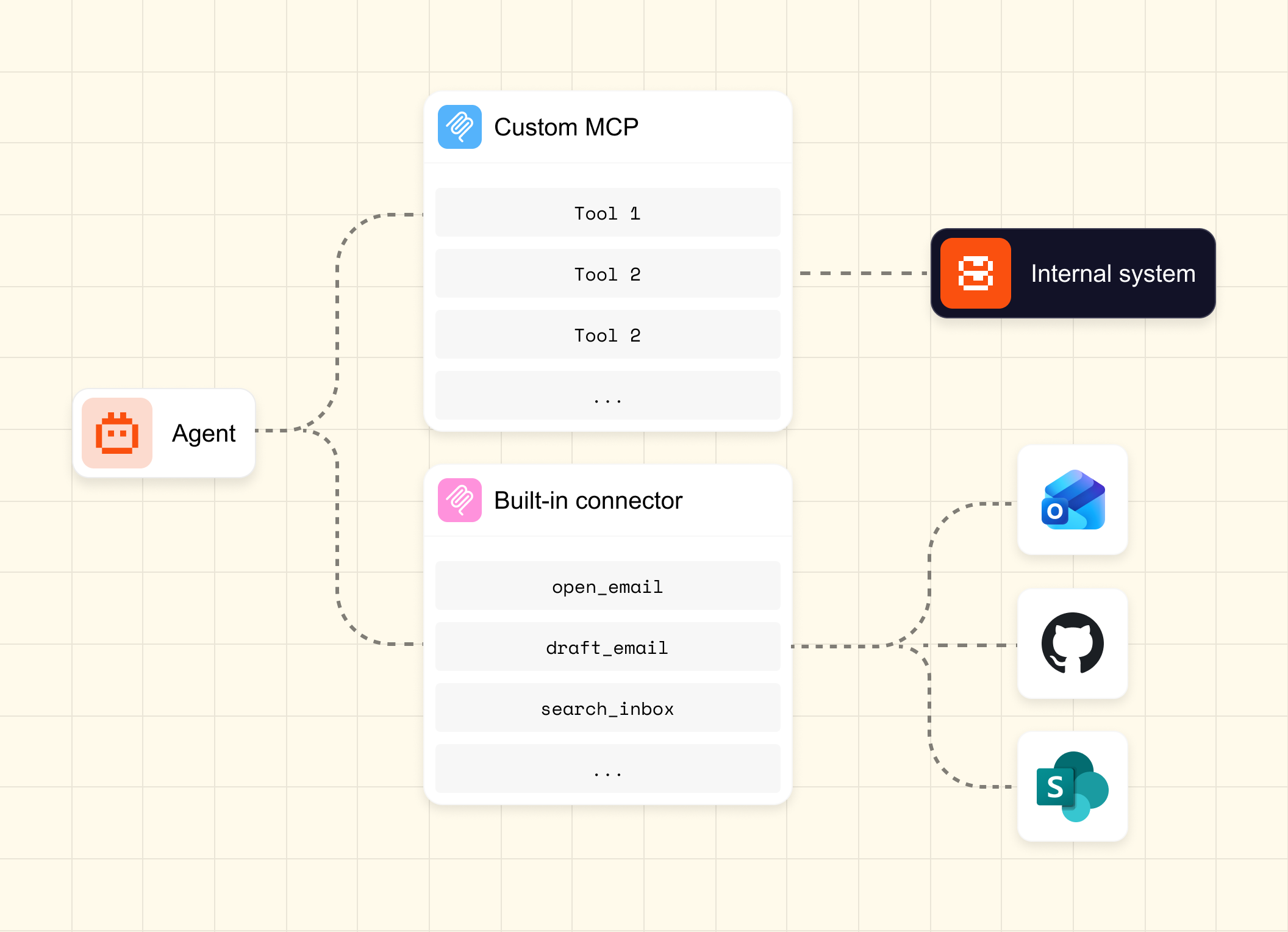
Connectorsin Public Preview, making built-in connectors and custom MCP servers usable as shared tools across APIs and SDKs.- The same connector can be reused from the Conversation API, Completions API, and Agent SDK, with support for direct calls to a specific tool.
- Why it matters: MCP is moving beyond local developer setup and app-specific wrappers into a central, observable, approval-ready integration asset.
- Watch: As connectors concentrate tool authority, controls such as
requires_confirmation, tool exclusion, and audit logs will decide production quality.
Mistral AI announced the Public Preview of Studio Connectors on April 15, 2026. Read narrowly, the update says developers can use built-in connectors and custom MCP servers from Mistral APIs and SDKs. Read as an infrastructure signal, it shows where the bottleneck in agent applications is moving. The hard problem is no longer only whether a model can produce a correct tool call. It is how many teams connect the same Salesforce instance, GitHub organization, internal document store, database, or business system safely; how those calls are logged; and where human approval appears before an agent takes a risky action.
Mistral Connectors shift that problem from "integration wrappers inside application code" to "connectors registered on the platform." According to the announcement and documentation, developers can create, update, list, and delete connectors, inspect the tools a connector exposes, and execute a connector tool directly. Once registered, the connector can be reused from Le Chat, AI Studio, the Conversation API, the Completions API, and the Agent SDK. Instead of attaching the same MCP server separately inside every app, teams get one integration asset that multiple agents and workflows can share.
That matters because MCP has succeeded quickly. Model Context Protocol is becoming a common interface for letting models reach external tools and data. But having a standard interface is different from operating it safely inside a company. One MCP server can expose email search, file reads, issue updates, CRM writes, payment requests, and deployment actions. That is convenient on a developer laptop. In production, the same surface immediately raises questions about permissioning, authentication, auditability, approval boundaries, and incident response. Mistral is aiming at that gap.
The first message in the official launch is that integrations should move out of each app's code path. Mistral describes enterprise AI agent development as easier than before, while the surrounding work remains repetitive: finding API docs, writing tool functions, wiring OAuth, handling token refresh, and debugging edge cases such as pagination. Inside one company, several teams can end up rebuilding similar integration layers. That creates duplicated work, uneven security, and weak traffic visibility. Connectors package the integration as a single MCP-based reusable unit.
The example is straightforward. A developer can register a connector such as salesforce-crm with client.beta.connectors.create, including an MCP server URL, workspace visibility, and OAuth configuration. The registered connector can then be attached to a conversation or agent with a tool object such as {"type": "connector", "connector_id": "salesforce-crm"}. The important part is that this is not just an SDK convenience. The connector becomes discoverable, governed, and monitored infrastructure. Mistral's product direction is clear: set it up once, then run it everywhere.
The second message is that developers need deterministic control back in parts of the agent stack. The attractive part of agent tool use is that the model can look at context and choose the right tool. The operational risk is that handing every decision to a model makes pipelines harder to debug and repeat. Mistral exposes connectors.call_tool_async, where the developer specifies the connector ID, tool name, and arguments. The official example calls the DeepWiki MCP read_wiki_structure tool for a particular repository. In that path, the model does not have to decide which tool should run.
That is useful in debugging, batch processing, evaluation pipelines, and approval flows where ambiguity should be reduced. After a human approves an operation, for example, the application may want to rerun exactly the proposed tool call rather than ask the model to choose again. Direct calls also help teams separate model-driven exploration from deterministic execution. In mature agent systems, both modes matter. A model can discover what needs to happen, while code can execute a known tool with known arguments.
This is a meaningful distinction in the broader agent-platform race. OpenAI Agents SDK, Anthropic's agent tooling, Microsoft Foundry, AWS AgentCore, and similar platforms are all trying to connect models, tools, runtime controls, observability, and policy. Mistral's angle is to put MCP, an open protocol, in the foreground while still handling the operational hazards of raw MCP through a Studio layer. It is an open-standard story wrapped in an enterprise control-plane story.
The third message is human-in-the-loop approval. Mistral shows requires_confirmation as a way to pause specific tool executions and return control to the user's application. In a Gmail connector, for example, a tool such as gmail_search can be marked for confirmation so the model's proposed tool call is not executed immediately. The application decides whether to approve, deny, or resume. Mistral frames this as making the boundary between AI judgment and human judgment explicit in code.
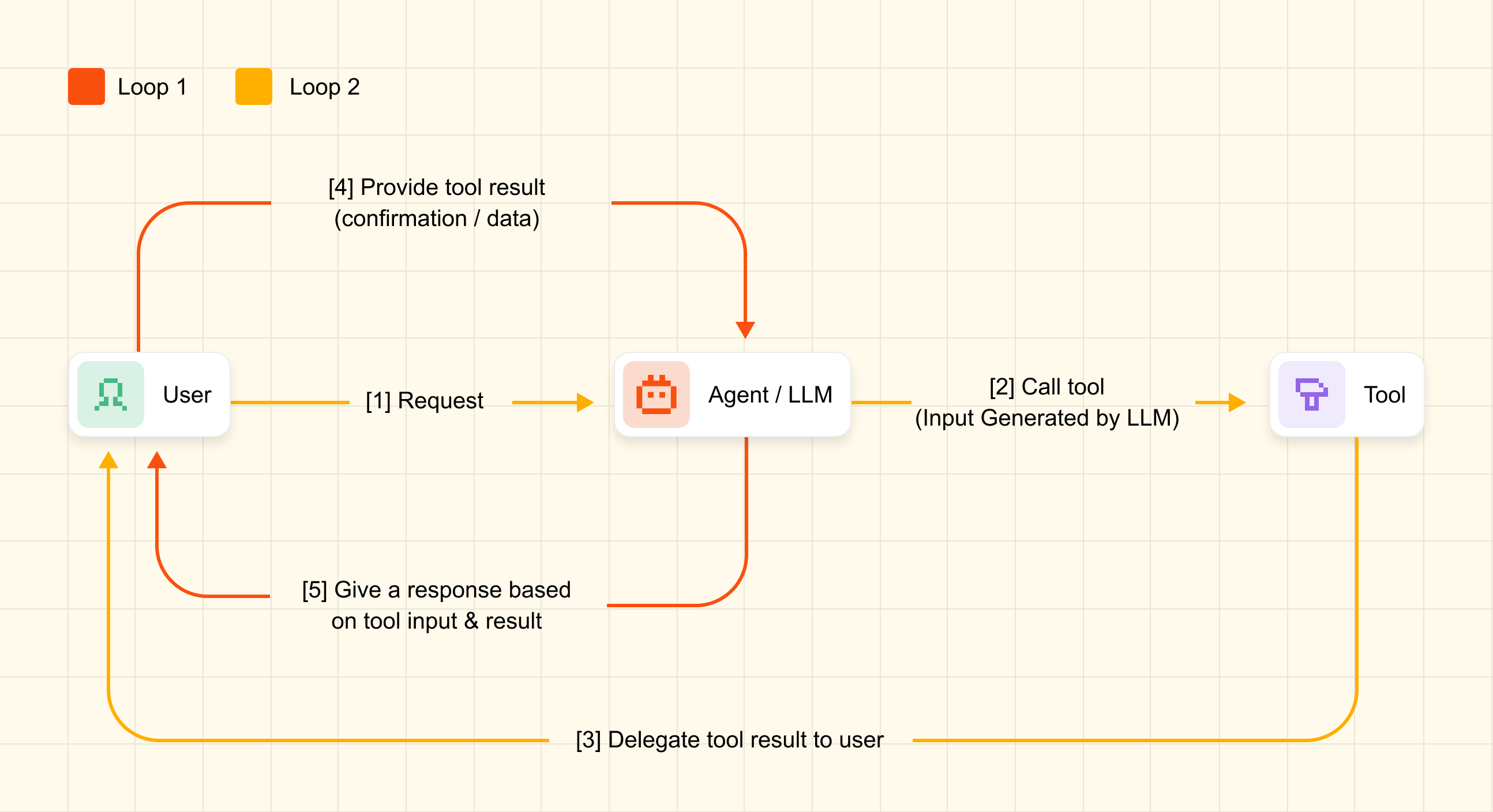
It would be too small to treat that as a security checkbox. As agents touch real work systems, the distinction between reading and writing becomes a central product design problem. Searching email may be relatively low risk. Sending email, changing CRM records, initiating payments, changing permissions, or triggering deployments is different. Traditional SaaS products built these boundaries with buttons, confirmation dialogs, permission screens, and audit logs. Agent apps must rebuild the same boundaries between natural language and tool calls. Mistral's approval flow expresses that boundary through SDK configuration and application resume logic.
For developers, this leaves three practical questions. First, who registers and owns a connector? Once an MCP server URL is placed in a shared workspace, it stops being an individual convenience and becomes organizational integration infrastructure. Second, which tools exposed by that connector should an agent see? Mistral describes tool_configuration for excluding tools, which means teams can hide dangerous operations without blocking the whole connector. Third, where are tool results and failures observed? "Governed and monitored" is the right product direction, but real operations require log schemas, user attribution, API-key attribution, retry behavior, and incident-response paths.
| Category | App-specific tool wrapper | Raw MCP connection | Mistral Connectors |
|---|---|---|---|
| Reuse | Duplicated in each app | Server can be reused, but operation is distributed | Registered in Studio, then used across agents and APIs |
| Permission control | Depends on each app's code and OAuth implementation | Depends on MCP server and client configuration | Expressed through tool exclusion, visibility, and approval gates |
| Deterministic calls | Possible, but wrapper maintenance grows | Varies by client implementation | API support for calling a specific connector tool |
| Operational risk | Team-by-team drift and shadow integrations | Fast to wire, but central audit can be weak | Centralization helps control, but increases platform dependency |
Mistral's use of DeepWiki MCP in the example is also telling. The official post registers a public remote MCP server to inspect code repositories and documentation, then combines it with built-in GitHub and web-search connectors to build an "Open-Source Software Auditor" agent. The agent can review a repository, inspect dependencies and risks, and return a verdict on whether to adopt it. That is closer to an agent workflow than to a basic RAG chatbot. It uses multiple tools, some tools read fresh external data, and the final output includes source citations and a decision.
The same example also shows why controls matter. If an auditor agent has access to a GitHub connector, excluding a tool such as delete_file immediately makes sense. Connectors are not just about adding capabilities; they are about defining which capabilities should be visible to which agent, in which context, and under which approval rules.
Community reaction around the Connectors launch was not enormous, but the direction was clear. A Reddit post in r/MistralAI summarized the appeal as registering an MCP connector once and reusing it across Le Chat, AI Studio, and programmatic tool calls. Secondary coverage read the move as an enterprise AI development layer that reduces arbitrary wrappers. Direct tool calling was viewed as a way to put deterministic control inside a probabilistic agent stack. That is a practical reaction. For many companies, the deployment blocker is less "is the model smart enough?" and more "is this tool allowed to run now, as this user, with this authority?"
Still, Mistral Connectors do not automatically solve every MCP security problem. Central registration can make governance easier, but it can also increase blast radius. A badly configured shared connector can expose too much tool scope to many agents at once. OAuth scopes can be too broad. Tool names can be ambiguous. Approval gates can miss risky operations. Audit logs can be too thin for real incident response. The key is not only the feature set, but the operational habits around it: read-only defaults, least privilege, explicit confirmation, per-tool telemetry, and routine review of connector scope.
There is also a broader tension in the MCP ecosystem. MCP gained momentum as a vendor-neutral connection standard. But when companies actually operate MCP, they need connector registries, permission policies, approval interfaces, observability dashboards, SDK lifecycle management, and trust models. Those are naturally product surfaces for platform vendors. Mistral lets developers register MCP-compatible servers, while making connectors feel native inside Le Chat, AI Studio, and Mistral APIs. The standard remains open, but the production experience becomes platform-shaped. That pattern is becoming familiar across AI infrastructure.
For development teams, the important takeaway is architectural rather than vendor-specific. Hard-coding tool functions directly into an agent app is the fastest way to build a demo. The structure starts to strain when a second team needs the same API, a third agent needs the same data, and security asks who executed what. Mistral Connectors anticipate that future. Register the connector, limit its tool set, separate deterministic calls from model-selected calls, and put approval loops in front of sensitive actions.
This update is quieter than a frontier-model launch because it is not a visible chatbot feature. It is plumbing that agents need before they can safely touch real systems. But in AI-driven development, that plumbing is becoming product-critical. When a model writes code, reads docs, queries CRM, drafts email, or touches deployment pipelines, tool integration is not a side feature. It is a permission model, an audit log, and a control surface that limits the cost of mistakes.
The next things to watch are concrete. First, how far Connectors move beyond Public Preview into production audit and policy features. Second, how Mistral handles connector directories and trust as custom MCP servers multiply. Third, how tightly Connectors integrate with Mistral's Agent Runtime, Workflows, and AI Registry. Mistral has already positioned AI Studio as a production AI platform with runtime, observability, and registry concepts. Connectors are the place where that platform lets an agent reach the outside world.
The bigger meaning of Mistral MCP Connectors is not simply "MCP support." It is a move to make agent integrations centrally registered assets, to support both model-selected and deterministic tool execution, and to leave a human approval boundary before sensitive actions. It is another sign that agent competition is moving from model quality alone into the operational layer. The launch is a Public Preview for now, but for enterprise agent deployment, this kind of control plane may become as important as the model name.