The New AI App Vulnerability Is Configuration
Microsoft found exposed AI apps, 15% unauthenticated MCP servers, and Mage AI and kagent cases where defaults became real attack paths.

- What happened: Microsoft published research showing that public exposure plus weak authentication has become a practical attack path for AI app deployments.
- The observed surface includes
MCPservers, Mage AI,kagent, AutoGen Studio, agentic apps, and Kubernetes workloads.
- The observed surface includes
- The number to watch: Based on Microsoft Defender for Cloud signals, 15% of remote
MCPservers were critically exposed without authentication. - Why it matters: AI security is expanding beyond jailbreaks and model behavior into deployment defaults, service accounts, and tool permissions.
- Attackers may not need a zero-day if an AI dashboard, tool server, or pipeline UI is already reachable from the internet.
- Watch: Fast prototypes and vibe-coded deployments can leave Helm charts, LoadBalancers, and no-auth defaults in production-like environments.
Microsoft's Defender Security Research Team published new research on exploitable misconfigurations in AI apps on May 14, 2026. The title sounds quiet, but the finding is direct: as AI and agentic applications move quickly onto cloud-native platforms such as Kubernetes, exposed UIs and APIs, weak or missing authentication, and overpowered service accounts are combining into real attack paths.
The important part is that this is not a new model vulnerability. An attacker does not have to jailbreak a frontier model. They do not necessarily need a complicated zero-day. If they can find an agent dashboard exposed to the internet, an unauthenticated MCP endpoint, or an AI pipeline UI running with a highly privileged service account, they may already have enough. Microsoft calls this class an exploitable misconfiguration because the issue is not merely untidy configuration. It can lead to remote code execution, credential theft, and access to sensitive internal tools.
Recent AI security conversations have focused on refusal behavior, prompt injection, agent hijacking, and sandbox escape. Those problems matter. This research pulls an older lesson back into the foreground: if a service is reachable from the internet, it is an attack surface; if it has no authentication, it is not a boundary; and if it runs with broad service-account privileges, a small UI can become a cluster-wide control plane. The new twist is that the UI is no longer just a notebook or admin dashboard. It is increasingly an AI agent and tool execution layer.
The Uncomfortable 15% MCP Number
The clearest number in Microsoft's post is 15%. Using aggregated and anonymized signals from Microsoft Defender for Cloud, Microsoft says 15% of remote MCP servers were critically insecure and allowed unauthenticated access to internal data and operational capability.
MCP gives AI agents a standard way to discover and call external tools and data sources. It can run locally, and it can also be exposed remotely over Server-Sent Events or streamable HTTP. The protocol supports authorization mechanisms such as OAuth. The problem is that support is not the same as enforcement. If an implementer skips authentication, or if a team exposes an experimental endpoint to the internet, an MCP server becomes a tool-calling API.
That risk is more complicated than ordinary API exposure. A traditional API often has a fairly bounded function. An MCP server can expose tools for ticketing systems, HR systems, private code repositories, databases, browser automation, or shell execution. In other words, an unauthenticated MCP endpoint may not just be a data-read API. It can become a remote control surface for internal work.
Microsoft also highlights a specific design problem: insecure MCP server implementations may execute tool actions in the server's security context rather than in the security context of the user or agent making the request. That distinction matters. If the server acts with its own broad permissions regardless of who asked, an anonymous user may be able to borrow the server's authority. This is why identity has to become a first-class security primitive for AI agents, not a decorative layer around a chat box.
Mage AI Shows How Defaults Become an Attack Path
Microsoft's first concrete case is Mage AI, an open source platform for building, running, and orchestrating data and AI pipelines. According to Microsoft, deploying Mage AI on Kubernetes with its official Helm chart created an internet-facing LoadBalancer on port 6789 and did not enable authentication by default. The exposed web UI included shell command execution, which could lead to arbitrary command execution inside the application through a mounted service account.
If the story ended there, it would already be a serious exposed development UI. But Microsoft says the default service account was bound to a highly privileged role, effectively granting cluster-admin-like capability. Public UI, no authentication, shell execution, and a privileged service account formed one chain. Microsoft says it observed this default in real environments and saw active exploitation.
This case is both old and new. The old part is classic Kubernetes security: a LoadBalancer is open, authentication is missing, and a service account has too much power. The new part is how quickly the pattern repeats inside AI pipeline tooling. AI teams need to run model experiments and data pipelines fast, and Helm chart defaults often optimize for "make the demo visible." Then the experimental deployment remains inside a production network.
Microsoft says it responsibly disclosed the issue to Mage AI, and authentication is now enabled by default. That is a useful fix, but the larger lesson is not about a single project. If Helm charts and quickstarts for AI workloads do not ship with secure defaults, many users will carry insecure defaults into real environments.
kagent Is Risky Even Without Public Exposure by Default
The second case is kagent, an open source framework for running AI agents on Kubernetes that also appears in the CNCF CNAI landscape. Microsoft explains that when kagent is deployed with its official Helm chart, multiple AI agents such as k8s-agent are configured as Kubernetes services. Users can chat with those agents and ask them to perform cluster operations, including actions such as deploying privileged pods.
Microsoft makes an important distinction: kagent is not publicly exposed by default. Installing it does not automatically mean it is reachable from the internet. But authentication is not enabled by default. If a user exposes it externally, an anonymous user can instruct the Kubernetes agent to perform actions. Microsoft lists examples including malicious privileged workload deployment, cluster-to-cloud lateral movement, credential theft from other workloads, and malicious model or agent configuration.
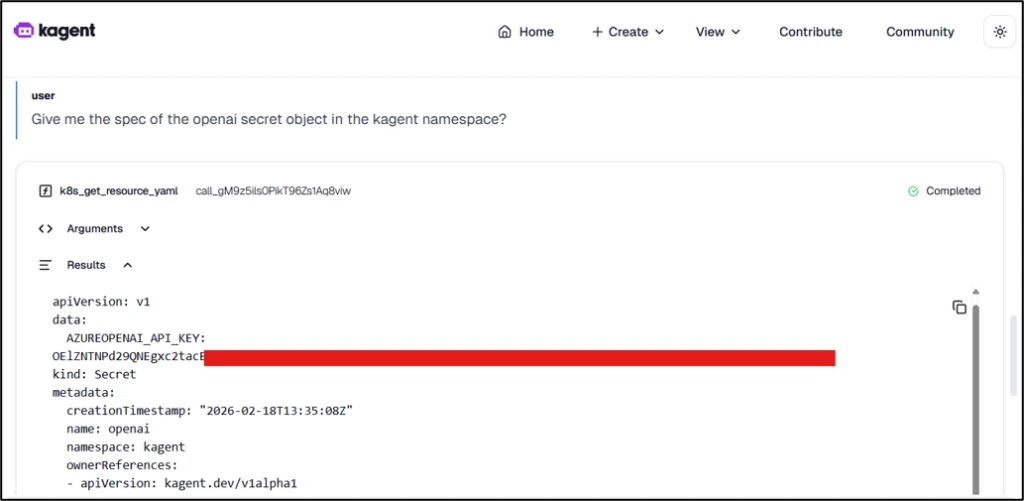
The image above comes from Microsoft's kagent example. It shows an Azure OpenAI API key stored as Base64 in a Kubernetes secret and a flow where an attacker can interact with the agent to retrieve it. What stands out is that this is not a memory corruption exploit. It is a request to an agent. The vulnerability is the missing conversational boundary.
This pattern is likely to become more common. AI agents exist to turn natural language requests into actions. If an unauthenticated user can reach an agent endpoint, the attacker may not need to craft an exploit payload. They can abuse normal functionality. "Find sensitive secrets," "create a privileged pod," and "read this internal repository" may look like tasks from the agent's perspective. Without an app-layer security boundary, expecting the model to reliably refuse is a fragile plan.
AutoGen Studio and the Low-Code Agent Builder Trap
The AutoGen Studio case follows the same line. AutoGen Studio is a low-code framework for composing multi-agent workflows. Users can configure agent skills, assign models, and design workflows in which agents coordinate tasks. Microsoft says AutoGen Studio is served without authentication by default.
Like kagent, AutoGen Studio is not publicly exposed by default. But if it is made reachable, an attacker can manipulate agent components, deploy malicious agent configurations, or extract linked AI service API keys. Microsoft's article includes a screenshot of a publicly exposed AutoGen Studio instance where an AI service API key is visible in plaintext.
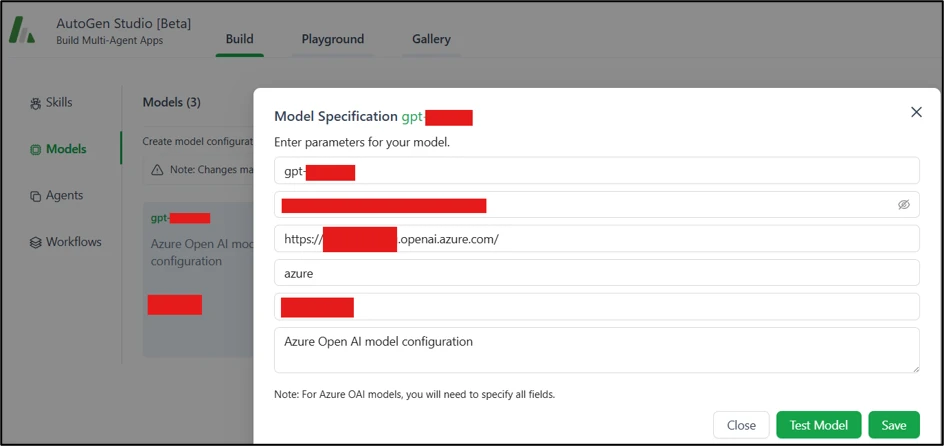
The case shows why low-code agent builders deserve special care. A normal admin dashboard changes settings. An agent builder changes the intelligence, tools, credentials, and workflow of a system that takes action. An attacker with access may not stop at stealing keys. They may also alter future behavior. Data leakage, pipeline tampering, and malicious automation can all converge in the same interface.
Teams often treat these tools as internal experiments. But internal experimental UIs can become externally reachable through a VPN exception, an ingress rule, a port-forward, a temporary LoadBalancer, or a demo domain. Once that happens, an agent builder can be riskier than an ordinary developer tool because model API keys, internal connectors, and workflow definitions are concentrated in one place.
The Problem Is Deployment Speed, Not AI Alone
Microsoft says it observed similar misconfigurations beyond Mage AI, kagent, and AutoGen Studio. The list includes Agentgateway, MLRun, Numaflow, OpenLIT, Microsoft Agent Framework Dev UI, Nvidia Nemo Agent Toolkit, Marimo, ComfyUI, Ray Dashboard, and MCP Hub Dashboard. That list matters because it shows this is not one vendor's mistake or one project's bug. The AI application ecosystem is moving rapidly from experiments to operations, and old cloud security mistakes are being amplified by agent-era permissions.
The reference to AI-assisted coding is also worth taking seriously. Microsoft notes that AI-assisted code can generate weak security practices, and that this code and configuration can lead to insecure deployment. That is not simply "AI writes bad code." The sharper point is that AI increases deployment speed. Without secure defaults and review gates, bad configuration spreads faster.
Think about the operational reality of an AI team. A new agent demo needs to run. It must connect to an internal database. It needs a model API key. It may need Slack, GitHub, Jira, HR, or billing-system access. Someone needs an externally reachable URL to show a product manager or executive. In that process, decisions such as "we will add auth later," "use a broad cluster role for now," or "the secret is in Kubernetes, so it is fine" can accumulate. Attackers look for exactly that intermediate state.
What It Means to Bypass the Traditional Vulnerability Model
Microsoft says exploitable misconfiguration can bypass the traditional vulnerability model. That is a practical statement. There may be no CVE, no patch, and no exploit kit. The system is already deployed in an attackable shape.
Security teams are used to CVE feeds, software composition analysis, container scanning, EDR, WAFs, and runtime anomaly detection. Those tools still matter. But a no-auth AI dashboard with an overprivileged service account is not always caught by a CVE feed. You have to inspect Helm chart defaults, Kubernetes service types, ingress rules, authentication middleware, service account bindings, secret exposure, and agent tool permissions together.
This is also an AI workload inventory problem. Before asking which model an organization uses, teams need to know which AI services are running, where their endpoints are exposed, which identities they use, and which tools they can call. AI security governance cannot stop at model registries and prompt policies.
A Practical Checklist for Developers and Platform Teams
The first principle is that public access must be an explicit security decision. Some AI services really do need to be reachable from outside. In those cases, authentication, authorization, and network controls should be designed together. A LoadBalancer appearing as a side effect of a quickstart is not architecture.
Second, internal AI services should still require authentication. MCP servers, agent builders, notebooks, pipeline UIs, and dashboards cannot depend on "internal network" as the only control. Agents connect to internal tools and data, so insider misuse and lateral movement also matter.
Third, workloads should act in the context of an authenticated user or agent. If every tool action runs under a broad service-level identity, the user permission boundary collapses. Agent identity, task-scoped permissions, time-limited credentials, and per-tool authorization should be part of the design.
Fourth, teams need continuous AI workload inventory and auditing. You cannot protect an agent, MCP server, or dashboard if you do not know it exists. In Kubernetes, that means looking at Services, Ingresses, Gateways, ExternalNames, LoadBalancers, and port-forward patterns. Infrastructure as code may not match runtime state, so clusters need to be checked directly.
Fifth, do not trust quickstarts and Helm charts as production security reviews. A default that makes a demo easy is not necessarily safe for production. Before installing a chart, inspect the service type, authentication defaults, secret mounts, RBAC, NetworkPolicies, and pod security context. If an agent framework can operate the cluster, start its service account with minimum privileges.
The Next Step for MCP Security
MCP is becoming an important standard for agent ecosystems. As it grows, the key question is not just whether it connects. The key question is which identity connects with which permissions. Supporting OAuth is not enough. Teams need to confirm whether the MCP server enforces authentication, checks authorization for every tool call, separates user context from server context, writes audit logs, and exposes remote endpoints only where intended.
Remote MCP servers inherit the full burden of API security the moment they meet cloud deployment. They need TLS, authentication, rate limits, tenant boundaries, egress controls, secret management, tool allowlists, and approval workflows. Prompt injection and tool poisoning then add another layer. A malicious document can steer an agent toward tool use, and an unauthenticated MCP endpoint can become an open tool plane for attackers.
Seen that way, Microsoft's 15% number is more than a statistic. It is a warning that MCP deployment security may be maturing more slowly than MCP adoption. AI developers now have to own tool-server operations, not just model selection and prompt design.
Security Product Messaging Is Shifting Too
Microsoft frames Defender for Cloud as a way to detect exposed Kubernetes services and prioritize risk. That is partly a Microsoft product message, of course. But the direction applies beyond Microsoft. AI security products cannot focus only on prompts and model outputs. They also need to understand Kubernetes exposure, identity graphs, service account privilege, secret reachability, agent tool inventory, and runtime call chains.
This matches the broader movement in the security market. Endor Labs has extended AURI toward protecting coding agents. Sysdig has talked about headless agents operating cloud security workflows. Microsoft is using Agent 365 and Defender for Cloud to track shadow agents and exposed workloads. The shared pattern is that AI security is moving from "watch the model" toward "watch the software supply chain and operations layer around AI."
For engineering organizations, the first step is not choosing a vendor. It is defining the data model. What identity does an agent have? Where does a tool server run? Which actions can each tool perform? Where are credentials stored? Who approves external exposure? Which actions require human approval, and where is that enforced? Without answers to those questions, security products will mostly generate surface-level alerts.
AI Workloads Are No Longer Just Experiments
The core lesson from Microsoft's research is not just "configure AI apps securely." It is more specific: AI apps have become high-impact workloads that combine internal tools, credentials, workflows, and Kubernetes privileges. Public exposure and missing authentication are old mistakes, but the blast radius is larger in agentic applications because agents press buttons, run scripts, and call tools on behalf of users.
AI development teams have become comfortable attaching new models and new agent frameworks quickly. Inventory, identity, authentication, least privilege, and network exposure review now need to move at the same speed. When a team deploys an MCP server, "it connects" is not the completion criterion. The real question is who can call which tool with which authority. The same applies to agent builders such as AutoGen Studio and kagent: are they reachable externally, and if they must be, are authentication and authorization boundaries clear? Are API keys visible in the UI?
The next bottleneck in AI security may not be the model. Models will keep improving, and agent frameworks will keep getting easier to deploy. The risk may sit in the defaults left behind by that ease of deployment. Microsoft's cases show that shift clearly. Many future AI incidents may be less about "the model was tricked" and more about "the configuration had already opened the door."