Meta AI incognito mode turns privacy into infrastructure
Meta Incognito Chat runs AI conversations through WhatsApp Private Processing. The key shift is not deleted history, but verifiable private inference.
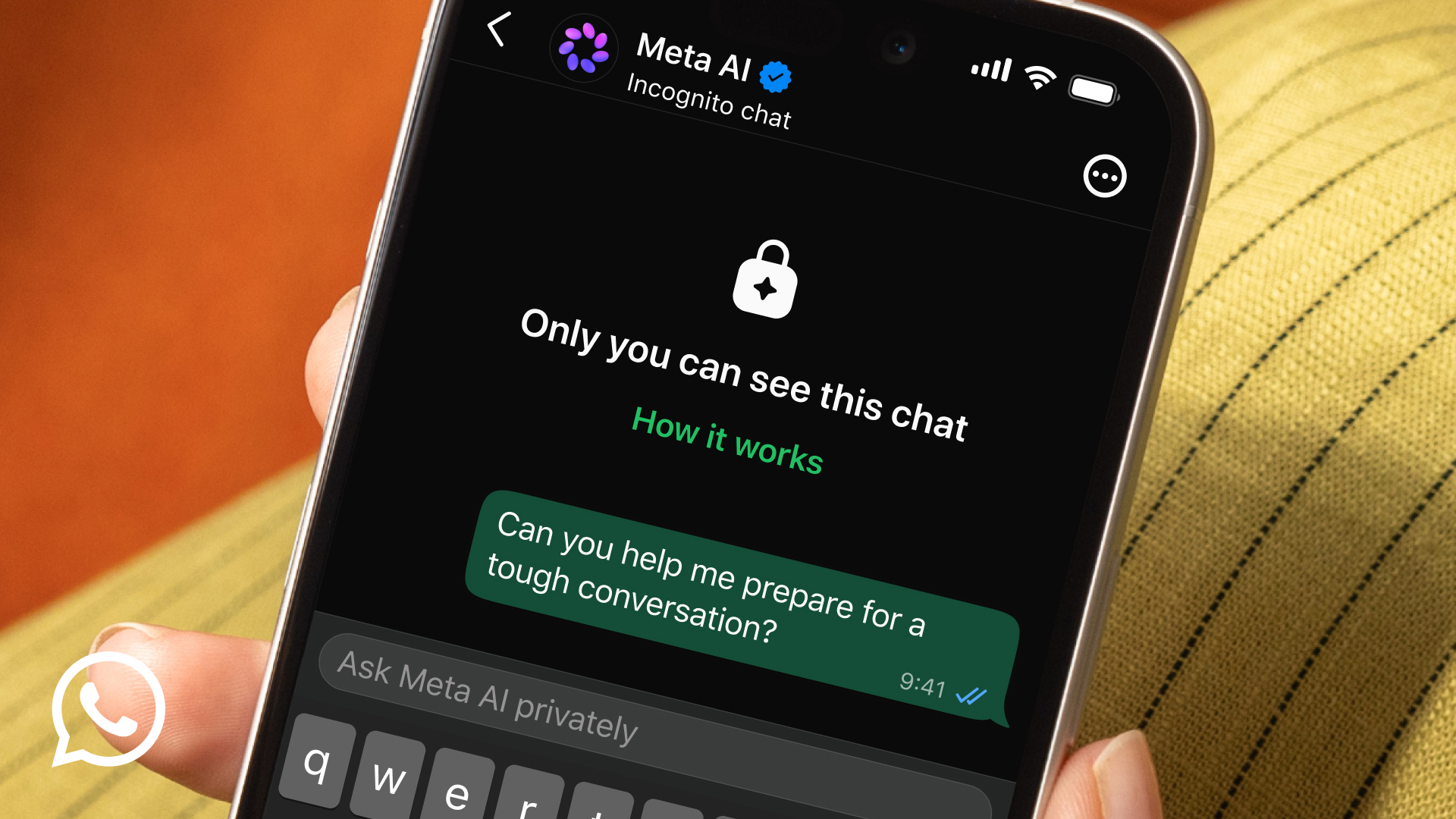
- What happened: Meta is adding
Incognito Chat with Meta AIto WhatsApp and the Meta AI app.- The announcement landed on May 13, 2026. Meta says these chats are not saved and disappear by default after the session ends.
- Technical core: This is not just a history toggle. It wraps server inference in
Private Processing, TEEs, OHTTP, and remote attestation.- The central product claim is that neither Meta nor WhatsApp can read the user's questions and answers.
- Why it matters: AI privacy competition is moving from opt-out settings toward verifiable infrastructure.
- Watch: TEEs are not magic. Transparency logs, audits, implementation trust, and feature limits still matter.
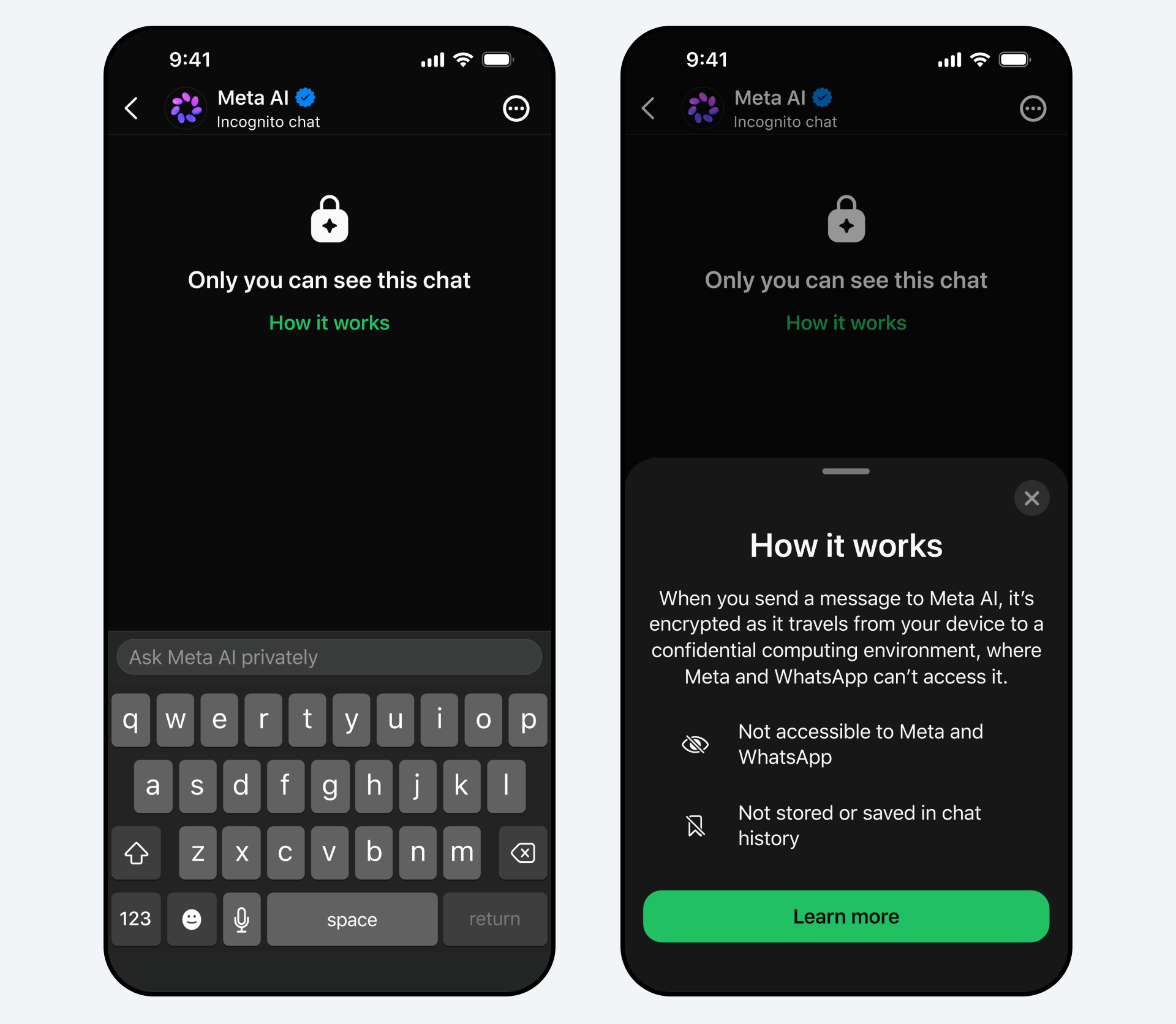
Meta announced Incognito Chat with Meta AI on May 13, 2026. The feature lets users start temporary conversations with Meta AI in WhatsApp and the Meta AI app. Meta says those conversations are processed in a secure environment that even Meta and WhatsApp cannot read. The chats are not saved and disappear by default. Rollout is planned over the next several months.
At first glance, this looks like the temporary chat mode that many AI chatbots already provide. The more important news is the infrastructure underneath it. Meta says Incognito Chat is built on WhatsApp Private Processing. Private Processing is a confidential computing design that tries to run large AI models on servers while preventing Meta operators and normal WhatsApp infrastructure from reading user requests and responses.
Privacy in AI products has usually been described as a setting. You can turn off history. You can opt out of training. An enterprise plan may have a different data retention window. Those promises matter, but most of them are still close to a policy promise: the company says it will not look. Incognito Chat is interesting because Meta is making a stronger architectural claim. The point is not only "we will not look." The point is "we are building a system where looking is hard, changes are visible, and session data does not remain after the run."
Why AI chat privacy is hard
WhatsApp has built its core trust story around end-to-end encryption. When a user sends a message to another person, only the conversation participants should be able to read it. The server is a delivery layer. Adding AI to that model creates a hard problem. An AI system must read the conversation to help with it. If that AI does not run only on the user's phone and instead relies on a large cloud model, the message has to be decrypted somewhere.
On-device AI looks like one answer, but it does not solve every case. Larger models need GPUs, memory, fresh knowledge, low latency, web access, and safety systems. In a product used by more than 3 billion people, "run every AI feature only on the phone" quickly runs into limits around quality, cost, and device compatibility. Sending the request to a server makes the AI stronger, but it weakens WhatsApp's privacy promise.
Private Processing is Meta's attempt at a middle path. The user's device establishes an encrypted session with a server-side Trusted Execution Environment. Meta's normal infrastructure and operators are not supposed to see the request contents. After processing, the service should not retain message access. This does not remove the fact that an AI system reads the message. More precisely, it narrows the readable boundary to an isolated inference environment.
That distinction matters. If privacy is only a product promise, users have to trust terms of service and company behavior. If privacy is architecture, there are concrete things to verify: which code runs inside the TEE, whether remote attestation matches the expected binary, what logs can leave the environment, whether a specific user can be steered to a specific server, and whether session data survives after the interaction ends.
What Private Processing promises
When Meta Engineering introduced Private Processing in April 2025, it framed the design around three product principles. The feature should be optional. Users should know when Private Processing is being used. And in especially sensitive chats, Advanced Chat Privacy should let users block AI features such as Meta AI mentions. The technical requirements that follow are confidential processing, enforceable guarantees, verifiable transparency, non-targetability, stateless processing, and forward security.
In product language, that means several things. First, Meta or WhatsApp should not be able to read an AI request through ordinary server logs or operator access. Second, code changes that break the guarantee should fail or become publicly visible. Third, independent security researchers should be able to verify meaningful parts of the system. Fourth, an attacker should not be able to pick a specific user and route that person to a weaker server or special environment. Fifth, after a session ends, past prompts and responses should not remain accessible.
Start Incognito Chat in WhatsApp or the Meta AI app
Anonymous credentials plus OHTTP relay weaken IP and account linkage
Remote Attestation plus TLS connects only to verified TEE code
AI inference runs in a Confidential VM without writing messages to disk
The response returns to the device and access is removed after the session
Flow reconstructed from Meta Engineering and the Private Processing white paper
The white paper describes a specific flow. First, the client gets anonymous credentials that prove it is a real WhatsApp client. Then it fetches encryption keys for OHTTP from a third-party CDN and connects to a Meta gateway through a third-party relay. That relay is meant to prevent Meta and WhatsApp from directly seeing the requester's IP address. After that, the user's device and the TEE establish a Remote Attestation plus TLS session. The device compares the attestation result with a third-party ledger so it can confirm it is connecting only to approved code.
The request is then protected by an ephemeral key that only the user's device and the selected Private Processing server can access. The AI model processes the request inside a Confidential Virtual Machine and sends an encrypted result back to the device. Meta describes Private Processing as a stateless service that does not preserve message access after the session completes and does not store messages on disk or external storage.
The logging design is one of the most interesting parts. Large services need logs and metrics to operate. But in confidential computing, observability can become a data exfiltration path. Meta says only limited service reliability logs can leave the CVM, and log filtering exports only approved log lines. This is one of the hardest tradeoffs in private AI infrastructure. Operators need to understand failures, but debugging cannot leak a user's question.
How Incognito Chat differs from temporary chat
Most AI services already offer some form of history-off or temporary chat mode. Users can choose not to keep a conversation in history or can ask that content not be used for training. Enterprise APIs may offer zero data retention. Those controls are important from a data lifecycle perspective. They are not the same as preventing the provider from seeing prompts and responses while processing them.
Incognito Chat's differentiator is that Meta is making a claim beyond "the chat is not saved." According to WIRED's reporting, WhatsApp says it can see that an account used the feature, but not the questions and answers inside the conversation. Mark Zuckerberg said the inference runs inside a Trusted Execution Environment and that chat logs are not stored on servers. Meta's official announcement repeats the "not even Meta" framing.
| Comparison axis | Typical temporary AI chat | Incognito Chat with Meta AI |
|---|---|---|
| Main promise | Do not save history, exclude training, delete after a period | Process questions and answers so Meta and WhatsApp cannot read them |
| Technical mechanism | Account settings, retention policy, data pipeline controls | TEE, OHTTP, anonymous credentials, remote attestation |
| Verification point | Terms, admin policy, audit documents | CVM binary, transparency log, attestation, bug bounty |
| Limit | The provider may still see data during processing | TEE vulnerabilities, implementation trust, limited features, complex verification |
This does not make the system trustless. A TEE sits on a long chain of hardware, firmware, hypervisor behavior, attestation infrastructure, deployment pipelines, logging policy, and model execution code. Meta's own white paper includes TEE software attacks, physical attacks, supply chain attacks, and log leakage in its threat model. "Meta cannot read it" is a compact description of a technical intent and security boundary, not a mathematical proof that no attack is possible.
That is why verifiability matters. Meta says researchers will be able to inspect the CVM image binary, some load-bearing code, and attestation verification code. It also says Private Processing will be in scope for its Bug Bounty program. Most users will never verify those details themselves, but a meaningful review surface for security researchers is one of the things that separates architectural privacy from pure brand trust.
Sidechat may be the bigger product signal
Incognito Chat is a separate private conversation with Meta AI. But the Sidechat feature Meta previewed alongside it may be the larger product signal. Sidechat is designed to let a user ask Meta AI something while inside a WhatsApp conversation. For example, someone discussing travel plans with friends might ask for restaurant suggestions or ask for a summary of the group chat. The important claim is that the AI request does not disrupt the main chat and is protected by Private Processing.
If it works, AI can become much more natural inside messaging. Today, users often copy a conversation into another chatbot, upload screenshots, or explicitly invoke Meta AI. Sidechat reduces that friction. It also increases the risk. A user may be sending context from a conversation with other people into an AI system. Even if Meta cannot read it, the other participants still have expectations about how their shared context is used and controlled.
This is where WhatsApp's Advanced Chat Privacy matters. Meta Engineering says sensitive chats should be able to block AI features such as Meta AI mentions. As AI assistants become embedded in messaging, privacy expands from "how is my data processed" to "how is data from conversations I participate in processed." In group chats, the unit of consent and permission is more complicated than a single account.
Developers and AI product teams should pay attention to that boundary. Making AI features safe requires more than a button that deletes chat history. The design has to cover the source of input data, participant expectations, feature invocation permissions, output visibility, log retention, and whether the model can call external search. Incognito Chat is packaged as a consumer UI feature, but the deeper issue is data boundary design for AI products.
Meta is also building a strategic defense line
The timing matters. Meta AI is spreading across WhatsApp, Instagram, Facebook, Messenger, Threads, and AI glasses. After Muse Spark, Meta has been pushing its AI into more places, including shopping, search, recommendations, group chat, and camera-based experiences. The more that strategy grows, the sharper the privacy question becomes. Before users ask whether Meta AI is useful, many will ask what they are handing over.
WhatsApp is especially sensitive. It carries more private conversation than email or web search for many users: family, friends, customers, medical issues, legal issues, finance, politics, and work. If Meta AI is going to live in that space, a normal chatbot privacy mode is not enough. Incognito Chat gives Meta a stronger defense. It lets the company argue that AI inside WhatsApp should inherit a WhatsApp-style privacy model.
AP framed the feature as a response to generative AI privacy concerns. WIRED analyzed Private Processing as WhatsApp's attempt to avoid a collision between AI features and its end-to-end encryption promise. TechCrunch noted that sessions end when the app closes or locks, and that Meta AI loses the context of that conversation. The shared point across those reports is clear. This is not just another WhatsApp feature. It is an experiment in the trust model required when AI enters private messaging platforms.
Questions for developers
First, AI privacy is no longer only a product settings problem. History retention, training opt-outs, and admin console policies still matter, but the security boundary around inference itself is becoming important. Internal enterprise AI, medical AI, legal AI, and financial advisory AI will face the same question. After "we do not store it," users will ask, "who can see it while it is being processed?"
Second, confidential AI inference raises operational difficulty. Running a model inside a TEE complicates debugging, logs, performance optimization, routing, and cost management. WIRED reported that routing optimization mattered for reducing Incognito Chat latency. Stronger security can slow the user experience, and matching the expected user experience can require complex infrastructure. Privacy is not a free feature. It consumes product performance and infrastructure budget.
Third, verifiable transparency becomes a competitive asset. Meta is emphasizing the CVM binary, third-party ledger, bug bounty, and reviewability because trust is not built by declaration alone. Enterprise AI is likely to move in the same direction. Teams using AI for regulated workloads will ask not only whether the model is good, but whether the inference boundary can be verified.
Fourth, product teams should be honest about feature limits. According to WIRED, Incognito Chat starts as text-only, with image processing and speech recognition still in development. Web search can be enabled in an anonymized way, but that is another data flow. The stronger a privacy mode becomes, the more it may constrain what the product can do. Good UX should expose those constraints clearly.
Finally, Meta's Incognito Chat is not the end state. It is a baseline signal. Apple's Private Cloud Compute, WhatsApp Private Processing, and confidential computing offerings from cloud providers point in the same direction. Larger AI models need servers. Users increasingly do not want to trust servers. The technologies that bridge that gap are becoming an important axis of AI infrastructure competition.
Incognito Chat will not be judged by the sentence "Meta promised complete privacy." It will be judged by rollout latency, the quality of researcher-facing verification materials, how transparently vulnerabilities are fixed, and how Sidechat handles consent in group conversations. But one thing is already clear. AI chatbot privacy competition has moved beyond a delete-history button. It is now a fight over where and how the model runs.