Grok Code Fast 1 Exits Copilot, and Model Routing Becomes the Risk
GitHub removed Grok Code Fast 1 from Copilot while xAI redirects the retired slug to Grok 4.3. The real issue is coding-agent model routing, cost drift, and operational control.
- What happened: GitHub deprecated
Grok Code Fast 1across all Copilot experiences on May 15, 2026.- The change covers Copilot Chat, inline edits, ask mode, agent mode, and code completions.
- Replacement path: GitHub points users toward
GPT-5 miniandClaude Haiku 4.5as suggested alternatives. - The hidden issue: In xAI's API, the same retired slug redirects to
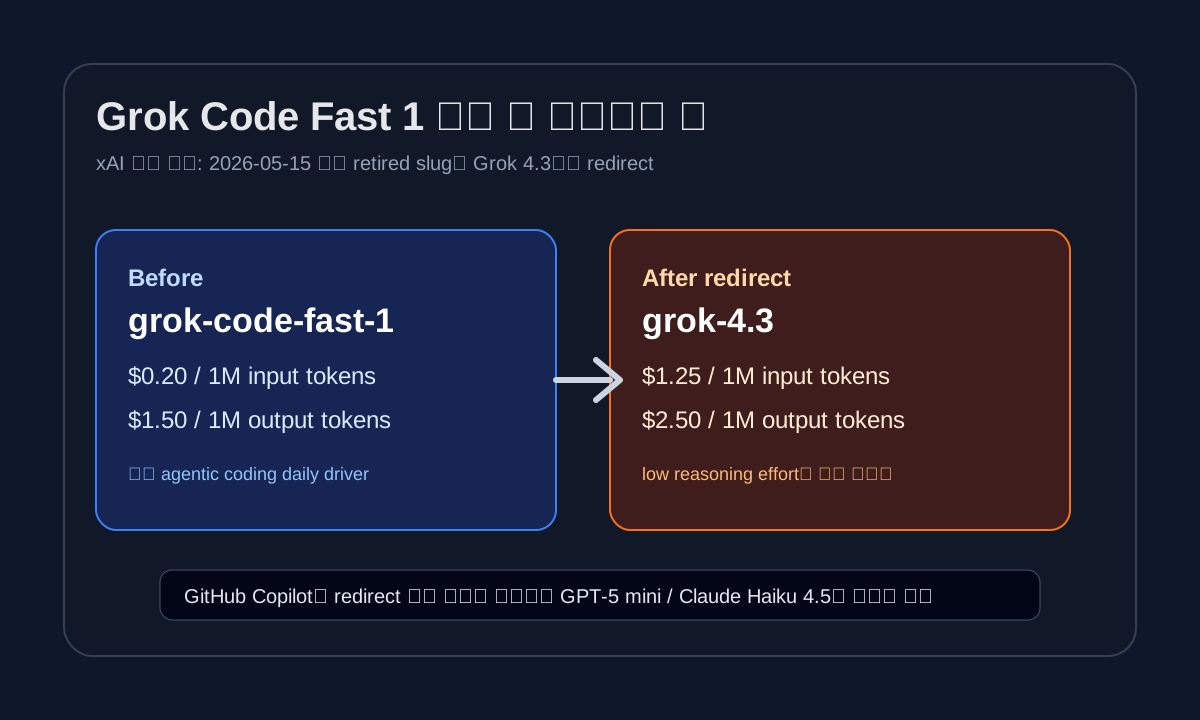
grok-4.3, with different pricing.grok-code-fast-1cost $0.20 per 1M input tokens, while the redirect targetgrok-4.3costs $1.25.
- Why it matters: Model choice for coding agents is no longer just a feature. It is an operational contract.
On May 15, 2026, GitHub deprecated Grok Code Fast 1 in Copilot. The changelog is brief, but it points to a much larger problem now emerging in coding-agent products. When a developer delegates work to an agent, is the model really a stable choice under the developer's control, or is it an operating variable that can change when the platform or upstream provider changes policy?
On the surface, this is a simple model removal. GitHub removed Grok Code Fast 1 from Copilot Chat, inline edits, ask and agent modes, code completions, and every other GitHub Copilot experience. The suggested alternatives are GPT-5 mini and Claude Haiku 4.5. Enterprise administrators may need to enable access to those replacement models in Copilot settings. GitHub also says administrators do not need to take separate action to remove the deprecated model.
The same date looks different from the xAI side. In its May 15, 2026 model retirement notice, xAI says several older model slugs, including grok-code-fast-1, are retired. API requests using those retired slugs do not immediately fail. They are automatically redirected to grok-4.3. The request still succeeds, but billing follows the grok-4.3 price, not the old model's price.
That difference is the story. Inside GitHub Copilot, the model disappears and users have to pick a replacement. In the xAI API, the same slug can continue to resolve, but to a more expensive model. One path is explicit removal. The other is compatibility-preserving redirect. Both can be reasonable product decisions. For teams running coding agents, they create very different risks.
A fast daily driver with a short shelf life
Grok Code Fast 1 was xAI's coding-specialized model, announced in August 2025. xAI described it as a speedy and economical reasoning model for agentic coding workflows. The pitch was clear. Frontier models are powerful, but coding agents burn time and tokens in loops: searching files, running terminal commands, editing code, reading test output, and patching again. A daily driver for that loop needs to be fast and cheap, not merely impressive on the hardest reasoning tasks.
xAI's announcement said the model was comfortable with TypeScript, Python, Java, Rust, C++, Go, and common coding-agent tools such as grep, terminal use, and file editing. The pricing matched the positioning: $0.20 per 1M input tokens, $1.50 per 1M output tokens, and $0.02 per 1M cached input tokens. For an agent that repeatedly reads repository context, cached input and low input pricing are not secondary details. They are part of the product's economic shape.
GitHub also made that model available in Copilot. On August 26, 2025, GitHub said Grok Code Fast 1 was rolling out as an opt-in public preview in the VS Code model picker for Copilot Pro, Pro+, Business, and Enterprise users. Business and Enterprise organizations needed administrators to enable it in Copilot settings. Individual paid users could select it directly in the model picker. GitHub also described a BYOK route for connecting an xAI API key.
At the time, the message was that Copilot was expanding into a multi-model coding platform. It was no longer just a single-model autocomplete surface. Developers could choose a model for the shape of the work: a fast model for iteration, a stronger model for deep reasoning or larger refactors, and different providers based on policy or preference.
Less than nine months later, that model is gone from the Copilot surface. That does not automatically mean the model failed. Models are replaced constantly. xAI says grok-4.3 offers stronger agentic coding and web development capability. GitHub may retire older models to maintain product quality, reliability, policy consistency, or cost control. But the lesson for development teams is still concrete: if an agent workflow is tuned around the latency and price of a specific low-cost model, the model lifecycle itself becomes an operating risk.
GitHub removed it, xAI redirected it
The striking part of GitHub's notice is how explicit the removal is. The model is deprecated across all Copilot experiences, and GitHub names suggested alternatives. Users need to update their workflow and integrations to GPT-5 mini or Claude Haiku 4.5. Copilot Enterprise administrators may need to enable those models under model policies. In other words, GitHub closes the model option on the product surface and forces a conscious replacement decision.
xAI's API path is different. Its retirement document says retired slugs such as grok-code-fast-1 are automatically redirected to grok-4.3. From a compatibility standpoint, this is useful. An application with a hardcoded model id does not immediately start throwing invalid-model errors. Long-running agents, internal tools, SaaS backends, and scripts can keep running while teams migrate.
From a cost-control standpoint, it is risky. grok-code-fast-1 cost $0.20 per 1M input tokens. The redirect target, grok-4.3, costs $1.25 per 1M input tokens. That is a 6.25x increase on input. Output moves from $1.50 to $2.50 per 1M tokens, roughly a 1.67x increase. Coding agents tend to be input-heavy: repository context, tool results, test output, diffs, and plans all flow back into prompts. In that workload, input price changes can reshape the bill quickly.
xAI does not hide this. Its retirement notice says requests sent to retired model slugs are billed at grok-4.3 pricing and recommends explicitly selecting a replacement model to avoid unexpected cost increases. The problem is that many teams do not manage model migration notices like production runbooks. A model slug chosen once because it was fast and cheap can spread across automation scripts, MCP tools, IDE settings, internal bots, and agent runners. If the provider changes redirect behavior, the same code may run a different model at a different price.
GitHub's choice to remove rather than silently redirect is meaningful in that context. Copilot has its own billing model, premium requests, usage limits, and enterprise policy controls. Letting users unknowingly shift to a more expensive xAI target would be hard to square with product trust. For teams using the xAI API directly, however, compatibility and cost drift remain their responsibility.
Model choice is a contract, not a dropdown
Coding-agent products have spent the past year selling the model picker as a feature. The ability to choose OpenAI, Anthropic, Google, xAI, or open-model providers from one interface is genuinely useful. Different tasks need different latency, cost, context, tool-use behavior, data controls, and enterprise approvals.
But a model picker only looks like a free dropdown. Operationally, it is the intersection of several contracts. The model provider has to keep serving the model. The platform has to keep exposing it. The organization has to allow it. The price and quota have to fit the workflow. The model's behavior has to remain compatible with the agent harness.
Grok Code Fast 1 shows how easily those conditions can move. xAI wants customers to move to a newer model. GitHub has to manage Copilot quality, cost, policy, and support. Enterprise administrators have to revisit allowed models. Individual developers have to re-evaluate latency and output quality after a fast model disappears.
This is not an xAI-only issue. Every AI coding platform faces the same pressure. Anthropic models change versions. OpenAI models have deprecation schedules. Google model availability can vary by region or product surface. A platform's automatic model selection may be convenient, but it can make it harder to answer a basic operating question: which exact model handled this task, and what did it cost? Pinning a model helps reproducibility, but it increases exposure to deprecation and stale quality.
Agent cost is not explained by request count
This matters more for coding agents than for ordinary chatbots because the unit of work is not a single request. A user may type "fix this bug," but the agent's work can include repository search, file reads, patch generation, test execution, failed-log analysis, another patch, linting, and a pull-request summary.
Input tokens compound through that loop. The same files are reintroduced. Terminal output enters the context. Previous diffs and plans get carried forward. Cheap, fast models make these loops affordable enough to run often. That was the role Grok Code Fast 1 played: not the best possible model for every hard problem, but a model that lowered the cost of everyday iteration.
If that model redirects to a more expensive target, teams need to revisit two policies. The first is the agent loop budget. How many repair attempts should a task get? How much test output should be fed back into the model? How much repository context should the agent reload? The second is model fallback. If the primary model is retired, rate-limited, or blocked by policy, what model takes over, under what cost ceiling, and with what quality expectations?
GitHub's suggested alternatives, GPT-5 mini and Claude Haiku 4.5, fit that framing. They are not presented as the deepest possible models for every task. They are practical candidates for day-to-day Copilot work where latency and cost matter. Coding agents are unlikely to be operated by one strongest model alone. Teams will combine fast models, stronger models, cheap fallbacks, approved enterprise models, and specialized domain models. The important question is who manages that routing.
What development teams should check
The immediate action is simple. Search code and configuration for grok-code-fast-1, grok-code-fast, and grok-code-fast-1-0825. If a team only used the model inside Copilot, this may end with the model picker changing. If the same team also uses xAI API keys, OpenRouter, Cline, or an internal agent runner, the risk is broader.
Second, if a provider redirects retired slugs, confirm the actual billed model. A successful request is not enough evidence. Teams need to know which model id processed the request, what reasoning mode or effort setting applied, and which input/output prices were charged.
Third, document model policy per agent. A small bug fix might use a cheap model. Architecture migration might require a stronger model. Production deployment steps might require human approval. If those rules live only inside one IDE plugin's settings, every model deprecation becomes a surprise.
Fourth, treat enterprise model allowlists as cost policy as well as security policy. Security teams care where code context is sent. Finance teams care how much token budget an agent task can spend. Copilot model policies, BYOK settings, provider API keys, and internal gateway rules need to line up. If they are managed separately, the organization does not really control the agent.
The real prize is stable routing
The retirement of Grok Code Fast 1 is not a giant product launch. It is more useful than that: a practical signal from the part of AI coding that teams will have to operate every week. Models will change faster. Platforms will host more of them. Providers will sometimes preserve compatibility through redirects. Developers will sit in the middle, trying to manage cost, quality, security, and reproducibility at once.
Teams adopting coding agents should stop asking only which model is best. Better questions are operational. If this model disappears, what model takes over? Does that happen automatically or require approval? Who sees a price change? Can the same task be rerun with the same expected behavior? Do enterprise model policies match the actual agent runner configuration?
The next bottleneck in AI coding is not only code-generation quality. It is model routing, price predictability, deprecation handling, and policy enforcement. Grok Code Fast 1 arrived as a fast daily driver. Its exit leaves the more important lesson: in the agent era, model choice is not a dropdown. It is an operating contract.