Grok Build Beta Puts xAI Into the Coding Agent War
xAI Grok Build early beta enters coding agents with a terminal UI, headless execution, ACP, and Claude Code compatibility behind a $300 tier.
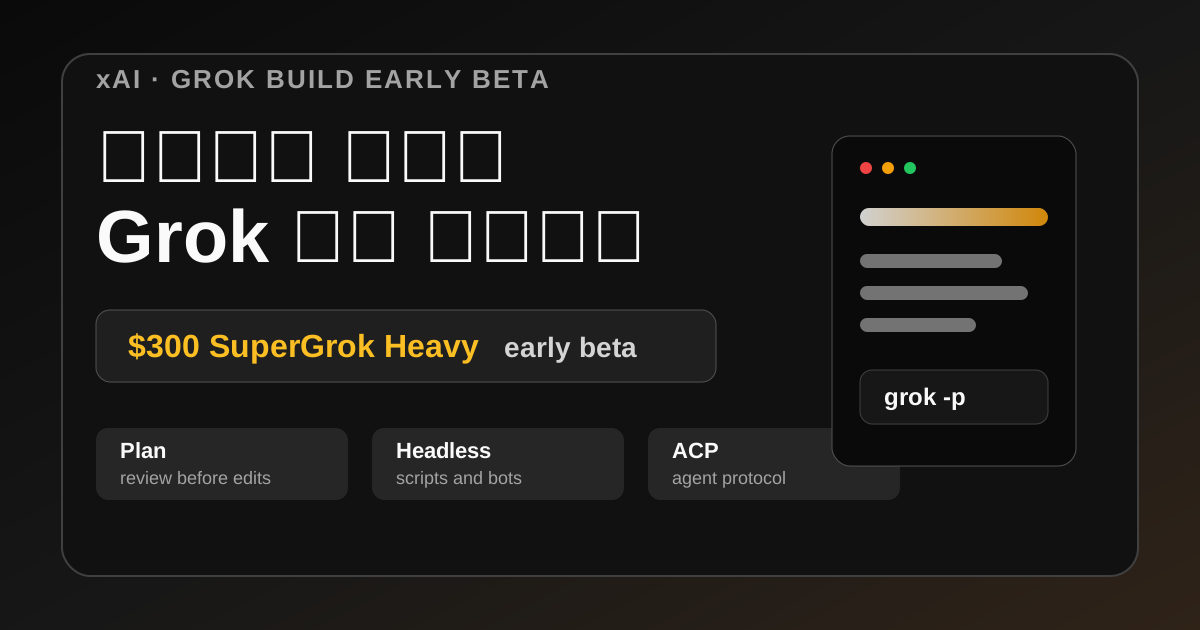
- What happened: xAI released the
Grok Buildearly beta and stepped into the coding agent market.- The product was announced on May 14, 2026, with initial access for SuperGrok Heavy subscribers.
- Core surface: Grok Build emphasizes a terminal TUI, plan-first workflow, diff review, headless execution, and ACP.
- Why it matters: Competition is shifting from model names to repo instructions,
AGENTS.md, MCP, skills, and plugin compatibility.- xAI is signaling that it wants to absorb the workflow standards created by Claude Code and Codex instead of forcing a clean-slate toolchain.
- Watch: Early beta access and the reported $300 monthly tier may slow adoption and limit real-world feedback.
xAI announced Grok Build early beta on May 14, 2026. At first glance, it looks like one more coding CLI in a market already crowded with terminals, IDE extensions, and autonomous coding assistants. The more interesting reading is different: Grok is moving into the same operational layer where developers already run terminals, review diffs, invoke scripts, wire MCP servers, and write repository-level instructions for agents.
That matters because coding agents are no longer judged only by whether a model can write a function. The practical test is whether the agent can live inside a real repository, respect local rules, make small changes, run the right commands, and recover when the first attempt fails. Grok Build arrives late compared with Anthropic Claude Code, OpenAI Codex, Google Gemini CLI and Antigravity, Cursor, and Windsurf. But it enters with the right primitives: a terminal-first interface, plan review, diff review, headless mode, Agent Client Protocol support, and compatibility with parts of the Claude Code ecosystem.
Access is still narrow. xAI says the early beta is available first to SuperGrok Heavy subscribers. CIO Dive and eWeek describe that tier as a $300 per month subscription. So the announcement contains two stories at once. One is xAI's serious move into coding agents. The other is a product still sitting behind an expensive and limited-access gate. In developer tooling, demos are less important than daily use. Grok Build now has to prove it can be predictable enough to sit inside the developer loop.

Late, But Aimed at the Right Layer
xAI is best known for Grok as a consumer-facing assistant tied to X, real-time information, and multimodal interaction. Coding agents were not the center of that brand. Meanwhile, the developer market has already moved fast. Claude Code has spread through terminal workflows where developers ask an agent to take on multi-step work. OpenAI Codex is being pushed through both CLI surfaces and ChatGPT product surfaces. Google has been connecting Gemini CLI, AI Studio, and Antigravity into a broader story about moving from prompt to app, validation, and deployment.
If xAI had launched only a code-generation chatbot, this would be a small story. The official Grok Build announcement and docs point somewhere more specific. xAI describes Grok Build as an extensible coding agent for an interactive TUI, headless scripts and bots, and ACP. The basic usage pattern starts inside a project directory with cd your-project followed by grok. This is not a browser-side snippet generator. It is a tool designed to read context from a repository root and keep working there.
The compatibility story is even more strategic. xAI's docs say Grok can read not only .grok/ configuration, but also Claude Code marketplaces, plugins, skills, MCPs, agents, and instruction files. The docs also call out AGENTS.md and CLAUDE.md. That says a lot about where the coding agent market is now. The competitors are not just model providers. The durable assets are the instruction files, MCP servers, hooks, skills, and plugins that teams have already placed inside their repositories. A new agent that wants adoption has to read those assets.
For xAI, this is a practical move. A late entrant cannot ask every team to rebuild its agent operating rules from scratch. It needs to inherit what is already there. For developers, it is also a useful signal. The more agent behavior lives in repository files and protocols rather than a single vendor app, the easier it becomes to evaluate multiple agents against the same local workflow.
Plan, Diff, Headless
The official announcement highlights plan mode for complex work. The agent proposes an approach before editing files. The developer can approve it, comment on individual steps, or ask for a rewrite. After execution, changes are shown as diffs. That flow is not just a usability feature. It is a control mechanism.
A chat answer can be wrong without touching the codebase. A coding agent can open files, rewrite modules, run commands, and create side effects. The moment an agent can change the repository, "show me the plan first" and "show me the diff after" become part of the safety model. They give the human a place to interrupt before execution and a place to inspect after execution.
| Surface | Role in Grok Build docs | Meaning for engineering teams |
|---|---|---|
| Interactive TUI | Runs agent work through a full-screen terminal interface with mouse support | Gives individual developers a daily entry point inside the terminal |
| Plan mode | Reviews the approach and steps before edits are made | Puts human judgment before repository mutation |
| Headless | Supports grok -p, JSON output, and streaming JSON output | Makes the agent callable from CI, bots, and internal automation |
| ACP | Runs a JSON-RPC agent through grok agent stdio | Lets IDEs or custom orchestration apps use Grok as a sub-agent |
| Claude Code compatibility | Reads skills, plugins, MCP, AGENTS.md, and CLAUDE.md | May reuse agent operating rules teams have already written |
Headless mode is not a side feature. The xAI Headless & Scripting docs list flags such as -p, --single, --session-id, --resume, --continue, --cwd, --output-format, and --always-approve. Output formats include plain text, JSON, and streaming JSON. This is the difference between a person chatting with an agent and another program invoking the agent as part of a system.
That system role is where coding agents are heading. Teams will want agents that can react to CI failures, prepare pull requests, inspect security findings, run repetitive migrations, or operate inside internal developer platforms. A CLI that only works as a human-opened app has a ceiling. A CLI with stable headless output and resumable sessions can become part of a larger automation graph.
ACP support points in the same direction. The docs show grok agent stdio as a JSON-RPC agent endpoint. Coding agent competition will not stay inside one app. IDEs, issue trackers, build systems, security review tools, and chatops surfaces will all want to call agents. Grok Build's early emphasis on ACP suggests xAI understands that the agent is not always the top-level UI. Sometimes it is a worker behind another product.
The Weight of Claude Code Compatibility
One of the most important messages in the announcement is essentially "works with what you already use." The official page says AGENTS.md, plugins, hooks, skills, and MCP servers work. The supporting docs go further by saying Grok reads Claude Code marketplaces, plugins, skills, MCPs, agents, and instruction files with zero configuration.
This is a concession to the market Anthropic helped create. Claude Code is not just another competitor. It has shaped repository conventions and developer habits. If a team has already written AGENTS.md with test commands, style rules, forbidden actions, and review expectations, a new agent has to read it. If the team has already connected internal docs, GitHub, Jira, or database schemas through MCP servers, asking them to rebuild those integrations is friction.
For developers, compatibility is good only if it is operationally real. "Reads the file" is not the same as "behaves the same way." Agents can differ in instruction priority, conflict resolution, working-directory assumptions, hook timing, MCP approval rules, and what they do when instructions are ambiguous. Any team testing Grok Build should evaluate those differences directly rather than assuming Claude Code assets will behave identically.
Still, the direction is useful. It means the agent configuration layer may become more portable. If AGENTS.md, MCP servers, skills, and plugin metadata become shared assets across tools, teams can keep some leverage. The lock-in shifts away from every local rule being trapped inside one vendor's UI. Vendors then have to compete on execution quality: who follows the rules better, who produces smaller diffs, who asks for approval at the right time, and who fails more safely.
The $300 Gate Is Both Signal and Constraint
The biggest limitation is access. xAI says Grok Build is initially available to SuperGrok Heavy subscribers. CIO Dive and eWeek describe SuperGrok Heavy as a $300 per month tier. That price is not casual for individual developers, and it creates a gap for teams as well. A few power users experimenting is very different from a whole engineering group using a tool every day.
A narrow early beta can make sense. Coding agents have higher failure costs than ordinary chatbots. A bad answer is one thing. A bad repository edit, a misunderstood test command, or an over-permissive shell action can create a larger incident. Starting with a smaller group may help xAI collect feedback while limiting the blast radius.
The market problem is speed. Claude Code and Codex already have developer mindshare. Google is trying to pull agentic development into its broader AI tooling story. Cursor and Windsurf are embedded in editor habits. A late entrant that also starts behind a high-priced tier may struggle to gather broad real-world usage data quickly. Coding agents improve through exposure to messy repositories, not only curated demos.
That is why the adoption question is not simply "is Grok Build good?" It is "can Grok Build become common enough to matter in real developer loops?" Terminal-first design and compatibility help. Limited access works against that. The next phase will show whether xAI treats Grok Build as a narrow premium feature or expands it into a developer platform with wider distribution.
What Teams Should Evaluate
First, do not evaluate Grok Build only on model response quality. The better questions are about repository understanding, plan quality, diff minimality, test selection, failure recovery, and permission boundaries. Plan-first design recognizes those risks, but real repositories are different from launch examples. Monorepos, slow CI, legacy tests, private packages, and internal APIs expose the actual quality of a coding agent.
Second, headless mode deserves careful testing. grok -p with JSON or streaming JSON output is promising for automation, but production use depends on stable schemas, useful exit behavior, session resumption, secret handling, approval policy, and logs. Options such as --always-approve are powerful and risky. They should be combined with sandboxing, branch protections, scoped permissions, and file access rules.
Third, test compatibility rather than trusting the label. If Grok reads AGENTS.md, CLAUDE.md, skills, plugins, and MCP configuration, try the same task across multiple agents. Compare whether each one follows local instructions, chooses the same test commands, handles conflicts the same way, and asks for approval at the same points. The differences will matter more than the compatibility headline.
Fourth, treat price and data boundaries as part of the product. A $300 monthly tier is not only a budget question. It affects who can try the tool, which repositories can be opened, where logs and feedback go, and whether company policy allows external agents to touch certain code. The bottleneck for coding agent adoption is shifting from "can the model write code?" to "can the organization govern the execution?"
From Coding Model to Agent Runtime
Grok Build's announcement captures the next stage of the coding agent market. Early competition was about whether a model could solve coding benchmarks, write functions, and pass SWE-bench-style tasks. Current products talk about repository roots, terminals, plans, diffs, tests, MCP, hooks, plugins, headless execution, and protocols. The model still matters, but the surrounding runtime determines whether the agent can be trusted with daily work.
xAI's hand is clear: the Grok model brand, a terminal-first product, a compatibility strategy for a late entrant, and distribution through SuperGrok Heavy. The strength is that Grok Build tries to absorb existing coding-agent conventions from day one. The weakness is that the market is already crowded and access starts high.
For AI builders, the important part is not only xAI. It is the direction of the market. Coding agents will increasingly be judged by how well they read repository instructions, integrate with MCP and security policy, support headless automation, and keep humans in the review loop. Grok Build is another signal that the fight has moved from "which model is smarter?" to "which agent runtime can operate inside our engineering system?"
Observation Comes Before Verdict
Grok Build is too early for a final verdict. The product is explicitly in early beta. We still need to see how well it handles large repositories, whether plan mode creates real review points, whether headless JSON events are stable enough for internal automation, and whether Claude Code compatibility remains consistent in complex projects.
Even so, the announcement is worth watching. xAI is treating developer tooling as more than a side feature of a chatbot. It is building a separate execution surface for code work. Whether Grok Build succeeds or not, the fact that a late entrant arrived with AGENTS.md, MCP, plugins, skills, headless mode, and ACP on the first page says a lot about the new baseline. A coding agent now needs more than clever answers. It has to read the team's existing rules and move carefully inside them.