When the search box becomes a 24-hour agent, Google tests mini apps
Google Search agents extend search from answers into persistent monitoring, task state, alerts, and generative UI mini apps.
- What happened: Google used I/O 2026 to introduce
Search agentsand expand generative UI inside AI Mode.- Search is moving toward preserving context and continuously checking conditions such as prices, availability, reservations, and tickets.
- Why it matters: Search results are starting to look less like answer pages and more like small apps for tracking goals, comparing options, and moving toward action.
- Builder impact: Structured data, real-time inventory and pricing APIs, source trust, and agent-readable documentation become more important than classic SEO alone.
- Watch: Ads, recommendation logic, source clicks, and notification permissions still need much clearer boundaries.
Google brought the next stage of search back to the center of I/O 2026. The surface-level announcement is AI Mode expansion, Gemini 3.5 inside search, and a smarter search experience. The more durable phrase for developers and AI product teams is different. In its official Search announcement, Google introduced Search agents: a direction where search does not simply answer once, but remembers a user's constraints and keeps checking them in the background.
That is not just "AI search got better." Traditional search made users type a query, scan results, open links, and compare conditions manually. AI Overviews and AI Mode compressed that process into summaries and direct answers. Search agents go one step further. If a flight price drops, a restaurant reservation opens, or an event ticket matches a user's criteria, the search system can keep watching instead of relying on the user to remember to search again.
Once the search box changes in that way, the product surface that teams need to optimize also changes. Until now, teams cared about strong titles, descriptions, structured data, and document quality on a search results page. In the agentic version, the real-time status of a product, price, inventory, location, policy, and API response quality start to matter more. If search moves from recommending links into comparison tables, reservation flows, and alerts, a product needs a data surface that agents can interpret and act on, not only a web page that humans can read.
What Google actually announced
Google's May 19 Search announcement says AI Mode is expanding for users in the United States and combines Gemini 3.5-based reasoning with a query fan-out technique that breaks complex questions into sub-questions. When a user asks for a summer trip that works with children, fits a budget, and includes backup plans for rain, AI Mode can run multiple searches in parallel, then combine summaries, comparisons, and recommendations.
The new piece is where Search agents enter the flow. Google describes search as being able to keep checking user-specified conditions, notify the user when needed, and connect the result to a next step. Examples include lower airfare, newly available restaurant reservations, or tickets that match a set of criteria. This moves part of the "I should check that again later" burden from the user into search itself.
The other important axis is generative UI. Google says AI Mode can go beyond answer text and assemble interfaces such as tables, interactive graphs, shopping comparisons, and small tools that match the question. That means a search results page can become less like a fixed set of templates and more like a mini app shaped around the user's current task.
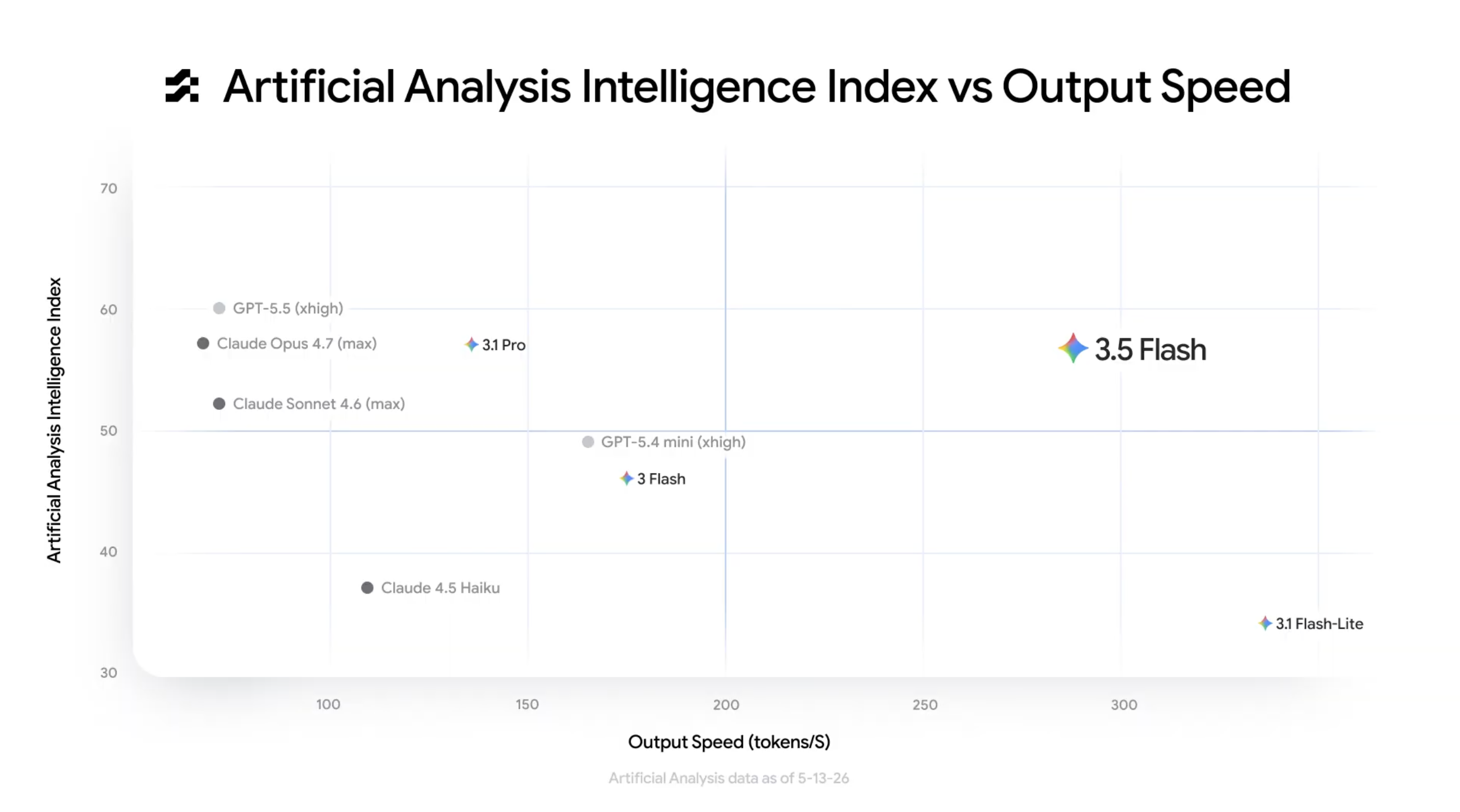
The chart above comes from Google's Gemini 3.5 announcement and uses Artificial Analysis data. It is separate from the Search post's thumbnail, but it helps explain why Google is presenting this search shift together with Gemini 3.5. Search agents are not just crawler features. They become meaningful when search indexes, live tools, model reasoning, and generated interfaces are connected in one flow.
Search results as mini apps
"Generative UI" can sound vague. In a search context, the shift is concrete. Existing search results combine links, snippets, maps, shopping cards, videos, and other fixed components. AI Mode changes the user's request shape. More queries now look like "compare the options that fit my situation" instead of "find the page that contains the answer." That requires more state and more controls than a simple result card.
Imagine a user asking search to keep watching flights from Seoul to San Francisco next month, avoiding overnight flights, allowing no more than one layover, and staying under a specific budget. Classic search was good at sending the user to flight search pages or showing currently available results. Agentic search needs to store the conditions, watch prices and seats, and come back when the result changes. The required UI is not a single answer. It is a small workspace with editable conditions, alert status, candidate comparison, reliable sources, and a way to cancel or adjust the task.
Google's generative UI direction can be read as an attempt to build that workspace inside search results. If the question needs an interactive chart, search creates a chart. If it needs shopping comparison, search creates filters and a table. If it needs itinerary planning, search can assemble a schedule. Instead of moving across several websites to reconcile state manually, users can narrow choices inside the search experience itself.
| Category | Traditional search | AI Mode | Search agents |
|---|---|---|---|
| User behavior | Enter queries and open links | Ask complex questions and compare answers | Set conditions and delegate monitoring |
| Result shape | Links, snippets, and cards | Summaries, evidence, and sub-questions | Alerts, state, refreshed candidates, and action flows |
| Product-team work | SEO and document quality | Source trust and structured data | Real-time APIs, policy boundaries, and agent permissions |
Why this matters to developers
First, AI search exposes the gap between a human-readable page and a machine-readable state surface. A person may understand a price table by looking at it. An agent needs to reliably know the price validity window, inventory status, regional restrictions, refund conditions, and API limits. Products with frequently changing information are especially exposed here: commerce pages, SaaS pricing, API plans, appointment slots, and ticket availability.
Second, search acquisition metrics become less stable. If a user finishes comparison and condition editing inside Google, fewer clicks may reach the original website. At the same time, being chosen as a candidate inside AI Mode, cited in an answer, or re-surfaced through an agent alert may become more important. The problem is that those signals are not fully visible through existing web analytics. A product team may only see fewer visits while missing whether it was shortlisted, excluded, or cited inside the search agent layer.
Third, trust and policy language become part of the product surface. When an agent checks conditions for a user over time, the boundary is heavier than ordinary information retrieval. How often may it notify the user? What permission did the user grant? How are sponsored results separated from organic results? Which sources support the recommendation? In high-cost decisions such as travel, finance, healthcare, hiring, and procurement, recommendation evidence becomes part of the product experience.
Fourth, documentation and APIs need to become more agent-friendly. Developer-tool companies should expose documentation structures, fresh release notes, clear pricing tables, versioned code examples, error messages, and limitations in ways that models can understand. When a search agent answers a developer question, a conflict between an old blog post and the current docs can immediately damage product trust.
Google's competitive position
Google's strength in this shift is obvious. Search index, Shopping Graph, Maps, YouTube, Workspace, Android, Chrome, and Gemini models all live inside the same company. Perplexity and OpenAI Search are moving quickly, but Google still has a large base of real-time data and consumer touchpoints needed to turn search results into agent tasks.
The weakness comes from the same place. Google Search is deeply tied to an advertising business. When a search agent recommends "the best option," users and publishers will keep asking how ads and organic results are separated, how sponsored candidates enter monitoring flows, and how original websites are compensated. Answer-style search already triggered concern about source clicks and copyright. Agentic search extends that tension into execution and notification.
OpenAI and Perplexity lead with a more direct AI product experience. Users can ask ChatGPT or Perplexity to find something under a set of conditions and narrow the result in conversation. Google has the habit layer. It can put agents inside a search box that people already open every day. The winner will not be decided by model quality alone. Source trust, UI speed, notification restraint, ad transparency, and a sense of user control will matter together.
The uncomfortable community questions
Reactions around I/O 2026 on Hacker News and Reddit mix interest with fatigue. The optimistic view is straightforward: search can reduce repetitive work and handle complex comparison better. Travel, shopping, events, learning, and work research all involve repeated searches today. Price tracking and reservation checks are natural agent use cases because users already delegate similar work to alerts, bots, and saved searches.
The skeptical view focuses on sources, ads, and the web ecosystem. If AI Mode writes the answer, generative UI builds the comparison table, and Search agents keep tracking candidates, users may visit original websites less often. Publishers and SaaS companies have to ask whether search remains an acquisition channel or becomes an intermediary that absorbs more of the value inside its own UI. If recommendation logic is not explainable, convenience can come with a loss of agency.
That skepticism is not just emotional resistance. An agent spends time on behalf of a user. It therefore needs to make clear what objective it optimizes, which candidates it excludes, when it sends notifications, and how the user can stop it. As search agents become mainstream, this will stop being a UX detail and become a core condition for product trust.
What product teams should prepare
The practical answer is not to abandon web pages and build only an agent API. The first step is to make web pages, structured data, APIs, documentation, and change history agree with each other. No matter how a search agent obtains information, it should see the same price, the same limitation, and the same policy. A human can tolerate "see terms for details." An agent needs more explicit signals about which conditions block which choices.
The second step is to expose the freshness and scope of changing information. When was a price updated? Which region does inventory reflect? Which version does an API example target? Which date and configuration produced a model benchmark? AI search can combine stale and current information in one answer. If teams do not mark freshness and applicability clearly, search agents are more likely to reach the wrong conclusion.
The third step is to design how the product appears when cited. Classic SEO focused on making titles and meta descriptions attractive enough for a human click. AI search may cite a short evidence sentence, a value inside a table, a comparison criterion, or a limitation. Intro paragraphs, FAQ entries, pricing copy, and changelogs all become agent material. Verifiable facts, dates, numbers, and conditions may become stronger signals than marketing language.
The fourth step is to define the boundary around alerts and action authority. If a user asks Google Search agents to monitor conditions, an external service may not know exactly what permission the user delegated upstream. When the flow moves into reservation, purchase, signup, or payment, the service still needs clear confirmation and cancellation steps. The more convenience the agent provides at the front, the more explicit the downstream product must be about authority and responsibility.
Search is moving from answer surface to operating layer
The meaning of Google Search agents is not simply "AI was added to search." That has been underway for years. The larger shift is that search is becoming an operating layer that remembers goals, checks conditions over time, and generates the UI needed for the task. Search is no longer only the start of discovery. It is trying to own comparison, monitoring, alerts, and parts of execution.
This does not mean the product experience is solved. Ads, sources, publisher compensation, notification fatigue, bad recommendations, privacy, and permission boundaries remain open problems. But the direction is clear. The next phase of AI search competition will not end with answer quality. It will ask which system can follow a user's goal for longer, with more transparency and less friction.
For developers and AI product teams, the signal is uncomfortable but important. A product increasingly needs to be a website for humans, documentation for models, and a state surface that search agents can call or interpret. When the search box becomes a 24-hour agent, visibility competition shifts from keyword rank toward a harder question: how accurately can an agent use the facts and live state of your product?