The 24-hour agent inside Google Search and the new edge of the link economy
Google Search agents expand AI Mode from link retrieval into background monitoring, booking, commerce, and generated mini-apps.
- What happened: At I/O 2026, Google said Search will gain information agents, booking agents, generative UI, and Antigravity-powered mini-apps inside AI Mode.
- AI Mode moves to Gemini 3.5 Flash as its default model, while information agents start with Google AI Pro and Ultra subscribers in summer 2026.
- Why it matters: Search results are turning from ranked links into an agent operating surface that monitors user-defined conditions, builds tables and dashboards, and can execute parts of a workflow.
- Watch: Source attribution, clicks, ads, and accountability become harder. The publisher debate around AI Overviews may get sharper once Search agents read and act on the web in the background.
Google Search is changing shape again. This is not just a redesign of the search box or a longer AI answer at the top of the results page. On May 19, 2026, at I/O 2026, Google said it would put "information agents" inside Search, let them keep watching user-defined conditions in the background, and generate tables, charts, simulations, and mini-apps that fit a query. In Google's framing, this is the arrival of Search agents.
The important shift is that Search is moving from a one-shot query flow into a persistent execution loop. Traditional Search asked users to enter a query, inspect a result page, and decide which links to trust. AI Overviews and AI Mode had already weakened that pattern by synthesizing answers before users clicked away. This announcement goes further. Search is no longer only answering a question. It is remembering a user's goal, watching the web and live data, sending updates when conditions match, and connecting the result to booking or shopping flows when needed.
Google's scale claims are not small either. The company said AI Mode passed one billion monthly users in its first year and that related queries have more than doubled quarter over quarter. That is Google's way of saying AI Search is no longer a lab curiosity. It is becoming a mainstream Search behavior. So the announcement is less "Google added AI to Search" and more "AI is redefining the default behavior of Search."
The first assumption Search agents change
The key line in Google's official Search announcement is that information agents can work in the background, around the clock. A user can describe a question that needs continuous tracking: apartment requirements, market movements, sneaker collaborations, local service availability, or any other condition that changes over time. The agent can then examine blogs, news, social posts, and Google's fresh finance, shopping, and sports data, and send synthesized updates when the condition is met.
That sounds familiar because it overlaps with Google Alerts. TechCrunch described the information agent as an evolution of that older product. But the difference is substantial. Google Alerts mainly detects when a keyword appears in a new document. Search agents interpret a richer goal, decide which tools and data sources matter, judge whether the user's condition has actually been satisfied, and return a summary with links. The interface moves from keyword matching to goal-based monitoring.
For developers and AI product teams, the important point is that this is not merely a consumer feature. An information agent is effectively a personalized worker running over the Search index. The user writes the monitoring rule in natural language, and Search turns that rule into an executable plan. That pattern directly overlaps with business AI products for research, sales intelligence, recruiting, price monitoring, supply chain monitoring, and competitor tracking.
The product lesson is also uncomfortable. Many startups have treated "agent that watches the web for you" as a wedge into enterprise workflows. Google is now showing a consumer-scale version of that same pattern in the default Search surface. The differentiated layer may move away from scraping and summarization, and toward proprietary workflow context, permissions, integrations, auditability, and the quality of the decision boundary.
AI Mode's default model becomes Gemini 3.5 Flash
The engine behind this Search update is Gemini 3.5 Flash. Google said it is upgrading AI Mode's default model to Gemini 3.5 Flash, and its I/O 2026 announcement roundup described the model as beating Gemini 3.1 Pro on several coding and agent benchmarks, including Terminal-Bench 2.1 at 76.2%, GDPval-AA at 1656 Elo, and MCP Atlas at 83.6%.
As a standalone model launch, that might sound like another Flash-family update. Inside Search, it means something different. Flash models are designed around latency and cost. Search is a product used by people around the world every day, so a model cannot only be strong. It also has to be cheap and fast enough for very high-volume use. Short answers, long conversations, multimodal inputs, background jobs, and UI generation all raise the operating cost. Google's repeated language about "frontier intelligence with action" makes more sense in that context.
The search box itself is changing too. Google described the new search box as its biggest upgrade in more than 25 years. It can accept longer natural-language prompts and handle images, files, videos, and Chrome tabs as input. It also suggests more complex follow-up questions by anticipating the user's intent. The box is becoming less of a keyword field and more of a prompt surface where users can pass goals and context.
For builders, that matters because the input contract changes. People will not only type "best running shoes" or "apartment near subway." They will describe constraints, preferences, exclusions, timing, and follow-up criteria. Products that depend on Search traffic need to think about how their data and actions look when consumed by an agent that is trying to satisfy those richer constraints before a human ever lands on the site.
| Category | Traditional Search | AI Overviews | Search agents |
|---|---|---|---|
| User behavior | Enter keywords, then inspect links | Read a summary, then explore further | Delegate conditions and receive updates |
| Output shape | Ranked links | Synthesized answer with source links | Alerts, dashboards, mini-apps, booking flows |
| Main bottleneck | Choosing terms and evaluating pages | Summary accuracy and source quality | Permissions, accountability, click allocation, execution checks |
When search results become mini-apps
The most interesting part of the Search agents announcement is "agentic coding in Search." Google said Search can use Google Antigravity and Gemini 3.5 Flash's agentic coding abilities to create generative UI for a specific question. If a user wants to understand an astrophysics concept, Search can build an interactive visualization. If the user wants to understand the structure of a watch, it can assemble a custom layout and simulation.
The bigger point is that this UI is not necessarily a disposable answer card. It can become a dashboard or tracker the user returns to, with state preserved over time. Google gave examples such as wedding planning, moving, and health routines. Search could create a mini-app like a fitness tracker, connect it to fresh data from reviews, maps, or weather, and keep it useful beyond the first query.
This puts Search in the same competitive frame as ChatGPT apps, Claude Artifacts, and Perplexity Pages. Google's position is different, though. Search already sits on top of intent, the web index, ads, shopping, maps, booking, and potentially personal context from apps such as Gmail and Photos. When generative UI attaches to that surface, it opens a broader action path than a simple answer card. It also gives Google more mediation power between users and websites.
Developers should treat this as a new distribution surface, even if the implementation details remain early. If Search can generate a temporary interface before a user visits an app, the first interaction may happen inside Google's runtime. That does not mean every company needs to rebuild its product around Google's internal UI system. It does mean structured data, reliable actions, clear identity, source labeling, and reversible transactions become more important.
Why Universal Cart belongs in the Search agents story
On the same day, Google announced Universal Cart. It looks like a shopping update on the surface, but it is better read as a concrete Search agents example. Universal Cart keeps a shopping cart across Search, Gemini, YouTube, and Gmail. Once a product is added, Google says it can check price drops, restocks, price history, card benefits, and part compatibility in the background.
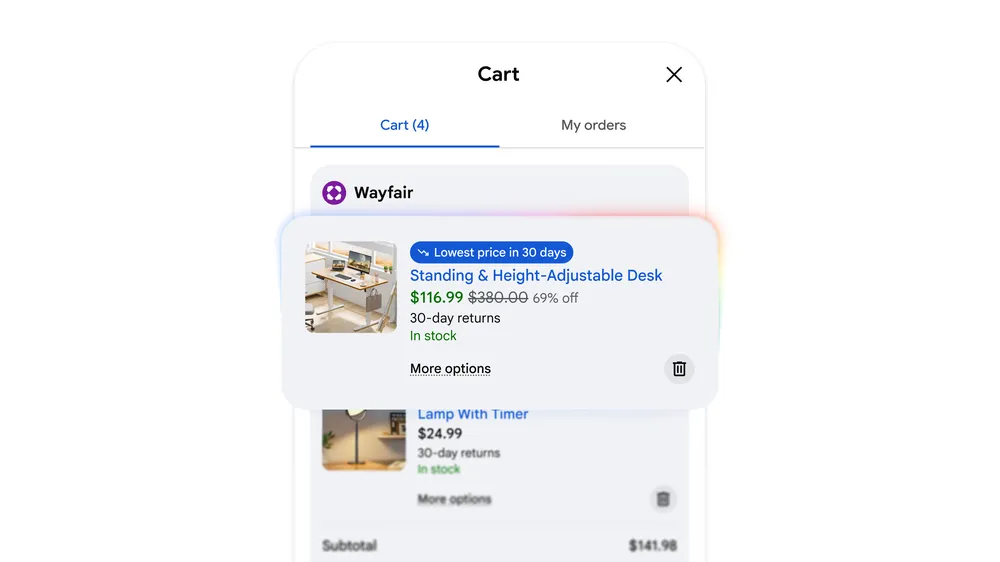
Google said its Shopping Graph contains more than 60 billion product listings and that more than one billion shopping actions happen across Google every day. If agentic commerce is layered on top of that data scale, Search becomes not only a product discovery surface but also a place for purchase-condition monitoring and checkout. Universal Commerce Protocol gives agents a common language for carts and checkout, while Agent Payments Protocol adds budgets, brand and product constraints, and a verifiable digital mandate for agent payments.
That is a useful signal for AI product teams. Once an agent spends real money, books a service, or calls a business, the question shifts from "is the model smart?" to "is the delegation verifiable?" Google describes AP2 as creating a verifiable link among user, merchant, and payment processor, with a durable record that the agent acted on the user's behalf. As agentic commerce grows, that kind of auditability becomes infrastructure rather than a nice-to-have feature.
This is also where Search agents stop being an abstract interface trend. A shopping agent has to understand user intent, merchant constraints, payment authorization, delivery rules, and exception handling. A booking agent has to handle availability, cancellation, price changes, and the difference between asking for information and making a commitment. These are product and systems problems, not just model problems.
The uncomfortable question for publishers and the link economy
Search agents matter beyond the demo because the web's business model is involved. Traditional Search sent traffic to websites while Google monetized the results page with search ads. AI Overviews already created friction by synthesizing answers before users clicked through. Search agents go one step further: they reduce the need for users to repeat searches, and they let an agent read information in the background.
The May 13, 2026 arXiv paper "Measuring Google AI Overviews" is useful context for this tension. The researchers measured 55,393 trending queries over 40 days, from March 13 to April 21, 2026, and analyzed activation, source quality, claim fidelity, and publisher impact. The paper points to a structural tension: if AI Overviews reduce clicks, publishers that depend on display ads may lose revenue while Google's ads remain on the same page.
Search agents make the issue more sensitive. If the user no longer scans search results directly, and an agent reads and synthesizes information in the background, where should source links appear and how prominently? If an agent sends a wrong update, misunderstands a booking condition, or misjudges price information, who is accountable: Search, the data provider, the merchant, or the user? AI product teams should not treat these questions as copywriting details at the edge of UX. They belong at the center of product architecture.
There is a second-order problem too. The web has long optimized for being discovered, clicked, and read by humans. Search agents optimize for being parsed, monitored, summarized, and acted on by software. That changes incentives for site owners. The winning page may not be the page with the strongest headline or the deepest human-readable guide. It may be the source with the clearest structure, most reliable update cadence, and most machine-verifiable claims.
For developers, Search becomes another deployment surface
If Search starts generating UI and mini-apps, developers will experience Search as something close to a runtime. Before a user installs an app or enters a website, Search may create a temporary UI that matches the user's goal. That changes the acquisition funnel. A user may first interact with a mini-app inside Search, then move to the original service only when the handoff is necessary.
The practical questions are straightforward. First, are your service's data and actions exposed in a way an agent can understand? Second, if a user invokes your service from Search or another agent surface, can you verify authorization, payment, cancellation, and error handling? Third, when an agent synthesizes an answer, is your brand and source identity still visible enough to matter?
Commerce, booking, and local services may feel the impact quickly. Google said Search's agentic booking will expand to local experiences and services, and in some categories such as home repair, beauty, and pet care, Google may call businesses on a user's behalf. The feature is expected to roll out to all users in the United States in summer 2026. Services in these categories need more than API integrations. They need agent-friendly operational data for phone handling, inventory, pricing, appointment slots, and service constraints.
How not to overrate the announcement
There is still a lot to verify. Google's announcement shows direction, but the real quality can only be judged after rollout. We do not yet know how often information agents will misread conditions, how transparently they will show source links, how much control users will have over notification fatigue, or how stable generated UI will be for complex questions.
The openness of Search mini-apps is another unresolved point. It matters how Google's generated UI connects to external service APIs, which standards developers can use to expose data and actions, and how ads or sponsored links appear inside generated interfaces. As the search results page becomes more app-like, ad labeling and recommendation accountability need to become more app-like too.
Still, the direction is clear. Google is not only trying to make Search an answer engine. It is turning Search into an agent execution surface where information work, booking, shopping, personal trackers, and learning simulations can begin. The model layer is Gemini 3.5 Flash. The developer execution layer is Antigravity. Commerce is tied to Universal Cart, UCP, and AP2. Personalization can be connected through apps such as Gmail and Photos.
The important competition is no longer who writes the longest answer. It is who can track and execute a user's goal for the longest period, with the strongest safety, attribution, and verifiability. Search agents are a sign that this competition has moved into the search box. The next boundary of the link economy may not be showing more links. It may be deciding what sources, permissions, and records an agent must leave behind before it reads links and acts on them.