Genkit Middleware Moves Agent Control Outside the Prompt
Google Genkit Middleware shows how retries, fallback, tool approval, and filesystem boundaries are moving into the runtime layer of agent apps.
- What happened: Google added Middleware to Genkit, letting developers intercept
generate()calls and tool loops.- The first SDKs are TypeScript, Go, and Dart, with Python support planned.
- The built-in middleware set covers Retry, Fallback, ToolApproval, Skills, and Filesystem.
- Why it matters: Agent safeguards are moving from prompt wording into runtime hooks and operating policy.
- Builder impact: Teams can control model failures, quota exhaustion, destructive tool calls, and file access more explicitly in application code.
- Watch: Middleware is not a complete security layer. It creates a new place where teams must design policy, approval UX, and observability.
Google for Developers announced Genkit Middleware on May 14, 2026. On the surface, it is a new developer feature for the Genkit framework. The more interesting shift is broader: the recurring operational problems in AI and agent apps, including retries, model fallback, tool approval, file access, skill injection, and observability, are being pulled out of prompt text and into the runtime layer.
Many AI apps have grown by putting instructions such as "answer carefully," "ask before deleting files," or "try again if something fails" into the system prompt, then adding application-specific exception handling when the demo starts to break. That can be enough for an early prototype. Once tools, multiple model calls, user data, and filesystems enter the loop, the failure mode changes. A failure is no longer just a wrong answer. It can become an incorrect action, runaway cost, sensitive data exposure, or production downtime.
Genkit Middleware targets exactly that boundary. Google's announcement says building production-ready AI features and agentic apps requires more than a strong model and a good prompt. Teams need retries for failed requests, fallback to another model, human approval before destructive tools run, and visibility across each layer. Genkit implements this as composable hooks that intercept the generate() call and the tool execution loop.
Why Genkit Reached for Middleware
Genkit is an open source AI application framework from the Google and Firebase ecosystem. The GitHub repository describes SDKs for JavaScript/TypeScript, Go, Python, and Dart, and says Genkit is used in production by Google Firebase. At the time the Korean source article was researched, the repository showed roughly 6,000 stars and 739 forks. This is not just a sample project. It is closer to the framework Google is using to bind server-side AI app logic, model integrations, tool calling, and observability for its developer ecosystem.
The reason Genkit Middleware is worth watching is that the framework is climbing from a model wrapper into an application runtime. In the first wave of AI app development, the central question was "Which model should we call?" Gemini, OpenAI, Anthropic, and open source models were the main axis. In agent apps, the question changes. May the model call this tool? If a request fails, which exact part should be retried? If a quota is exhausted, can the same request be routed to a cheaper or more available model? Can file writes be pinned inside a safe root? Can an operator reconstruct later why a specific action happened?
Those are runtime-control questions, not model-selection questions. That is why the word middleware matters. Middleware is not a way to speak to the model more nicely. It is a way to insert rules between the model and the application. Google's announcement points to the larger bottleneck for agent apps: the constraint is not only model capability, but control over the execution layer.
Three Hooks Break Down the Tool Loop
Genkit's documentation says every generate() call runs a tool loop. The model produces output, required tool calls execute, tool results are fed back into the model, and the loop repeats until the model completes. Middleware attaches to three layers in that flow.
User request and app state
WrapGenerate: policy around a full turn of the tool loop
WrapModel: retries, fallback, and filtering for model API calls
WrapTool: tool approval, sandboxing, and logging
Response, tool results, and trace data
The first hook is WrapGenerate. It wraps each iteration of the tool loop. This is a fit for logic that looks at the whole conversation, injects system instructions, or manages message accumulation. The second is WrapModel. Because it wraps the actual model API call, it is where retries, fallback, caching, and content filtering naturally sit. The third is WrapTool. It wraps each tool execution, and because tools can run in parallel, any state it touches needs to account for concurrency.
That distinction is small but important. If a model call fails with RESOURCE_EXHAUSTED, restarting the entire tool loop could duplicate external actions that already ran. Genkit's documentation says the Retry middleware retries only the model API call and does not rerun the surrounding tool loop. In other words, retry scope is part of the safety story. A retry policy that is too broad can increase side effects while trying to improve reliability.
Five Built-In Middleware Pieces
Google's announcement highlights five built-in middleware pieces: Retry, Fallback, ToolApproval, Skills, and Filesystem. The names are familiar, but the notable part is that they are shipped together as agent-app runtime controls.
Retry handles transient failures. The documentation mentions status values such as RESOURCE_EXHAUSTED, UNAVAILABLE, DEADLINE_EXCEEDED, ABORTED, and INTERNAL. Retries are ordinary in web services, but AI apps add model-call cost, latency, and tool-loop side effects. That makes the retry layer more consequential. Genkit attaches the policy explicitly to the model-call layer.
Fallback routes a request to another model when the primary model fails. The announcement's example shows a Gemini call falling back to Claude Sonnet after resource exhaustion. This is also a signal that Google's framework is not trying to force every app through Gemini alone. The Genkit repository says it can integrate model providers including Google, OpenAI, Anthropic, and Ollama. Once model fallback becomes a default framework concept, teams start designing model portfolios for continuity rather than betting everything on one best model.
ToolApproval is the most direct safety feature for the agent era. It turns calls to tools outside an allowlist into interrupts, and the app must resume after a user provides an approval flag. For example, if a user asks the agent to clean up temporary files and a delete tool is invoked, the runtime can stop before execution and wait for approval. That is stronger than writing "ask before deleting" in a prompt, because the runtime can block the tool even if the model misinterprets the instruction.
Skills scans SKILL.md files, injects them into the system prompt, and exposes a tool for loading needed skills. This connects agent task instructions to a repository or an organization's operating practice. It matches the recent pattern across coding-agent tools, where repo-level instructions, skills, and playbooks are becoming normal. The important detail is that a skill is not just a document. It becomes middleware that enters the model-call flow.
Filesystem injects file tools while preventing traversal outside a configured root directory. The docs mention path-safety controls against .., absolute paths, and symlinks that escape the root. As more agents read and write local files, this is closer to baseline hygiene than an optional feature.
| Middleware | Risk controlled | Practical question |
|---|---|---|
| Retry | Transient model-call failure | How much can be rerun without side effects? |
| Fallback | Quota limits, outages, unsupported model paths | Can the app tolerate the replacement model's quality and policy differences? |
| ToolApproval | Destructive tool calls | Can approval UX fit the execution flow without blocking normal work? |
| Skills | Scattered or missing task instructions | Which instructions should always load, and which should load on demand? |
| Filesystem | Access outside a permitted file root | At what task boundary should read and write permissions be separated? |
Why the Developer UI Matters
Google says Middleware is visible in the Developer UI. Once middleware is registered, developers can inspect configuration, follow execution through hook layers, and test combinations. That is not just a convenience feature. One of the most common operational questions in agent apps is "Why did it call that tool?" followed closely by "Where did it fail?"
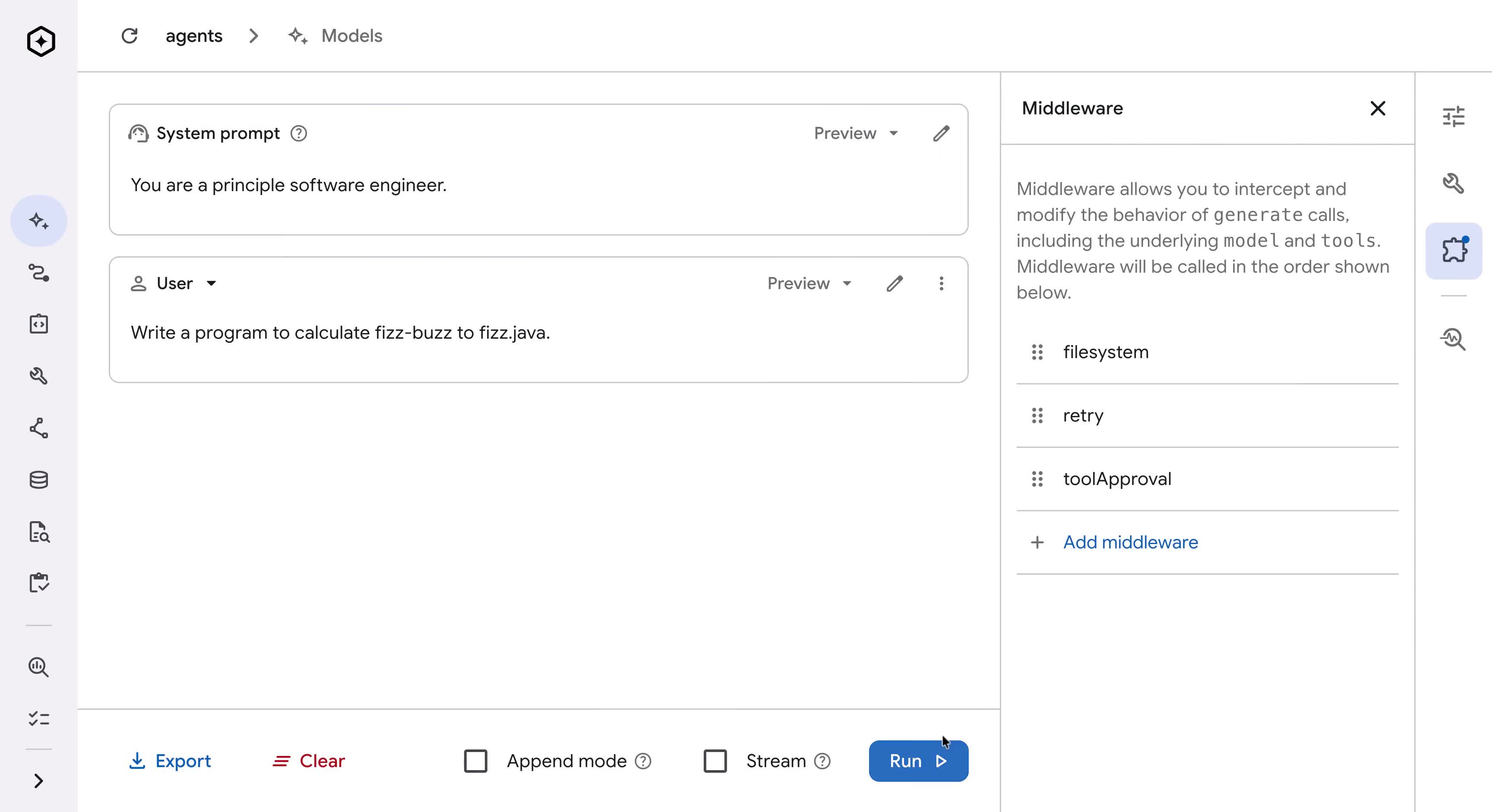
Logs alone are a poor fit for understanding a tool loop. Model calls, tool calls, tool results, retries, fallback, approval waits, and final answers are all interleaved. This is also why observability vendors have been emphasizing agent timelines and LLM tracing. By exposing middleware execution in the Developer UI, Genkit is signaling that an agent app framework has to cover both local development tools and operational debugging.
The Community Question Was: Can It Block Execution?
This announcement did not create the kind of large community reaction that a frontier model release does. No major Hacker News or GeekNews debate was found in the research pass. But a Reddit r/Firebase thread raised a useful question: can Genkit Middleware intercept and reject tool calls by name and arguments, or is it just decoration and observability?
That question captures what builders actually care about in an agent runtime. "There is a hook" is not enough. The important capability is whether a tool can be stopped, whether execution can wait for approval, and whether tool arguments can be inspected. The answer in the discussion pointed to ToolApproval turning tool calls into interrupts, and to custom middleware that can inspect tool parameters. In other words, the community interest was not middleware as an architectural label. It was whether Genkit is entering the execution boundary where agent actions can be stopped or resumed.
The Competition Is Moving to the Operations Layer
Genkit Middleware belongs to the same broad movement as LangChain and LangGraph, Vercel AI SDK, Mastra, OpenAI Agents SDK, and Anthropic's MCP ecosystem. Each uses different language, but the shared questions are similar. How should state be preserved when an agent acts across several steps? Where can a human interrupt the process? How should tool execution be constrained? How should models be swapped? How can results be traced and reproduced?
Google's advantage is the potential connection to Firebase, Google Cloud, Gemini, Android, and the web developer ecosystem. Genkit is not merely a library for calling one model. It is shaped more like an application framework tied to deployment and developer tooling. That makes Middleware strategically important even if it looks like a small feature. It is one of the places where AI apps move from "model-call code" toward an operable application runtime.
The limits are just as clear. Middleware does not automatically make an agent safe. A poorly chosen retry policy can increase cost and latency. Fallback reveals differences in response style, policy, and context handling across models. ToolApproval can create approval fatigue. Filesystem boundaries can block access outside a root, but they do not prevent the agent from modifying the wrong file inside that root. Teams still have to design policy, split risky tools apart, build approval UX, and read observability data.
The Work After Prompt Engineering
If this announcement is read only as "Google added middleware to Genkit," it sounds small. The direction is larger. The quality of agent apps is no longer determined only by prompt-writing ability. Operable agents need failure handling, model routing, permission boundaries, human approval, and observability. Genkit Middleware turns those concerns into first-class framework components.
For development teams, the useful question is less "Should we adopt Genkit?" and more "Does our agent app have these boundaries?" When a model call fails, how much gets retried? Which tools run automatically, and which wait for approval? Does the fallback model follow the same policy? Is file access pinned to a root? Can operators reconstruct the tool loop later?
If a team cannot answer those questions, a better model will not make the production agent stable. Genkit Middleware does not complete the answer. It creates a place to put the answer. It moves operating rules that used to hide inside one prompt line into hooks, middleware, UI, and documented policy. As AI apps move into real work, files, databases, payments, and deployment pipelines, this kind of runtime layer may become as important as the model announcement itself.