Google Saw the First AI Zero-Day, and Security Timelines Are Changing
Google GTIG disclosed the first zero-day exploit attempt it assesses was developed with AI, shifting how defenders should think about discovery and weaponization speed.

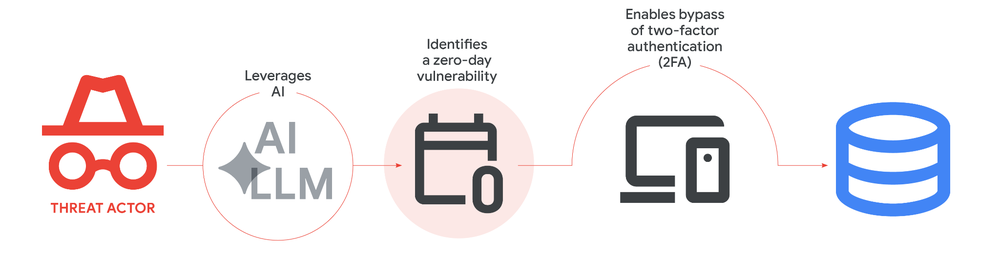
- What happened: Google Threat Intelligence Group disclosed the first case it assesses as a zero-day exploit developed with AI assistance.
- The May 12, 2026 report says the exploit targeted a
2FA bypassin a popular open-source, web-based system administration tool.
- The May 12, 2026 report says the exploit targeted a
- Why it matters: LLMs are becoming vulnerability analysis tools that can read a developer's trust assumptions, not just scanners that wait for crashes.
- Practical impact: Security teams need to plan around
AI-assisted weaponizationspeed, not only the familiar 90-day disclosure clock.- For AI product teams, agent skills, API connectors, packages, and delegated-permission layers are now part of the software supply chain threat surface.
Google just moved the baseline for the AI security debate. On May 12, 2026, Google Threat Intelligence Group, or GTIG, published an AI Threat Tracker report saying it had identified a zero-day exploit that a criminal actor appeared to have developed with help from an AI model. The wording matters. Google is not saying Gemini was used. It is also not claiming a mathematical proof that an AI system authored every line of the exploit. GTIG is saying that the code structure and surrounding evidence give it high confidence that an AI model supported both vulnerability discovery and weaponization.
The important part is not the headline version of the story, where "AI becomes a hacker." The more useful framing is about time. Many security programs still assume there is a human-speed interval between vulnerability discovery, proof-of-concept construction, patching, disclosure, and exploit diffusion. Highly skilled attackers can move quickly, but turning a semantic logic flaw into a reliable exploit has traditionally required focused human work. GTIG's report is a signal that this assumption is weakening.
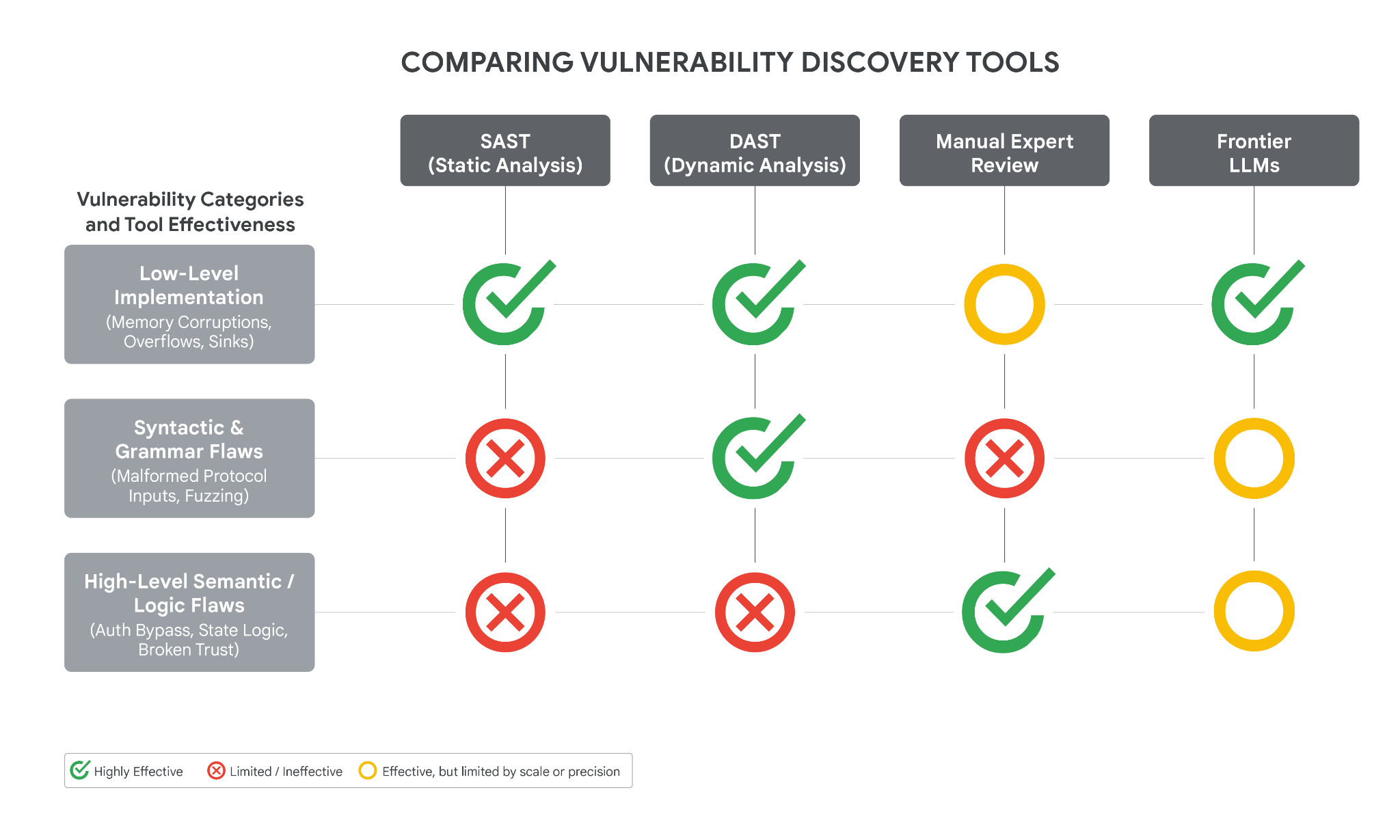
The vulnerability in this case was not a memory corruption bug or a familiar input validation mistake. Google describes it as a 2FA bypass in a popular open-source, web-based system administration tool. More specifically, it was a higher-level semantic flaw rooted in a hardcoded trust assumption: under certain conditions, the application did not require additional authentication. Traditional fuzzers and static analyzers are good at finding crashes, sinks, tainted input, unsafe calls, and other implementation-level patterns. Logic flaws like this require a reviewer to read both what developers intended and what the code actually permits as an exception.
LLMs fit into that middle layer. They are not perfect, and hallucination remains a real risk. But they are already useful at reading large codebases, summarizing comments and control flow, and pointing out where authentication boundaries appear to soften. GTIG says the Python exploit script contained unusually instructional docstrings, a hallucinated CVSS score, textbook-style Python structure, detailed help text, and a clean ANSI color class that looked characteristic of model-generated training patterns. That is not courtroom-level proof. It is threat-intelligence reasoning. It is also specific enough that security teams should not dismiss it.
This Is Not Just One Vulnerability, but a Shift in Attack Production
The GTIG report is broader than one zero-day. Since its February 2026 report on AI-related threat activity, GTIG says threat actors have been moving generative AI from experimental tooling into industrial-scale attack workflows. Across Mandiant incident response, Gemini-related observations, and GTIG's proactive research, AI is showing up in several parts of the attack lifecycle at once.
The first area is vulnerability research. The report says threat clusters associated with the PRC and DPRK have shown strong interest in AI-assisted vulnerability discovery. Some actors prompted models to act like senior security auditors reviewing embedded devices, then used that setup to analyze TP-Link firmware or OFTP implementations. In another case, GTIG describes actors using a repository of more than 85,000 historical WooYun vulnerability cases as if it were a Claude Code skill plugin, pushing the model to prioritize logic flaws like a seasoned expert.
The second area is exploit validation and automation. GTIG describes APT45 sending thousands of iterative prompts to recursively analyze multiple CVEs and validate proof-of-concept exploits. That does not look like one analyst manually grinding through a long night. It looks closer to putting a model in a loop, narrowing candidate issues mechanically, and using test environments to raise confidence in payload behavior. The report also discusses activity around agentic tools such as OpenClaw and OneClaw, combined with intentionally vulnerable test environments, to improve exploit reliability.
The third area is autonomous malware. GTIG's PROMPTSPY analysis is especially uncomfortable. PROMPTSPY, an Android backdoor first identified by ESET, used the Gemini API to interpret Android UI state. It serialized the accessibility tree into an XML-like representation, asked the model what to click or swipe next, and expected structured JSON in return. GTIG assesses that the module was designed for more than one persistence action and could extend into multiple forms of device interaction. In other words, malware is not only executing remote commands. It is beginning to read screen state and choose the next action like an agent.
The fourth area is industrialized model access. Attackers need accounts, payments, API keys, and quota to use premium models. GTIG observed anti-detect browsers, account pooling, relay services, automated signup and cancellation scripts, and OpenAI-compatible proxies used to anonymize and scale premium LLM access. That goes beyond banning individual abuse accounts. Attackers are trying to procure model usage like supply chain capacity, distribute quota, and avoid safety monitoring.
| Attack stage | Traditional automation | What AI changes |
|---|---|---|
| Vulnerability discovery | Fuzzers, SAST, and dependency scanners | Reads intent and exceptions to find semantic logic flaws |
| PoC construction | Experts manually adjust exploit conditions and environments | Iterative prompts and test setups quickly validate candidates |
| Operational automation | Scripts and C2-driven execution | Reads UI or system state, then generates the next action |
| Access procurement | Individual API keys and stolen accounts | Account pools, relays, and proxies scale LLM usage |
Why the 2FA Bypass Signal Matters
At first glance, "2FA bypass" can sound familiar. Security teams have dealt with phishing proxies, session cookie theft, SIM swapping, push bombing, OAuth consent abuse, and many other ways to route around second factors. This case is different. Google is not emphasizing social engineering that tricks a user into surrendering a code. It is emphasizing an exception in the application's own authentication logic.
That distinction matters directly to development teams. Many products do not contain their authentication boundary in one file or one middleware layer. Admin exceptions, migration paths, legacy APIs, service accounts, internal callbacks, password resets, remembered-device flows, and recovery flows all pile up over time. A single exception can look reasonable in isolation and become a bypass path at the system level. Human reviewers need product context to see it. Scanners often lack that context. LLMs still do not have perfect product understanding, but they are increasingly useful at reading multiple files and proposing a candidate like: "This route is the only place where the second factor is missing."
Google's Figure 3 visualizes that difference. Traditional discovery mechanisms are strongest at lower-level implementation defects. Frontier LLMs are still not reliable at navigating complex enterprise authorization logic end to end, but their ability to spot contradictions between hardcoded exceptions and developer intent is growing. The new threat-model question is simple: can an attacker ask a model to explain the logical exceptions in our code?
Defenders Gain the Same Speed, but Organizations Remain Slow
One useful detail in Google's report is that it also highlights defensive AI. Google points to AI agents such as Big Sleep for software vulnerability discovery and to Gemini reasoning capabilities in automated repair workflows such as CodeMender. This is not a story where only attackers get AI. Defenders also gain faster triage, patch suggestion, exploitability analysis, and incident summarization.
The problem is the rest of the organization. Even if a model finds a vulnerability quickly, a patch still has to land in a release branch, customers still have to upgrade, operations teams still have to schedule maintenance windows, and security teams still have to approve exceptions. AI compresses analysis time. The risk often explodes in the deployment delay that follows. As the time required to read a patch diff and produce an exploit candidate shrinks, a culture of "we can upgrade this quarter" becomes harder to defend.
This also reopens the debate around the familiar 90-day disclosure practice. That does not mean 90 days is always too slow. Vulnerability disclosure balances vendor coordination, user protection, patch quality, and researcher rights. But if AI-assisted exploit generation becomes normal, the interval between public disclosure and exploit spread gets shorter. Security teams should prioritize patches based on exploit automation potential, not only public dates. Authentication bypasses, admin consoles, internet-facing management tools, and CI/CD credential boundaries deserve more scrutiny than a raw CVSS score can provide. A practical question is whether a model can understand and reproduce the issue quickly.
AI Product Teams Should Read This as a Supply Chain Warning
The second half of the GTIG report does not treat AI only as an attack tool. It treats the AI software ecosystem itself as an attack surface. OpenClaw skill packages, wrapper libraries, API connectors, third-party data connectors, PyPI packages, and GitHub Actions compromises all appear in the report. The core point is that attackers do not always need to compromise the model. Owning the execution layer, delegated-permission layer, or tool connection layer can be enough.
That message is especially important for teams building AI agents. Agents usually ask for more authority than ordinary SaaS features. They read files, run commands, edit repositories, control browsers, and reach into internal documents or ticket systems. That authority creates productivity. It also means one malicious skill, one vulnerable connector, or one unvetted MCP server can open a user's environment to an attacker.
GTIG notes that VirusTotal researchers reported malicious or vulnerable skill package risks in the OpenClaw ecosystem, and that OpenClaw integrated VirusTotal Code Insight-based automated scanning into ClawHub. That direction should apply to other agent marketplaces too. Installable agent components need the security bar of npm packages and VS Code extensions, and arguably a higher one. Many of them run close to credentials, local files, shells, and browser sessions immediately after installation.
What Development Teams Should Change Now
This story can easily dissolve into a broad security narrative, but it points to several practical habits teams can change.
First, defenders should use LLM-assisted review on authentication and authorization boundaries before attackers do. That should not mean asking a model to "find vulnerabilities" and trusting the answer. A more useful pattern is to have the model map recovery flows, remembered devices, admin bypasses, service-to-service callbacks, migration flags, feature flags, and legacy routes, then produce a list of exceptions for human review. The goal is not automated verdicts. The goal is to increase the number of semantic candidates a reviewer sees.
Second, teams should stop treating a clean scanner result as proof of logic safety. SAST and DAST are still necessary. Dependency scanners are still necessary. But this case lives in the category of code that trusts something differently than the product actually should. Hardcoded trust lists, internal IP exceptions, localhost exceptions, debug modes, tenant isolation rules, and admin impersonation code all need review with product context.
Third, agent components should be managed like packages. Skills, plugins, MCP servers, connectors, and workflow templates need provenance, permission manifests, network behavior review, secret-access boundaries, and update policies. This applies to personal developer tools too. A local coding agent should leave an audit trail showing which skill it read, which command it ran, and which repository secret or browser session it could reach.
Fourth, incident response playbooks need to include LLM accounts and relay infrastructure. If attackers procure model access through API aggregators, account pools, and automated trial abuse, defenders need more than IP blocking. They need to inspect usage patterns, prompt volume, account lifecycle, proxy endpoints, and suspicious automation signals together. For AI service providers, abuse detection is not a peripheral policy function. It is core product-security telemetry.
Do Not Exaggerate It, but Do Not Move Slowly
This incident should not be exaggerated. Google did not name the affected tool and did not identify which model was used. Judging that code looks LLM-assisted can be strong circumstantial evidence, but it is not complete proof by itself. It also does not mean AI has suddenly replaced skilled exploit developers. The attack still required a valid account first, and Google says coordinated counter-discovery and vendor disclosure stopped mass exploitation.
Underestimating it would also be a mistake. In security, important changes often arrive not as a brand-new capability but as a reduction in the cost of an existing one. Phishing followed that pattern. Ransomware operations followed it. Supply chain attacks followed it. Even if AI cannot solve every stage of vulnerability research, it can raise attacker throughput by generating more candidates, refining PoCs faster, interpreting error messages, and driving test environments.
Many recent devlery stories about agent runtimes, control planes, sandboxes, and coding-agent competition have looked at AI through a productivity lens. GTIG's report is the darker side of the same curve. If coding agents can read code faster and produce useful changes, attack agents can read weak boundaries faster too. That is why enterprises adopting AI agents keep circling back to governance, observability, approval, and sandboxing.
The New Security Question Is What AI Can Read
Security reviews are going to ask a slightly different set of questions. Not only "does this code pass our scanners?" but "when this code is explained to a model, what bypass path does it summarize?" Not only "is this plugin in an official marketplace?" but "what rogue action could an agent take with this plugin's permissions?" Not only "is this vulnerability still under embargo?" but "once it becomes public, how long would it take AI to produce an exploit candidate?"
GTIG's report is less a declaration that one era has ended than a warning that the unit of observation in security operations is changing. Vulnerabilities are no longer discovered only between human researchers and automated scanners. Malware is no longer limited to static payloads and remote commands. AI components are no longer just application features. They are becoming operational layers with execution rights, data access, and decision boundaries.
It is too early to say the age of AI zero-days has fully arrived. It is safer, however, to assume the age of AI-shortened zero-day timelines has already begun. The defender's job is not panic. It is speed: find faster, fix faster, split permissions more strictly, and treat agent ecosystems as software supply chains. That is the practical conclusion from Google's report, and it is clear enough to act on now.