Copilot LTS model makes coding agents enterprise infrastructure
GitHub Copilot has moved GPT-5.3-Codex to the default model for Business and Enterprise. The bigger story is not speed, but lifecycle, billing, and governance.
- What happened: GitHub Copilot Business and Enterprise now use
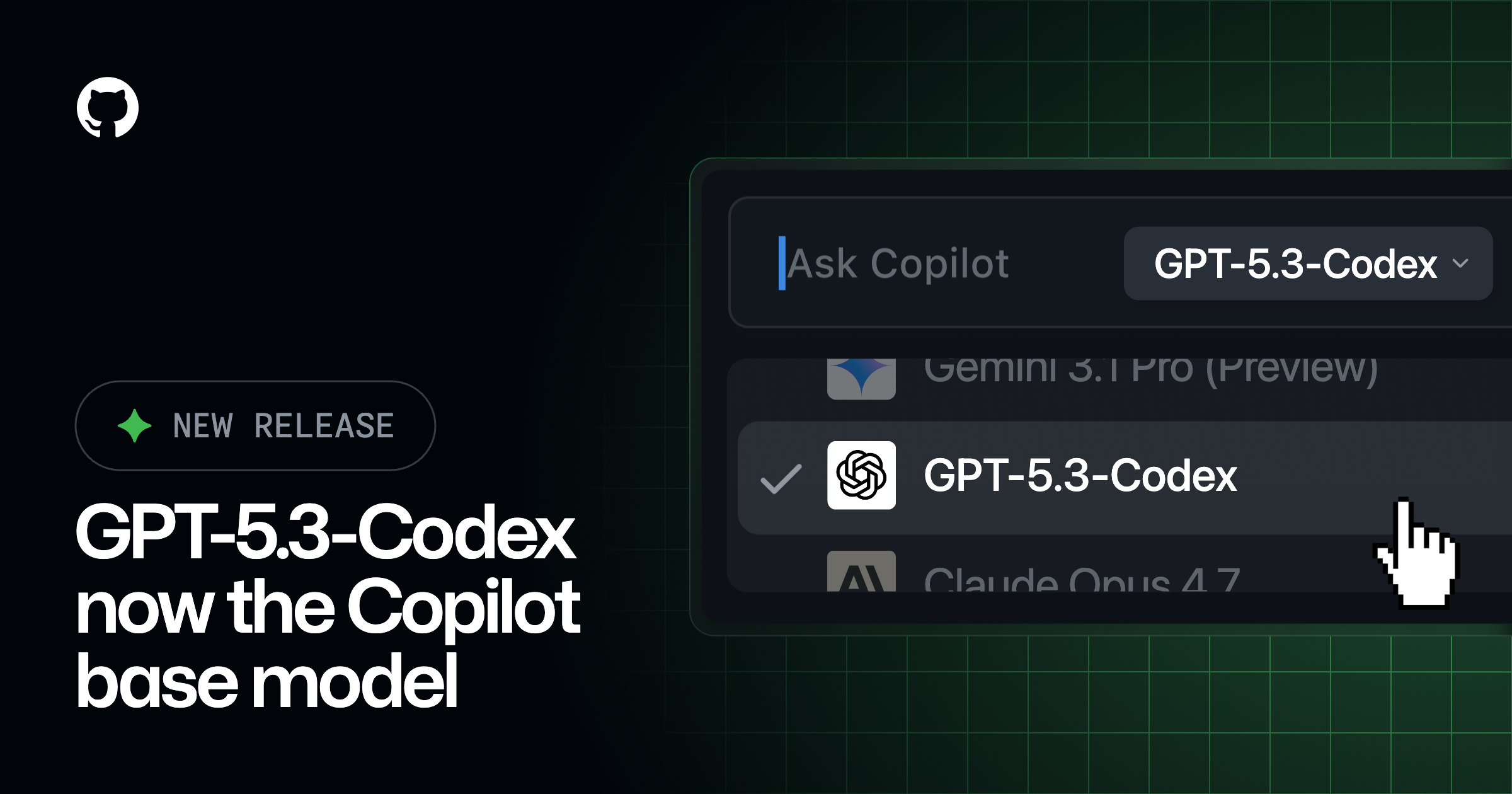
GPT-5.3-Codexas the default base model.- The switch took effect on May 17, 2026. Individual Pro, Pro+, and Free plans are not part of this default-model change.
- Why it matters: GPT-5.3-Codex is Copilot's first long-term support model, available to enterprise plans through February 4, 2027.
- That turns model choice into an operations question: lifecycle, security review, extension upgrades, billing units, and fallback behavior.
- Builder impact: Teams should track
premium requests, model allowlists, and their own code survival metrics instead of treating the default model as a pure benchmark upgrade. - Watch: GitHub mentions strong code survival signals, but it has not published the measurement window, denominator, or comparison data.
GitHub switched the default base model for Copilot Business and Copilot Enterprise to GPT-5.3-Codex on May 17, 2026. At first glance, this looks like a standard model upgrade: the default moves from GPT-4.1 to a coding-specialized Codex model. But the announcement is more interesting when you read the operational terms around it: base model, long-term support, premium request multiplier, and usage-based billing.
The core story is not simply that Copilot received a stronger model. It is that enterprise AI coding tools are starting to look like managed software infrastructure. Which model is the default? How long will that model remain available? Can a security team finish its review before the model disappears? How are requests counted? What happens when quota is exhausted? Those questions now sit next to benchmark scores in the buying and rollout discussion.
Why "base model" matters
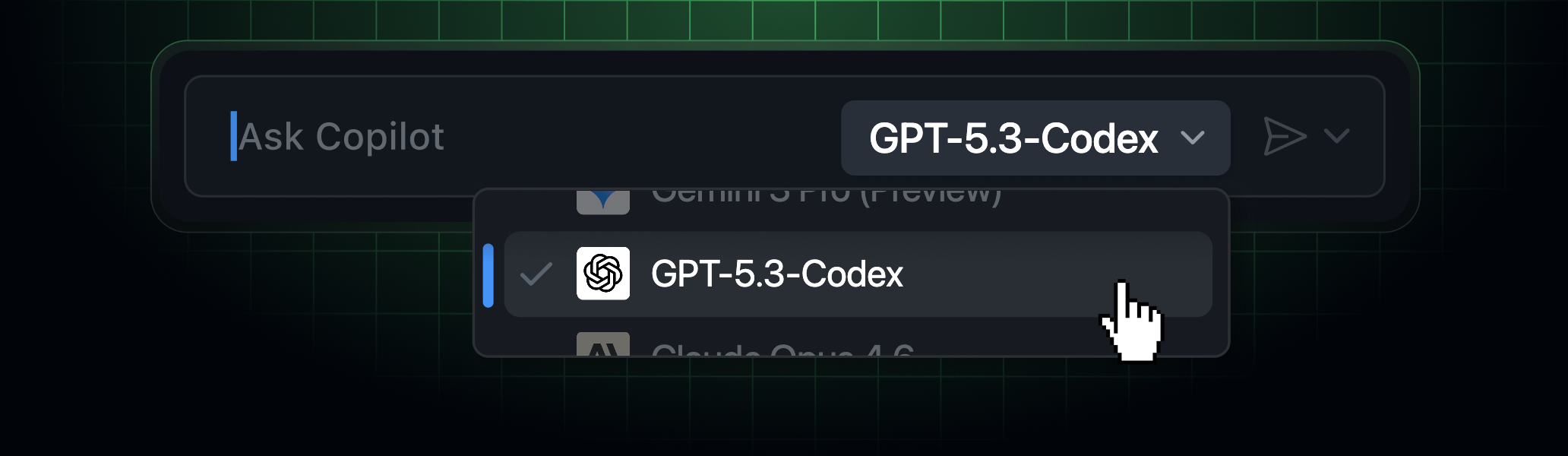
In GitHub's terminology, the base model is the AI model Copilot uses when an organization has not enabled or selected another model. For an individual developer, this can feel like a model picker default. For an enterprise, it is a governance decision. Copilot Business and Enterprise administrators need to decide which models are allowed, which IDE extension versions are required, how internal policy exceptions are handled, and what their security review actually covers.
GitHub's base and LTS model documentation describes this as a 60-day operational process. A new base model was designated on March 18, 2026. Customers then had 60 days to upgrade to IDE extensions that support the new model. On Day 60, the new model became automatically enabled as the default for Business and Enterprise accounts. The May 17 change is that enablement date.
That process says a lot about the maturity of the category. AI models are no longer invisible backend components that can be swapped quietly. Coding models influence pull requests, security fixes, test generation, code review behavior, internal API usage, and the shape of developer assistance across an organization. When a model changes, the suggestion style, tool-use pattern, failure modes, and cost curve can change with it.
Large organizations therefore want more than fast access to the newest model. They also want a predictable migration window. They need time to update extensions, brief developers, refresh allowlists, test internal policy controls, and explain the change to teams that will experience it through editors and automation rather than through an admin console.
The first Copilot LTS model
The most important phrase in the announcement is not "GPT-5.3-Codex." It is "long-term support." GitHub says GPT-5.3-Codex is the first LTS model for GitHub Copilot. The model was launched through GitHub's partnership with OpenAI on February 5, 2026, and GitHub says it will remain available to Copilot Business and Enterprise users until February 4, 2027. GitHub frames that commitment as a way to give companies stability while they run internal security and safety reviews.
In software, LTS is a familiar contract. Node.js, Ubuntu, Kubernetes, Java, and other ecosystems use LTS releases as stable baselines that may not be the absolute newest thing, but are easier to run in production. Enterprises choose them because they can plan around support windows, patch expectations, compatibility, and training material.
That language now belongs to coding-agent models as well. This is a meaningful shift. AI coding tools have mostly been marketed through frontier performance: SWE-bench scores, agentic coding speed, long context, code understanding, and tool-use capability. Those things still matter. But the pain inside large companies is different. If models rotate every few weeks, policy documents, developer guides, security exceptions, audit language, and training material all keep moving.
LTS is a response to that fatigue. It gives organizations a way to trade some novelty for deployment stability. That matters more for coding agents than for plain autocomplete. Agents can edit files, run commands, execute tests, open pull requests, and connect to internal systems or cloud resources. For that kind of workflow, an enterprise cares about how smart the model is, but also about how long the same reviewed model can be operated under the same assumptions.
| Category | This change | Operational meaning |
|---|---|---|
| Plans affected | Copilot Business and Copilot Enterprise | The change ties directly into organization policy and administrator approval flows. |
| Default model | GPT-4.1 replaced by GPT-5.3-Codex | The baseline development experience changes when no alternate model has been approved. |
| Support window | Available through February 4, 2027 | Security reviews, rollout notes, and training material can use a more stable target. |
| Billing unit | 1x premium request multiplier | Model choice is now tied to monthly usage forecasting as well as quality. |
More operations announcement than performance announcement
GPT-5.3-Codex itself was already generally available in GitHub Copilot before this default-model change. In its February general availability announcement, GitHub said the model performed strongly on coding, agentic, and real-world task evaluations, and that it was up to 25% faster than GPT-5.2-Codex in complex, tool-driven long-running workflows. GitHub also listed a broad set of surfaces: chat, ask, edit, and agent modes in Visual Studio Code, GitHub Mobile, Copilot CLI, and Copilot Coding Agent.
That February news was "a new model is available in Copilot." The May news is "that model is now the enterprise operational baseline." The difference is not cosmetic. A model picker option and an organization-wide default carry different responsibility. A developer can experiment with a model and treat failure as a local productivity issue. A default model shapes the daily assistance and automation behavior of hundreds or thousands of developers.
GitHub also says Copilot data showed GPT-5.3-Codex achieving a high code survival rate among enterprise customers. Code survival rate is an interesting direction for measurement because it tries to ask whether AI-generated code remains in the codebase over time. That can be more useful than acceptance rate alone. A completion may be accepted and then deleted a few minutes later. A pull request may be generated but heavily rewritten during review. Surviving code at least signals that the change made it into the team's lasting codebase.
Still, the phrase needs caution. GitHub did not publish the exact number, measurement window, comparison set, language breakdown, customer segment, or post-review definition of survival. It should not be treated like an independent benchmark. A more careful reading is that GitHub saw enough internal signal to make GPT-5.3-Codex the enterprise default. That signal matters, but buyers should still run pilots on their own repositories.
The cost question behind the model question
The billing detail is one reason this announcement landed differently from a normal model launch. GitHub states that GPT-5.3-Codex uses a 1x premium request unit multiplier. It also says GPT-4.1 will remain force-enabled for now with a 0x multiplier, but is planned for deprecation when usage-based billing launches on June 1, 2026.
That combination creates a practical calculation for admins. The default model is more capable, but it consumes premium request units. If a team uses Copilot mainly for inline assistance, the usage curve may be relatively easy to reason about. If a team leans into agent mode, CLI workflows, coding agent tasks, and pull request automation, the curve can move quickly. Agentic tasks often involve file discovery, planning, edits, test runs, retries, and explanations inside what feels to the user like a single instruction.
The community reaction around r/GithubCopilot has focused heavily on this point. Around the March LTS announcement, some users asked whether becoming the base model meant the model would no longer consume premium requests. Others argued that the 1x multiplier and fallback behavior needed to be read as separate concepts. Around the May change, users also pointed to changes in fallback language in the docs. This is not just vague price anxiety. AI coding tool pricing is still less intuitive than a classic SaaS seat. Model multipliers, premium requests, overages, fallback behavior, and plan-level limits all move together.
This also makes the LTS move easier to understand. Enterprises want stability in capability, but they also want stability in cost and policy. "This model remains available for a year" is helpful. "Here is how its usage maps to monthly budget, quota exhaustion, fallback, and overage" is just as important. Once AI coding becomes normal development infrastructure, usage monitoring becomes part of operating the tool.
What it means to move from GPT-4.1 to Codex
There is also a symbolic layer in GPT-4.1 moving behind GPT-5.3-Codex. Copilot is moving from a broadly capable model attached to a coding environment toward a coding-specialized agent model as the enterprise baseline. Early Copilot was mostly about autocomplete. Today, Copilot spans chat, edit, agent workflows, CLI, coding agent tasks, mobile, and web-based control surfaces. Those surfaces reward repository navigation, intent inference, patch generation, test interpretation, and long-horizon task persistence more than generic conversational fluency.
When a coding agent enters the development loop, the model requirements change. It must find old internal APIs, read failing tests, follow local style, avoid risky commands, write pull request summaries, respond to review comments, and interpret CI logs. A model that is excellent at next-line prediction is not automatically excellent at that loop. GitHub making GPT-5.3-Codex the default signals that Copilot's center of gravity is continuing to move from autocomplete toward agentic coding.
That does not mean every team gets better results automatically. Coding-model performance depends heavily on the shape of the repository. Test coverage, monorepo structure, documentation quality, build time, permission boundaries, and review culture all affect outcomes. A strong model can still drift in a slow, poorly documented codebase. A repository with fast tests and clear conventions can expose much more of the upside.
So the model change is not the end of adoption work. It is the start of an operations design problem. Teams need to decide which workflows should use the default model, which ones need a different model, where agent actions are allowed, and what telemetry is needed to judge whether the tool is improving code quality rather than only producing more code.
What development teams should check now
First, check the organization's Copilot model policy. Business and Enterprise administrators should confirm which models are allowed, whether GPT-5.3-Codex is now the effective default, and whether any alternate models have been approved through internal review. A team with a free model picker and a team with a strict allowlist will have very different rollout experiences.
Second, check IDE extension versions. GitHub's 60-day upgrade window exists because clients need to support the new base model. If the organization default changed while part of the developer fleet remains on old extensions, support tickets and inconsistent experiences are likely.
Third, monitor premium request usage. Teams that actively use agent mode and Copilot Coding Agent may see a steeper usage curve than teams that mostly use chat. Quota exhaustion, overage policy, and fallback behavior should be understood before developers encounter a sudden model change during normal work. If Copilot is becoming part of the build-and-review loop, quota and spend should be observable.
Fourth, measure local code survival. GitHub's internal signal is useful, but every codebase is different. Track what percentage of AI-generated changes are merged, how often they are rewritten during review, how often they are reverted, and whether they improve test coverage or simply increase patch volume. That turns model selection from taste into operational data.
Stability becomes a competitive feature
AI coding tools have often been compared by asking which vendor attached the strongest model. That still matters, but enterprise deployment brings a different set of questions to the front. Who commits to model availability? Who explains billing units clearly? Who lets admins govern model access and audit usage? Who gives teams time to upgrade clients before a default changes? Who runs deprecation and fallback policies predictably?
GitHub's GPT-5.3-Codex default-model change puts those questions in the open. LTS is not a flashy feature. It is a boring promise, and boring promises matter when organizations move AI coding tools from experiment to standard development infrastructure. The more coding agents edit files, run tests, and handle longer tasks, the more buyers will ask about stability as often as they ask about raw model performance.
That is why this announcement is broader than a faster Codex model. GitHub is turning Copilot into an operational layer for enterprise software teams. That layer contains defaults, lifecycle promises, billing units, deprecation schedules, fallback behavior, and admin policy. The next phase of AI coding competition will not be fought only on model scorecards. It will also be decided by whether teams can trust a model for a year, budget for its usage, encode it in policy, and verify that it leaves the codebase better than it found it.
Sources
- GitHub Changelog: GPT-5.3-Codex is now the base model for Copilot Business and Enterprise
- GitHub Docs: Base and long-term support (LTS) models
- GitHub Changelog: GPT-5.3-Codex is now generally available for GitHub Copilot
- Reddit r/GithubCopilot: March LTS discussion
- Reddit r/GithubCopilot: May fallback discussion