GitHub Gives Copilot Agents a Secrets Vault
GitHub shipped Agents secrets for Copilot cloud agent, moving private registry and MCP access into organization-level controls.
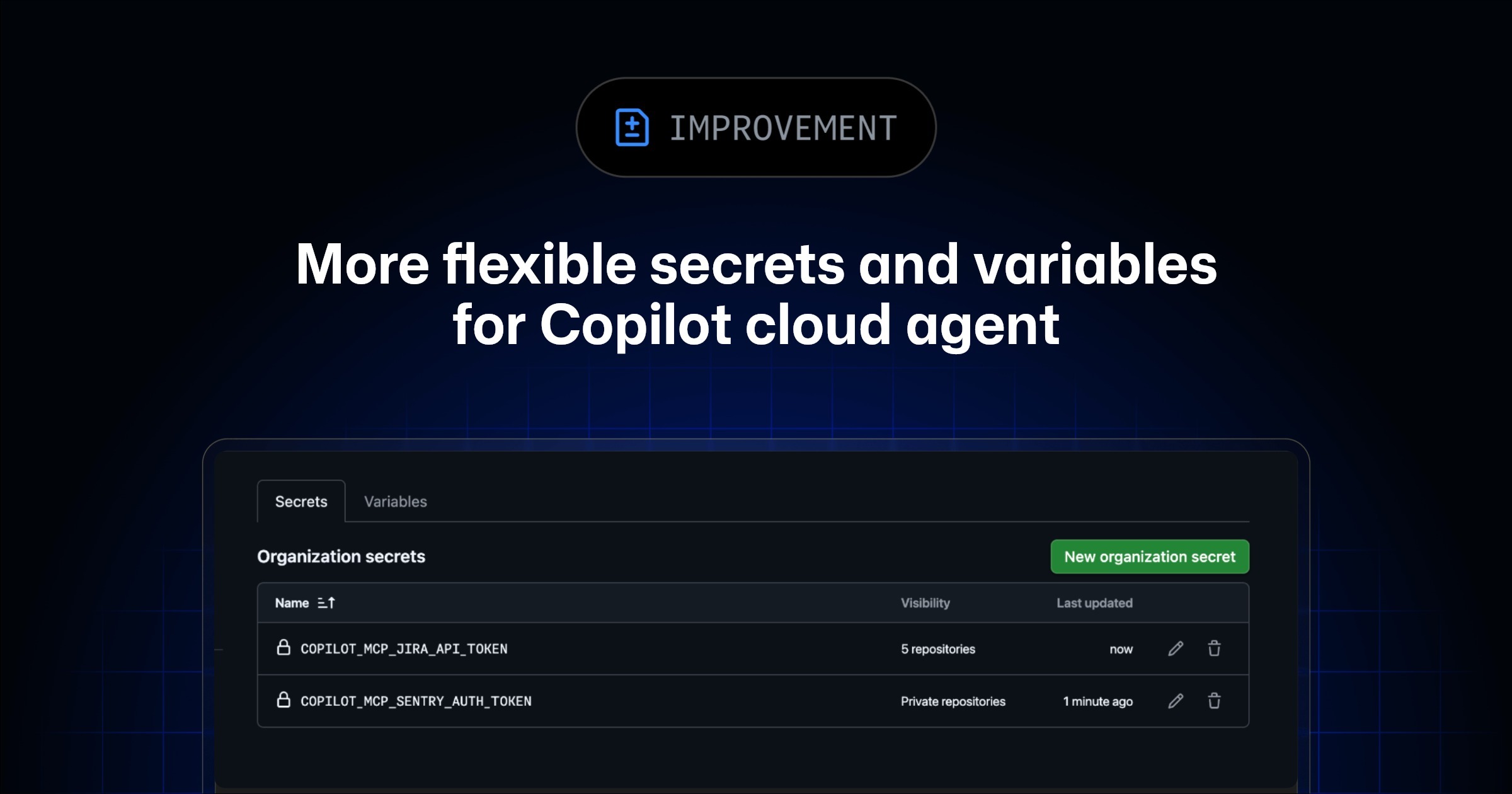
- What happened: GitHub launched
Agentssecrets and variables for Copilot cloud agent.- Organization owners can now create agent-specific secrets once and expose them to all, private/internal, or selected repositories.
- Why it matters: Coding-agent credentials are moving out of generic Actions configuration and into a dedicated operating surface.
- Builder impact: Private package registries, MCP servers, and setup workflow tokens need to be re-scoped for agent runtime use.
- Copilot cloud agent can still touch sensitive systems, so repository access and secret scope should stay narrow.
On May 8, GitHub shipped Agents secrets and variables for Copilot cloud agent. The changelog post reads like a small settings improvement at first glance. Teams no longer need to copy private package registry tokens or shared MCP server configuration into every repository. They can define values at the organization level and decide which repositories receive them.
The more important change is larger than convenience. Coding agents are moving beyond autocomplete inside an IDE. Copilot cloud agent can work in temporary GitHub Actions-backed environments, inspect a repository, run commands, create branches, and connect to MCP servers. In that world, credentials are no longer just a line inside CI configuration. They define what an agent can see, which systems it can reach, and what kind of operational evidence remains after the session ends.
That is why this launch is best read less as "GitHub made secrets easier" and more as "GitHub created a credential boundary for Copilot cloud agent."
The old model repeated credentials per repository
According to GitHub's documentation, teams previously configured secrets or variables for Copilot cloud agent through the copilot environment under each repository's Actions settings. That works for one or two repositories. It becomes operating debt when a company wants Copilot cloud agent available across dozens or hundreds of codebases.
Imagine an internal npm registry token, a private PyPI token, an API key for a company documentation MCP server, and credentials for an artifact store. The agent needs these values to install dependencies and run tests. If every repository carries its own copy, rotations become error-prone, ownership becomes unclear, and the boundary between Actions secrets and agent secrets becomes hard to audit.
The new structure adds Agents as a peer to Actions, Codespaces, and Dependabot in GitHub settings. Values meant for Copilot cloud agent live under that type. Organization owners can create organization-level secrets and expose them to all repositories, private and internal repositories, or only selected repositories. Repository administrators can still create repository-level Agents secrets when a value really belongs to one codebase.
This is a responsibility boundary, not just a UI change. A secret visible to an Actions runner, a Codespaces environment, Dependabot, and Copilot cloud agent can now be labeled and managed separately.
What the COPILOT_MCP prefix reveals
One of the most interesting details is the COPILOT_MCP_ prefix. GitHub Docs says Agents secrets and variables are generally exposed as environment variables in the Copilot cloud agent development environment. Values whose names begin with COPILOT_MCP_, however, are provided only to MCP servers.
That small naming rule captures where agent platforms are going. MCP is no longer an optional add-on. It is becoming one of the primary ways agents reach the outside world. If a coding agent only reads GitHub issues and edits code, token scope is relatively simple. Once it connects to internal docs, Jira, Slack, package registries, observability backends, security scanners, or schema viewers, each integration brings its own credentials.
GitHub is separating MCP-facing credentials from the general agent environment through a naming convention. This is not a perfect isolation model, and it should not be treated as one. Still, it shows the platform beginning to distinguish between the agent process and the tool servers that the agent calls.
| Type | Primary consumer | What changed |
|---|---|---|
| Actions | CI/CD workflows | Existing build and deployment secrets remain in place. |
| Codespaces | Human development environments | Remote developer environments stay separate from agent environments. |
| Dependabot | Dependency update bot | Package update automation keeps its own access model. |
| Agents | Copilot cloud agent and MCP servers | Coding-agent token scope becomes its own management surface. |
A signal that agents are using private resources
GitHub describes Copilot cloud agent as capable of repository research, implementation planning, bug fixes, small feature work, test coverage improvements, documentation updates, technical debt tasks, and merge conflict resolution. The capability list matters, but the execution environment matters more. Copilot cloud agent runs in an ephemeral development environment powered by GitHub Actions. It is not executing on a developer's laptop. It is exploring and running commands inside a remote environment that GitHub creates for the task.
Real enterprise repositories rarely build with public packages alone. They depend on internal packages, private modules, container registries, license servers, mock APIs, schema registries, and staging SDKs. One reason AI coding tools often look smooth in demos but stall inside company codebases is that the model may be capable while the execution environment lacks trusted access. If the agent cannot install private dependencies, it cannot run the same tests a developer would run.
GitHub's new feature attacks that bottleneck. If an organization owner can define a shared secret once and distribute it to the right repositories, a Copilot cloud agent rollout changes from "every team copies tokens into local repository settings" to "the platform team manages agent execution access." That is a decisive difference for larger organizations. Agent productivity does not come only from benchmark scores. It comes from repeatable runtime, permissions, logs, and verification.
Organization-level Agents secret
Repository access: all, private/internal, or selected repositories
Copilot cloud agent ephemeral development environment
Private registry, setup scripts, or MCP server configuration
The security gains and the remaining questions
The improvement is real. First, Copilot cloud agent does not receive Actions, Codespaces, or Dependabot secrets and variables. It receives values stored under the Agents type. Second, secret values are masked in session logs. Third, values that previously lived in the copilot environment are automatically migrated into the new repository-level Agents type. For operations teams, this creates a starting point for reclassifying agent credentials.
It does not remove risk. GitHub's own risks and mitigations documentation says Copilot cloud agent can access code and sensitive information, and that accidental or malicious input could cause leakage. GitHub lists mitigations such as internet access restrictions, hidden character filtering, branch permission limits, human review, session logs, and audit logs. Those are necessary controls. They do not change the core fact that, once an agent receives a secret, it has entered the organization's security boundary.
Prompt injection remains a hard problem. Copilot cloud agent can receive instructions through issues or pull request comments. GitHub describes defenses such as excluding hidden characters in HTML comments from agent input, but the attack surface is broader than that. A README, test fixture, generated file, documentation page, issue template, or external MCP response could carry instructions that attempt to redirect the agent. Masking can prevent a literal secret value from appearing in logs, but indirect leakage through a system the secret unlocks needs separate control.
So the message is not "agents are safe now, give them broader access." The better reading is "the platform now lets teams divide access more carefully, so they should actually divide it."
What development teams should check first
The first task is to inspect what was already stored in the old copilot environment. GitHub may migrate those values automatically, but migration does not prove that the values are still appropriate. A wide token added for testing convenience remains a wide token after it moves into the Agents type.
The second task is to minimize repository access for organization-level secrets. Sharing across every repository is convenient, but convenience expands blast radius. A token for a broad internal package registry may reasonably apply to private and internal repositories. A product API key, customer-data fixture token, or staging admin credential should usually be limited to selected repositories.
The third task is to separate MCP server credentials by name and purpose. Values intended for MCP servers should use the COPILOT_MCP_ prefix so they are distinguishable from general agent runtime variables. This does not solve every security concern, but it gives auditors and platform teams a cleaner inventory of what each kind of agent integration can use.
The fourth task is to make logs and audit trails part of the operating procedure. GitHub describes Copilot cloud agent commit authorship, co-authorship, signed commits, session logs, and audit log events. Having logs is not the same as reviewing them. Teams still need rules for when an agent used secrets, when it called MCP servers, and when an attempted validation failed.
Why this is more than a small feature
AI coding-tool competition is often described through model quality, context windows, SWE-bench scores, and the number of agents a tool can run in parallel. Those are important signals. But organizational adoption turns on drier questions. Can the agent install our private packages? If it can, where does the token come from? Which repositories can see that token? Which secrets reach MCP servers? Can we investigate what the agent did after the fact?
GitHub's Agents secrets launch is a platform-level answer to those questions. It is not a flashy model demo. It is one of the basic pieces required when coding agents move from lab experiments to organizational operations. Agents now receive permissions more like software identities. Those permissions are distributed by policy, and the resulting work leaves audit evidence.
The launch also suggests that GitHub does not see Copilot cloud agent as a single Copilot feature bolted onto the side of the product. GitHub's cloud agent documentation sits near custom instructions, MCP servers, custom agents, hooks, skills, and Copilot Memory. That looks less like a single coding bot and more like an agent runtime embedded in GitHub. Runtimes need boring infrastructure: secret management, access control, audit logs, firewalls, validation, and usage metrics.
For developers and platform teams, this announcement is worth more than a quick checkbox. If your organization already uses Copilot cloud agent or is evaluating it, the question is no longer just whether the agent can receive secrets. The real question is which secrets it should receive, through which scope, and under what review process.
When that boundary is poorly designed, a coding agent becomes another invisible automation account with broad access and unclear ownership. When the boundary is designed well, agents can install private dependencies, read necessary internal context through MCP servers, and still stay separate from Actions secrets and human development environments. The next stage of model competition will not be decided only by smarter answers. It will increasingly be decided by who can let agents work safely inside real software organizations.