Gemini Spark Tests the Permission Model for Personal Agents
Gemini Spark turns Google apps into a 24/7 personal agent, making permissions, approvals, and auditability the real product test.
- What happened: Google introduced
Gemini Sparkas a 24/7 personal AI agent.- It is built around Gemini 3.5 and the Antigravity harness, and it can keep working in the cloud after a laptop is closed or a phone is locked.
- The shift: Gemini is moving from an answer box toward an execution layer for Gmail, Docs, Slides, and connected apps.
- Why it matters: email sending, payments, and local browser automation are less about model benchmarks than permission, approval, and audit.
- Google says Spark will ask before high-stakes actions, but the real UX and policy boundaries still need to be proven in beta.
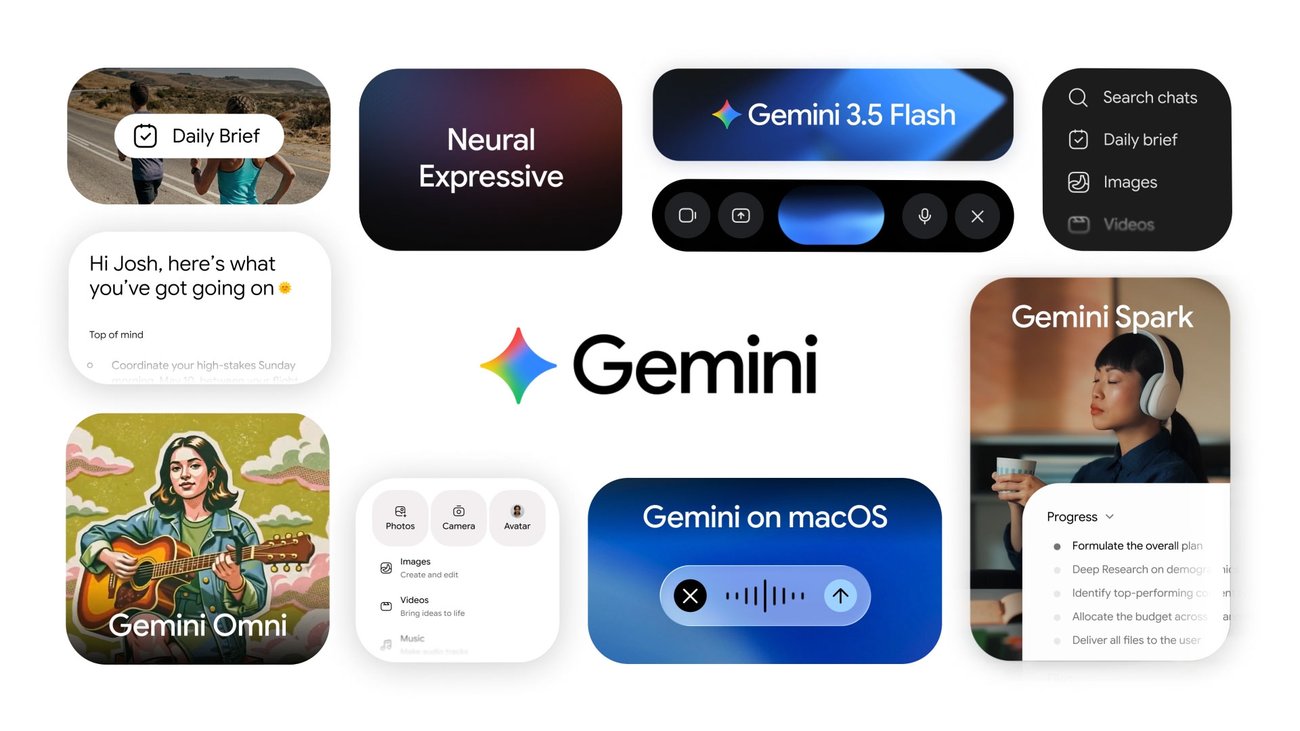
Google I/O 2026 brought a dense stack of AI announcements: Gemini 3.5 Flash, Gemini Omni, Google Pics, Antigravity 2.0, Search information agents, and Gemini Intelligence across Android. In that crowd, Gemini Spark can look like a consumer feature inside the Gemini app. For AI developers and product teams, though, it raises a harder question. If an AI assistant keeps working after the user closes the app, which permissions should it actually have?
Google's official announcement describes Spark as a "24/7 personal AI agent." It is based on Gemini 3.5 and the Antigravity harness, and it is deeply connected to Workspace tools such as Gmail, Docs, and Slides. The important part comes next: Spark is a cloud-based agent, so it can continue in the background when the user's laptop is closed or the phone is locked. That is not just a better mobile notification. It is a different operating model for personal AI, where work follows delegated goals and permissions rather than the user's active screen time.
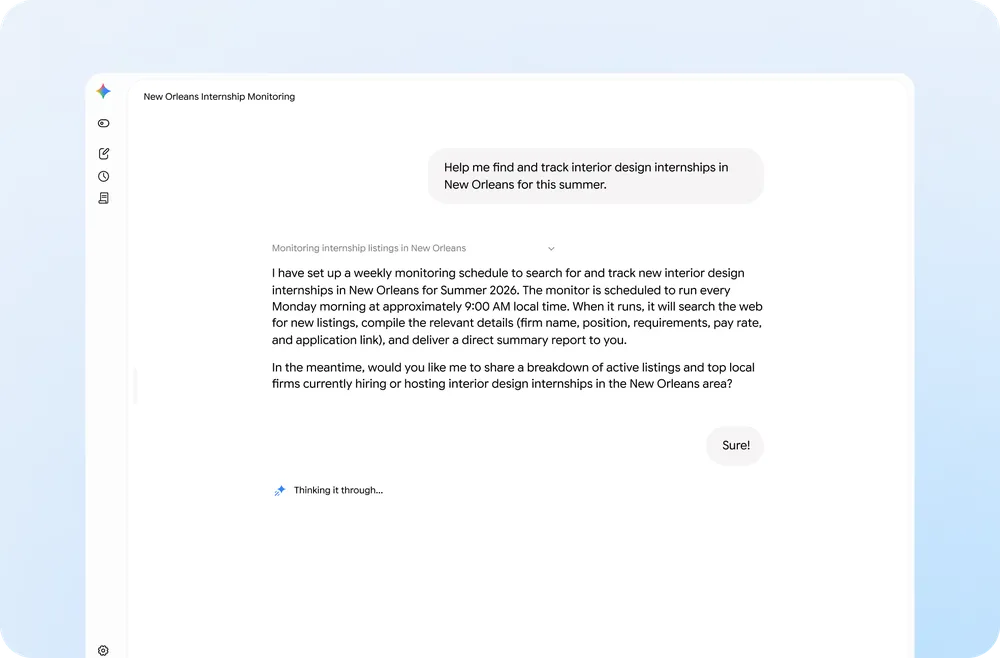
Google's examples are deliberately ordinary. Spark can scan monthly credit-card statements to find new or hidden subscriptions. It can watch school emails, extract important deadlines, and send a daily digest to the user and their partner. It can merge meeting notes scattered across email and chat into a Google Docs brief, then prepare a project kickoff email draft. Each task sounds familiar if you have used automation tools or personal assistant apps. The difference is that these tasks sit on top of the Gemini app, Workspace, Google Cloud, the Antigravity harness, and MCP connections as one product surface.
From answer app to execution partner
The default scene for personal AI assistants has been the chat box. A user asks a question, the model responds, and the user copies the useful pieces into another app. Spark points in a different direction. Gemini is supposed to understand the user's Gmail, Calendar, and Docs, produce artifacts directly, suggest next actions, and in some cases take action.
This ties directly to Google's Gemini 3.5 Flash positioning. In the Gemini 3.5 announcement, Google presents 3.5 Flash as a model designed for agentic workflows and coding. The company cites scores such as 76.2% on Terminal-Bench 2.1, 1656 Elo on GDPval-AA, 83.6% on MCP Atlas, and 84.2% on CharXiv Reasoning. It also says the Antigravity harness can coordinate collaborative subagents over long-running tasks. Spark takes that technical stance and moves it onto consumer and workplace surfaces. A coding agent reads a repository and runs tests; a personal agent reads inboxes, documents, and calendars, then prepares the next step.
The developer lesson is not simply that Gemini is getting smarter. Spark is closer to a permission product than a model product. Which apps can be connected? Which data can be read but not changed? Which contexts allow writing? When should the agent stop before sending email, approving a payment, adding a calendar event, or driving a local browser? The quality of a personal agent is not decided by reasoning scores alone. Intermediate approval, cancellation, logs, retries, failure recovery, spending limits, and data retention are all part of the product.
| Layer | What Spark changes | Product question to validate |
|---|---|---|
| Model | Long-running agentic workflows based on Gemini 3.5 | Does planning and context hold over extended execution? |
| Harness | Antigravity harness and subagent patterns | Are task decomposition, state, and recovery explainable? |
| Connections | Workspace, connected apps, and MCP partner connections | Can read and write permissions be separated per connection? |
| Approval | Confirmation before high-stakes actions | When should money, email, scheduling, and sharing stop for review? |
Google's advantage is the work surface
Spark is interesting not only because Google can reach personal data. More precisely, Google already owns a large share of the user's work surface. Gmail is where commitments, receipts, reservations, customer questions, school notices, and work threads arrive. Docs and Slides are where output gets produced. Calendar is the timeline for action. Android and Chrome are where users actually move through their day. A useful personal agent needs to cross those surfaces.
Automation platforms have been solving pieces of this problem for years. Zapier, Make, IFTTT, and RPA tools connect apps through triggers and actions. Most of those systems are still built around explicit rules and connectors. Spark's difference is that it packages natural-language goals, personal context, app connections, and cloud background execution in one product language. A user says, "Summarize school emails every day," and the agent must decide which messages matter, who should receive the digest, which deadlines are important, and which phrases should not be copied verbatim. At that point, automation is no longer just workflow configuration. It becomes judgment and responsibility.
Google's Workspace announcement frames Spark as part of a move from an assistant that answers questions toward an agent that acts on the user's behalf. That is marketing language, but it is also a precise product definition. If an answer is wrong, the user can often stop before pasting it somewhere else. Action is different. A wrong email, payment approval, calendar change, or document share can be hard to undo. The core UX for personal agents is therefore not the most polished demo. It is knowing when to pause.
What MCP partner connections open up
Google mentioned Canva, OpenTable, and Instacart MCP connections in the Spark roadmap. Today that is closer to a connection announcement than a fully demonstrated operating loop, but the direction matters. MCP spread first through developer and agent-tooling ecosystems as a way to expose files, APIs, SaaS systems, databases, and internal tools to models. Its appearance inside a consumer Gemini feature means the agent tool layer is moving beyond developer tools.
OpenTable and Instacart are especially sensitive. Restaurant booking touches schedule, preference, location, and sometimes social context. Grocery shopping touches payment, delivery addresses, household composition, dietary habits, and budget. Canva touches creative output, brand assets, and sharing permissions. These connections make Spark useful, but they also sharpen the question: what is a personal agent allowed to know, and what is it allowed to do?
Google's list of 100 I/O announcements goes further. It says Spark will eventually let users text or email it directly, create custom subagents, and authorize payments by budget and merchant. That is a natural roadmap for a personal AI product, but it is also a strong signal for security and trust. Payment is not just another tool call. It needs budget boundaries, merchant restrictions, item checks, refund handling, fraud detection, user confirmation, and audit history. If a personal agent can "buy groceries for me," the hard problem is not just choosing good items. It is defining the purchase authority clearly enough that users can trust it.
24-hour execution is an operating model
Spark's cloud-based design deserves its own attention. Many personal AI tools run only while the app is open. Close the browser tab, and the work stops. Put a laptop to sleep, and the work stops. Spark is positioned the other way: the cloud agent keeps working after the device is gone. That is convenient for users, but it raises the bar for product operations.
First, the system needs state management. A user should be able to see which goal was delegated, how far the agent got, and what evidence it is waiting on before the next action. Second, the system needs an approval queue. If the agent reaches a payment or email step while the user is asleep, the user should understand in the morning what they are being asked to approve. Third, it needs failure recovery. If Gmail search fails, an MCP connection hits a rate limit, or Docs editing runs into a permission problem, the agent should not fail silently. It should leave a recoverable state. Fourth, it needs cost and usage visibility. Once a personal agent runs around the clock, users need to know not only how many questions they asked but which tasks ran, how long they ran, and what they consumed.
In that sense, Spark resembles the coding-agent market. Codex, Claude Code, Cursor, and GitHub Copilot's coding agent all bring long-running work, diffs, approval, background execution, and remote control into the center of the product. Spark moves the same grammar into personal life and Workspace work. The difference is that code-agent output usually lands in a pull request. Personal-agent output spreads into email, schedules, payments, documents, reservations, and browser sessions. The blast radius is wider and more subtle.
The community's real concern is authority
At the time the Korean source was prepared, large independent Hacker News or GeekNews threads were not easy to find. Reactions were scattered across Reddit and technology coverage. Supportive responses treat Spark as Google finally attaching personal AI to real work surfaces. For people who live in Gmail and Workspace every day, an AI that continuously organizes incoming work may be more useful than an AI that answers one prompt at a time.
Skeptical responses focus on permissions and data. Ars Technica argued that if usefulness is high enough, users' comfort levels may shift, but many people will still feel uneasy about feeding a cloud AI model so much personal data. Some Reddit reactions pointed in the same direction: the UX and permission model may decide whether a 24/7 background agent feels helpful or invasive. This is not a generic privacy objection. It is a structural tension. A useful personal agent needs broad access, and broad access makes mistakes more expensive.
Google is aware of that tension. The official announcement says users choose whether to enable Spark, choose which apps to connect, and get prompted before high-stakes actions such as spending money or sending email. That direction is sensible. The hard part is implementing it. "High stakes" is easy to define in obvious cases such as email sending or payment. The edge cases are harder. Is drafting a sensitive email high stakes? What about placing a tentative calendar hold? Sharing restaurant options? Writing a message draft to a friend? Personal-agent safety will be decided by these boundary cases more than by policy copy.
Practical questions for builders
Spark is still an early product. Google says it will go first to trusted testers, with a beta planned for U.S. Google AI Ultra subscribers. That makes it too early to declare success or failure. The useful move for developers and AI product teams is to extract the design questions.
First, how granular should connection permissions be? Reading, drafting, sending, paying, booking, deleting, and externally sharing are all different authorities. Second, what evidence should a user see before approval? If the agent cannot show which email, document, or prior instruction led to a proposal, approval becomes a formality. Third, what can be rolled back after a mistake? A document draft can be reverted. A sent email or payment is harder. Fourth, how should a long-running agent explain its logs and cost in human language? "Task complete" is weaker than "here is what I read, what I created, and where I stopped for you."
The real Spark news is not that Google added another Gemini feature. Google is trying to turn the personal AI assistant into a background worker. That worker knows Google apps, can use external MCP connections, keeps state while the user is away, and may eventually handle local browser use and payment authorization. If this direction works, personal AI stops being a chat window and becomes a personal operations layer.
That also clarifies the next competitive front. The winner will not simply be the company with the flashiest agent demo. It will be the company that can divide data and authority in a way users understand, pause naturally before costly actions, and make long-running work inspectable. Spark's test is not only Gemini intelligence. It is whether personal AI can earn a permission model that users are willing to live with after they close the laptop.