The 65% IDE-Optional Era, and the Operations War for Coding Agents
Gartner’s 65% forecast signals that AI coding agent competition is moving from IDE experience to governance, pricing, verification, and execution platforms.
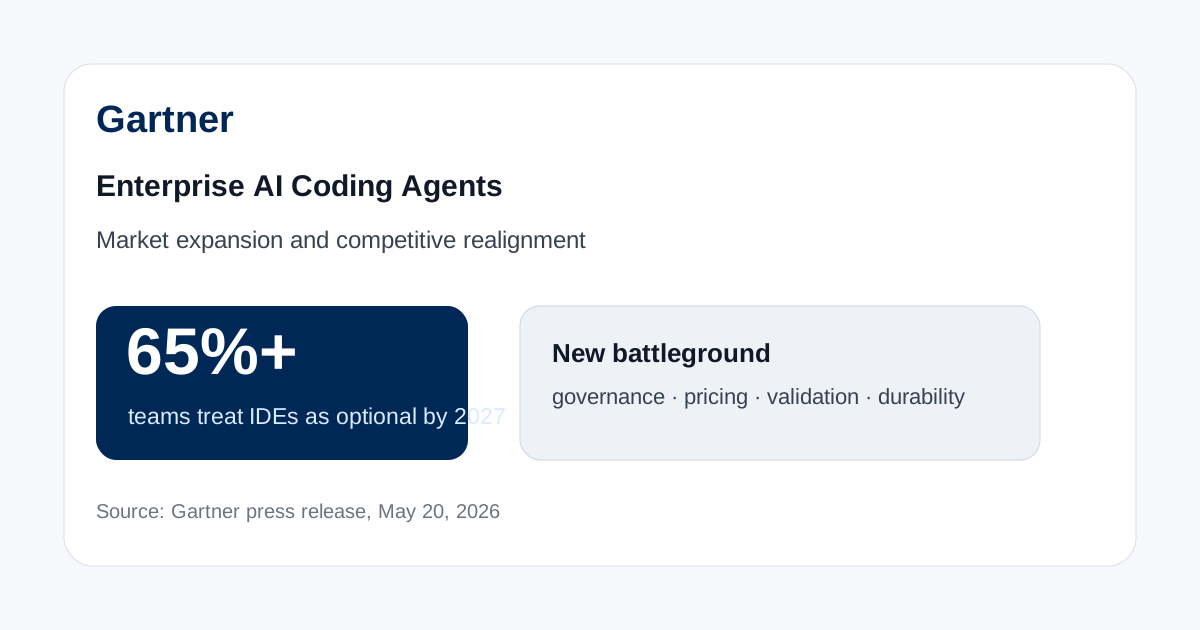
- What happened: Gartner says the enterprise
AI coding agentsmarket has entered a new phase of expansion and competitive realignment.- The headline forecast: by 2027, more than 65% of engineering teams using agentic coding will treat the IDE as an optional surface.
- Why it matters: The center of competition is shifting from model quality and IDE UX toward governance, pricing, support, workflow control, and verification.
- Watch: Teams should evaluate who controls execution, auditability, permissions, and cost, not only which agent writes the best code.
Gartner’s May 20, 2026 announcement is short, but it changes the frame for reading the coding agent market. Gartner says the enterprise AI coding agent market has entered a new phase of “expansion and competitive realignment.” The most important line is the number: by 2027, Gartner expects more than 65% of engineering teams using agentic coding to treat the IDE as an optional surface, while control, governance, and verification move into automation platforms.
Reading that as “the IDE is dead” would be too blunt. Developers will still read files, inspect diffs, narrow test failures, and leave review comments. The IDE is more likely to become one of several surfaces than to disappear. The deeper change is that the center of work is moving from the code editing screen to the agent execution layer. Once an agent takes on long-running work, calls multiple tools, touches repositories and cloud accounts, and pushes into PRs or deployment pipelines, the enterprise question changes. It is no longer only “which editor feels best?” It becomes “who can turn this automation into a controllable work system?”
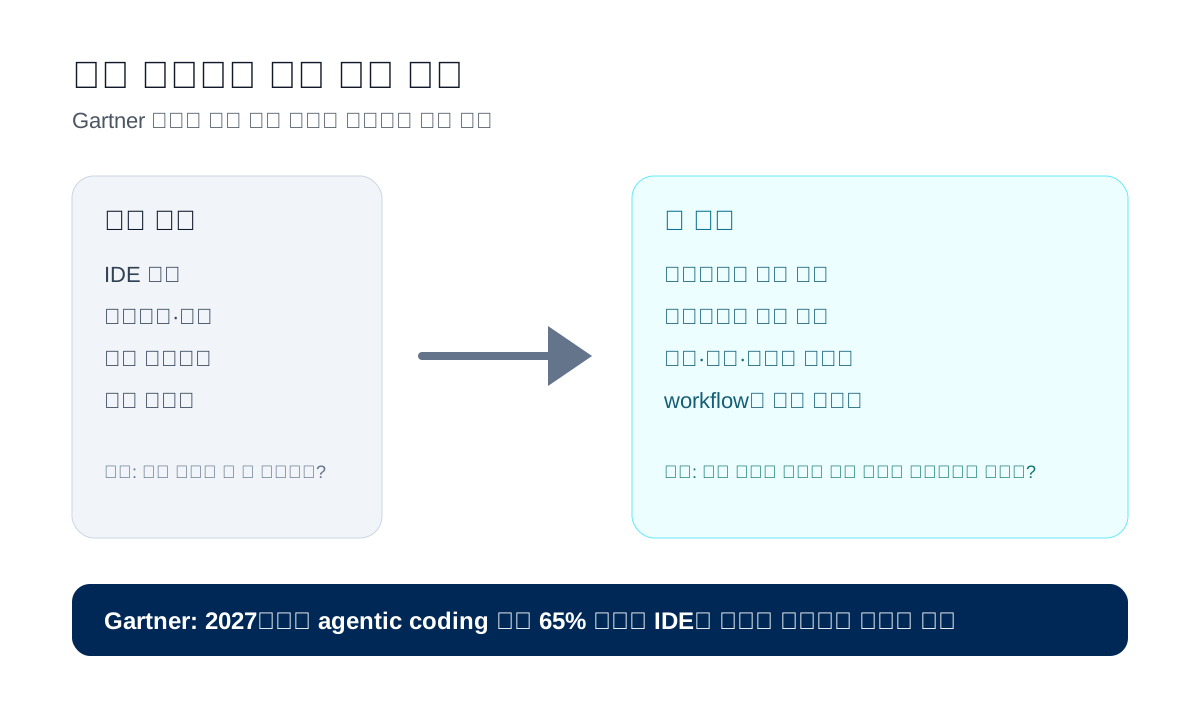
Gartner compresses that transition into a market thesis. AI coding agents are expanding across the software development lifecycle, including planning, creating, and reviewing code. That is different from autocomplete or chat-based coding help. When a user asks for a small function, IDE integration and model response quality matter most. When a user asks an agent to clean up an authentication flow, fix the related tests, and check deployment impact, the problem becomes execution management.
The Competition After Magical Developer Experience
One interesting part of Gartner’s language is what comes after “magical developer experience.” The announcement says competition is moving toward operational excellence, commercial maturity, and enterprise readiness. Developer experience and model capability still matter, but they are no longer enough. At enterprise scale, buyers also evaluate governance, pricing, support, workflows, commercial maturity, and market durability.
That shift matches recent product announcements. Google announced Managed Agents in the Gemini API on May 19, 2026. The pitch is that a single API call can spin up an Antigravity agent in an isolated Linux environment, where it can handle reasoning, tool use, code execution, file management, and web browsing. Google also describes agent definitions in Markdown files such as AGENTS.md and SKILL.md, registered as versionable files. That is a signal that an agent’s instructions and working style are becoming part of the repository, subject to review and deployment like other operational artifacts.
AWS is moving in a similar direction. Its May 6 announcement for Agent Toolkit for AWS targets a familiar enterprise problem: agents fail when they rely on stale cloud knowledge or stumble through complex multi-service workflows. AWS highlights more than 40 skills, a fully managed MCP server, IAM guardrails, CloudWatch and CloudTrail observability, and sandboxed code execution. The product story is not simply “let an agent use the AWS console.” It is “define boundaries, logs, and procedures for what happens when an agent touches AWS.”
UiPath’s May 12 announcement points the same way. UiPath for Coding Agents connects coding agents such as Claude Code and OpenAI Codex into a business orchestration and automation platform, with policy enforcement, audit trails, credential vaults, role-based access control, and runtime controls. The notable part is that UiPath is not assuming one coding agent wins every department. It imagines one team using Claude Code, another using Codex, and the enterprise still needing a shared orchestration and audit layer. In that view, models and agents can change. The longer-lived layer is the system that governs, routes, and records their work.
What IDE-Optional Really Means
An optional IDE does not mean developer experience becomes irrelevant. It means the IDE alone is unlikely to carry the whole workload. Early AI coding tools shined inside the editor. Completion, code explanation, function generation, and test writing all fit a file-centered UI. Agentic development is harder to describe with file tabs alone.
Agents break down a problem. They create branches, install dependencies, run commands, read failure logs, edit other files, and run tests again. Sometimes they search external documentation, provision cloud resources, inspect CI status, or answer review comments. That looks less like an editor session and more like a workflow run. The future surface is likely to be a mix of IDE, CLI, browser dashboard, mobile approval, PR comments, issue trackers, and automation platforms.
Gartner’s 65% forecast is pointing at that surface fragmentation. As teams rely more on agents, the human is not always sitting in the editor. A developer queues work, checks interim output, approves risky tool calls, reviews the resulting diff, and restarts failed sessions. The IDE remains a convenient place for some of that work, but it stops being the only control room.
Operations Is Harder Than the Model
For the past year, the coding agent market has moved quickly around model and product names: Claude Code, OpenAI Codex, Cursor, GitHub Copilot, Google Antigravity, Gemini CLI, xAI Grok Build. Each promises longer tasks, better diffs, more tools, and broader integrations. But once models become good enough to be useful, enterprise adoption exposes a different set of questions.
The first question is permissions. Which files can the agent read or write? Which shell commands can it run? Can it reach cloud accounts or production secrets? After a session ends, how is access revoked? If the agent creates subtasks, do those subtasks inherit the same authority?
The second question is auditability. Who made the request? Which tool calls did the agent execute? Which files and APIs did it touch? Why did a failed run fail? Can logs separate human-approved changes from automated agent behavior? In regulated industries, those questions often arrive before productivity claims.
The third question is cost. Agents can spend tokens faster than humans expect. Autocomplete is a series of short calls. Agentic work involves long context, repeated execution, test logs, documentation search, and retries. If subscription pricing does not match that usage pattern, rate limits and credit tiers appear, and teams must decide which work deserves the expensive model.
The fourth question is verification. An agent saying “done” and a task actually being done are different states. Did tests pass? Did type checking run? Did the agent miss files that require migration? Did it violate a security policy? Is the resulting change small enough to review? The most important feature in an agent operations platform may not be generation. It may be completion criteria and evidence management.
How to Read Gartner’s Forecast
Gartner-style forecasts always need careful handling. “65% by 2027” is a market signal, not a calendar that applies uniformly to every engineering team. Small teams and individual developers may still move fastest through IDE and CLI experiences. Regulated industries, large platform groups, and cloud infrastructure teams may demand a platform-style control layer much sooner.
Community reaction to this category is also mixed. In discussions around enterprise agents, developers often say demos have become easy while production deployment remains hard. If a team cannot track who approved a tool call, which credential was used, or what the agent actually touched, the project stalls once security teams ask basic questions. At the same time, skepticism toward Gartner’s framing is fair. “Agentic AI” can be used to repackage older automation and workflow products, and that critique still matters.
The useful part of Gartner’s announcement is not the number alone. It is the evaluation framework. When choosing a coding agent, teams now need sharper questions. Does the tool understand repository rules? Where does execution happen? Can a failed session be reproduced? Are logs retained? Can access to sensitive files be blocked? If the model changes, do workflow and audit controls remain intact? Are usage limits and costs predictable?
Coding Agents Become Work Systems
Early coding assistants were tools that made an individual developer’s hands faster. Current coding agents are becoming part of the engineering team’s work system. That difference is substantial. A tool that speeds up a person can be evaluated through preference and productivity. A work system is evaluated through permissioning, accountability, cost, failure handling, auditability, and long-term maintainability.
Google’s isolated Linux environment for Managed Agents, AWS Agent Toolkit’s IAM guardrails and CloudTrail observability, and UiPath’s credential vault and RBAC all come from different product strategies, but they point in the same direction. If agents are going to do real work inside enterprise environments, model calls are not enough. They need execution boundaries, tool catalogs, verification loops, policy engines, logs, and cost controls.
From that perspective, the IDE is no longer the whole product. The IDE is one entry point where a person invokes an agent. The CLI is an entry point for automation and local iteration. A browser dashboard is a surface for tracking multiple sessions. PRs and issues become surfaces for review and accountability. Cloud sandboxes become execution surfaces. Mobile becomes a surface for approval and monitoring. The coding agent market is moving toward a competition over who can connect those surfaces naturally and safely.
What Development Teams Should Check Now
This news does not require every team to change tools tomorrow. But it does clarify what an enterprise pilot should test.
First, do not treat agent usage as a single personal experiment. Divide it by work type. Documentation edits, test expansion, bug reproduction, infrastructure changes, and security fixes carry different risks. Each category should have different allowed tool calls, approval conditions, verification commands, and review expectations.
Second, treat agent artifacts with the same seriousness as code. AGENTS.md, SKILL.md, workflow prompts, and policy files are not casual settings. They define how agents behave inside an organization. They need history, review, and ownership.
Third, do not collapse vendor selection into a single model score. The strongest model today may not stay ahead next year. Permission models, audit logs, cost structure, workflow integrations, and support practices tend to live longer inside an organization. That is where Gartner’s emphasis on commercial maturity and market durability becomes concrete.
Procurement will likely change too. Older coding assistants often spread when a few developers tried them, compared satisfaction, and expanded seats. Coding agents pull in more stakeholders. Security teams ask about permissions and secret access. Platform teams inspect execution environments and network boundaries. Finance teams examine usage predictability and overage structure. Legal and compliance teams ask about log retention, data processing regions, and model training use. Even a great developer experience cannot carry a large rollout if these answers are weak.
That also raises the bar for vendors. “Our agent is smarter” is no longer enough. Products need to express which tasks can be auto-approved, which require a human checkpoint, and which should never run. Failed sessions must be investigable after the fact. Enterprises remember explanations for failed work longer than successful demos.
Gartner’s 65% forecast is bold. But the direction is already visible across recent product announcements. Coding agents are moving from intelligent features inside IDEs into an operations layer for software work. The next phase of competition will not end at who writes code most naturally. The larger fight is over who can run long-lived agent work safely, predict cost, verify outcomes, and fit the result into an organization’s accountability system.