Dust Raises $40M as Enterprise AI Hits a Teamwork Bottleneck
Dust’s Series B is a signal that enterprise AI is moving from personal chatbots toward shared workspaces where people and agents operate together.
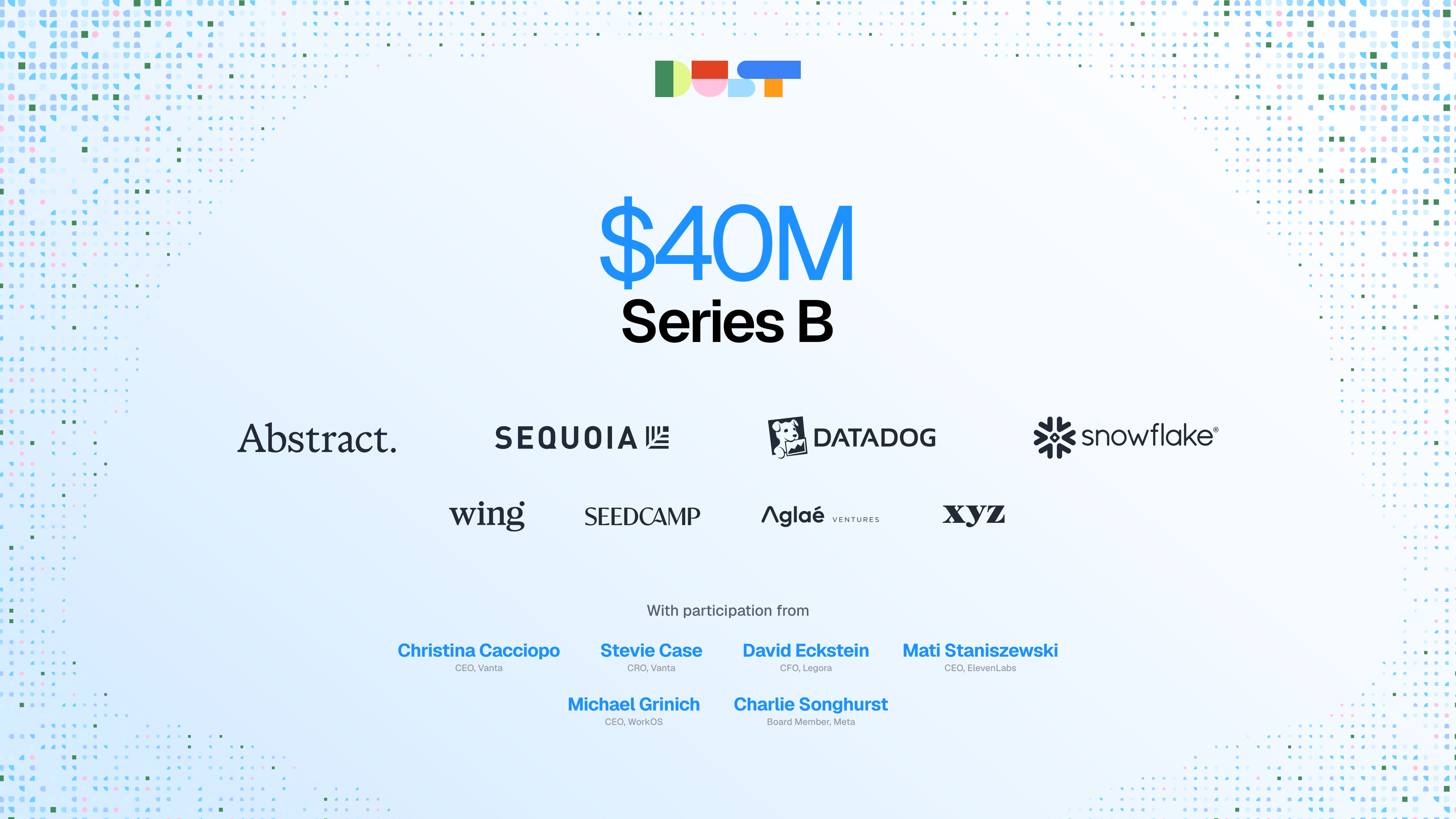
- What happened: Dust announced a $40 million Series B and put “multiplayer AI” at the center of the story.
- The announcement landed on May 18, 2026, with participation from Abstract, Sequoia, Snowflake Ventures, and Datadog.
- Key numbers: Dust says it is used by more than 3,000 organizations and has more than 300,000 deployed agents.
- Why it matters: The enterprise AI bottleneck is shifting from individual productivity to shared context, permissions, approvals, audit trails, and cost control.
- Dust frames its context layer as a hybrid of
semantic searchandMCPconnections.
- Dust frames its context layer as a hybrid of
- Watch: Funding and agent counts show traction, but real autonomy and business impact still depend on each customer’s operating model.
Dust announced a $40 million Series B on May 18, 2026. The round included Abstract, Sequoia, Snowflake Ventures, and Datadog. At first glance, this can read like another “AI company raises growth capital” headline. The more interesting part is the phrase Dust keeps repeating around the announcement: multiplayer AI.
Dust’s version of multiplayer AI is not a single employee handing tasks to a private chatbot. It is a structure where several people and several agents work in parallel inside the same team context, with access to the same data, tools, and approval flow. Dust says it is now used by more than 3,000 organizations and that users have deployed more than 300,000 agents. Those numbers matter because once agents multiply inside a company, the bottleneck is no longer only generation quality. It becomes coordination.
For the last two years, enterprise AI adoption has often meant giving every employee an AI assistant. ChatGPT Enterprise, Claude, Gemini, Copilot, and similar tools can speed up individual tasks: drafting email, researching an account, building a presentation, fixing SQL, summarizing meetings, or preparing a customer note. But real organizational work rarely ends with one person. Customer onboarding, product launches, security reviews, sales proposals, hiring, incident response, and finance processes all move through handoffs, reviews, approvals, and shared status.
The Next Bottleneck After Personal AI
Dust describes this as the limit of single-player AI. If each employee has a separate agent, individual tasks get faster. A sales rep can research an account sooner. A marketer can draft a campaign brief faster. A support lead can summarize a queue with less manual work. But if the next person cannot inherit the same context, team productivity only improves in fragments. A sales engineer may research the same customer again the next day. A content lead may write from a different brief. Sales enablement may build a battlecard from yet another source of truth. The speed created by AI leaks out through the gaps between people.
That is the useful signal in this funding news. The enterprise AI question is moving from “can AI perform this task?” to “when several people and several agents work at once, who knows what, who approved what, and what state is the work in?” Model capability still matters. But the operating bottlenecks are shared context, permissions, progress visibility, cost attribution, audit logs, and handoff quality. A chatbot can produce an answer. Team work needs state.
That is why Dust uses the multiplayer framing. In the announcement, the company points to shared workspaces, a context layer, self-improvement, and observability and governance. These do not look as glamorous as a new frontier model feature. But they are the layers that determine whether AI becomes a real operating system for company work or remains an opaque execution surface. If a company cannot see which data an agent accessed, which tool it called, where costs were incurred, or where a human approved an action, AI stops being a productivity layer and becomes a risk layer.
Dust’s Shared Workspace Bet
Dust’s product direction is broader than “a chatbot connected to company knowledge.” The announcement describes persistent shared workspaces organized around teams, initiatives, and workflows. Agents do not merely answer inside isolated chat windows. They work alongside people with access to prior work, team tools, and a shared operating context. That distinction matters because enterprise context is not a temporary attachment to a prompt. It is an operational asset that has to be maintained over time.
Consider customer onboarding. Sales knows the history of the deal. Solutions engineering knows the technical requirements. Customer success tracks success criteria and risk signals. Finance checks billing terms. Legal reviews contract exceptions. Add AI agents to that process and more parallel work becomes possible: summarizing customer logs, preparing Slack updates, checking HubSpot status, updating Notion pages, finding Google Drive materials, and suggesting follow-up actions. But if all of that work happens in separate personal chatbots, the organization has to spend time reconciling the outputs.
Dust’s answer is the shared workspace. If people and agents operate in the same context, research created by one agent can be picked up by another agent or by a human teammate. The unit of productivity changes from “one employee moved faster” to “the team’s work advanced faster.” We are already seeing a similar shift in coding agents. A useful coding agent is not judged only by whether it can edit files. It also has to understand branches, tests, review, CI, and pull request state. Enterprise work agents need the same kind of surrounding system: knowledge, tools, approvals, and logs.
A Context Layer Is More Than RAG
Another important phrase in Dust’s announcement is context layer. The company argues that many products can connect to external systems, but connection is not the same as understanding. Dust says it uses a hybrid approach for enterprise knowledge: semantic search for durable context understanding and higher-quality synthesis, plus MCP connections for simpler queries and actions across tools.
That structure captures where enterprise AI infrastructure is heading. In 2023 and 2024, many enterprise AI projects were compressed into the term RAG. Put documents in a vector database, retrieve relevant chunks, pass them to a model, and generate an answer. That is useful, but real work does not stop at document retrieval. Teams need recent Slack decisions, CRM state, warehouse metrics, Jira progress, external email context, and old decks in Google Drive. Some of that should be searched. Some should be read through APIs. Some should be changed only after explicit approval.
MCP is part of the push to standardize this action surface. That is why Dust’s pairing of semantic search and MCP connections is notable. The search layer answers “what does the agent need to know?” Tool connections answer “what can the agent do?” As enterprise AI moves from answer assistants to work agents, those layers cannot be governed separately. If a model summarizes a customer account, drafts a follow-up email, updates a CRM field, and calls a teammate in Slack, search and execution need to sit inside the same permission and audit model.
This also connects to Anthropic’s acquisition of Stainless. Anthropic was investing in the layer that helps agents use external APIs reliably, including API and MCP server generation. Dust is working one layer higher, targeting the way internal teams operate across many tools and many agents. Below the surface are SDKs, APIs, and MCP connectors. Above it are team coordination and operational visibility. Both point in the same direction: agent value is created inside connected work systems, not by the model alone.
Governance Is Not an Add-On
One of the less flashy but most important parts of Dust’s announcement is observability and governance. Dust points to granular permissions, cost and usage monitoring, a full audit trail, and agent analytics in one place. It also highlights SOC 2 Type II, GDPR compliance, EU and US data residency, and a policy of not training models on customer data. These can look like routine enterprise checklist items. In multiplayer AI, they are core product functions.
A personal chatbot can fail within a relatively narrow surface area. One employee receives a bad summary or rewrites a draft. A team-level agent can affect the state of multiple systems. It can generate flawed customer communication, propagate a wrong data interpretation, reference documents outside the intended boundary, burn unexpected model spend, or take an action that was never approved. As the agent count rises, observability becomes a control plane, not a nice-to-have.
Cost monitoring is especially concrete in 2026 enterprise AI. Agents usually consume more tokens than one-shot questions. They call tools, summarize intermediate results, recover from failed paths, and run again. The cost of one employee asking a chatbot a question is not the same as the cost of a department operating hundreds of agents. If usage and spend cannot be attributed by team, workflow, and agent, AI operations can quickly become shadow IT.
Auditability follows the same logic. Companies need to see not just the final answer, but the path behind it: which data informed the output, which tools were called, which human approved the action, and where the result was written back. This is not only a regulated-industry problem. Sales, support, HR, finance, data analysis, and operations all face the same question once AI starts moving real work.
How to Read the 300,000-Agent Number
Dust’s claim of more than 300,000 deployed agents is a strong traction signal. It is also a number worth reading carefully. The word “agent” is extremely broad across the AI market. Some agents are long-running workers with tools, permissions, and operational state. Others are closer to assistants wrapped around a prompt and a knowledge source. So the number of deployed agents should not be treated as a direct measure of fully autonomous business execution.
Still, the number points to a real structural change. Inside companies, agents are moving beyond a small experimental set and becoming something teams create in volume. Dust’s announcement says Persona has deployed more than 300 Dust agents across 11 departments, which is a useful example of the pattern. Once agents multiply by department, a central AI team cannot handcraft every prompt and workflow. Business users need to create, adjust, and operate agents for their own work. Dust’s “AI Operator” framing sits exactly at that point.
This shift matters for developers and platform teams. If enterprise AI is treated as “a feature that calls a model API,” teams will miss the registry, permissioning, evaluation, logging, cost attribution, and incident response that become necessary when agents spread through an organization. But if a central platform team controls every workflow too tightly, business teams lose speed. Dust is targeting that tension: let frontline teams create agents quickly, while the organization can still observe and govern the work.
The Race Toward an Enterprise AI Operating Layer
Dust overlaps with enterprise knowledge and workspace AI products such as Glean, Sana, Notion AI, and Atlassian Rovo. It also meets automation and governance platforms such as Microsoft Copilot Studio, Salesforce Agentforce, ServiceNow AI Control Tower, Zapier Agents, and Workato. The difference is the starting point. Some companies began with search and knowledge. Some began inside systems of record such as CRM or ITSM. Others began with iPaaS and workflow automation. Dust is putting shared AI workspaces and frontline agent operations at the center.
In this competition, the model itself becomes a more replaceable component. The durable difference is which work data can be connected safely, how easily business users can build agents, how naturally approvals and audits fit into the workflow, and how teams operate cost and quality over time. Enterprises do not only want to buy a model. More precisely, they want a system where organizational knowledge, permissions, workflows, and logs survive even as the model layer changes.
It is also notable that Dust names Snowflake Ventures and Datadog among the round’s participants. Snowflake sits close to enterprise data. Datadog is strongly associated with operational observability. That does not prove future product integration. But it does fit the message. Multiplayer AI cannot work through knowledge search alone. It has to span data systems and operational systems.
The Questions Builders Should Ask Now
This news should not be reduced to whether a team should use Dust. The more useful question is whether an organization’s AI deployment is still stuck in single-player mode. If employees are each using chatbots but the outputs do not become shared team knowledge, productivity remains individual. If agent output does not connect to approval, review, audit, and follow-up action, humans still have to stitch the workflow together by hand.
Development and platform teams should ask a few practical questions. Is internal knowledge searchable? Do search results respect permissions? Who approves the tools an agent can call? Can cost be viewed by team and workflow? Are agent decisions and execution logs retained? When an MCP server or internal API tool is added, are side effects and permission boundaries reviewed? If business users can create agents, how are quality and security managed?
These questions are more operational than an AI strategy deck, and that is the point. Models will keep changing. Today a workflow may use Claude, tomorrow Gemini, and next month a different model. But the organization’s work context and permission model are much harder to replace. Sustainable enterprise AI advantage is therefore less about one model call and more about an operating layer where people and agents share work state, use tools safely, and leave a traceable path.
Dust’s $40 million Series B is not just growth-capital news. It shows the bottleneck enterprises hit after personal AI becomes widely available. The ability to write, summarize, and suggest code is now common. The harder problem is what happens when many people and many agents work together: preserving the same context, executing with the right permissions, and recording who decided what. That is the real meaning of Dust’s multiplayer AI framing. The next enterprise AI battleground is not only how smart a model is on its own, but how well a whole team can collaborate with AI.