Docusign Agent Studio turns contracts into an execution layer
Docusign unveiled an Iris-powered AI assistant, agents, Agent Studio, and an MCP beta. The bigger shift is contracts moving from signed PDFs into enterprise workflow execution.
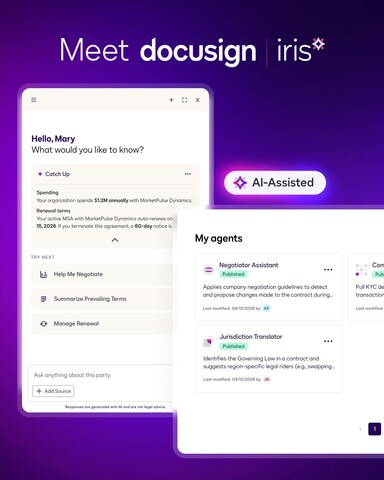
- What happened: Docusign introduced an
Iris-powered AI assistant, agreement agents,Agent Studio, and an MCP beta.- As of the May 21, 2026 Momentum announcement, the assistant, agents, and Agent Studio are in U.S. early access, with a U.S. rollout planned for July.
- Why it matters: The contract is moving from a signed PDF into a business execution layer that can drive approvals, risk checks, renewals, and CRM updates.
- Builder angle: Docusign MCP creates a path for frontier models such as Claude, Gemini, and ChatGPT to handle agreement data as a tool surface.
- Watch: Contract agents are useful automation, but they also require permission boundaries, audit logs, human oversight, and a clear cost model.
Docusign, long treated as shorthand for electronic signatures, is now talking less about the signature itself and more about the work that surrounds it. At its Momentum conference on May 21, 2026, the company announced an Iris-powered AI assistant, agreement agents, Agent Studio, and an MCP beta. In Docusign's framing, the goal is to move agreements from static records into systems that guide business decisions and move work forward.
That can sound like standard enterprise AI language. What makes the announcement worth watching is that Docusign described a concrete product boundary rather than only a chatbot layer. Its agents can review agreements against company standards, suggest revisions, route approvals, and track obligations and risk in the background. Agent Studio is positioned as a workspace for building custom agents around each organization's deal, renewal, approval, or legal process. MCP is the connection layer that lets external models such as Anthropic Claude, Google Gemini, and OpenAI ChatGPT work with Docusign agreement data and actions.
The real question is no longer whether AI can summarize a contract. That question is already dated. The more important question is whether a contract can become an operational object that actually moves sales, HR, legal, procurement, and finance systems. And if it can, whether outside agents and internal workflows can call that object safely.
Where does Docusign go after e-signature?
Docusign helped make electronic signatures mainstream. But the signature itself is increasingly becoming a feature rather than a standalone destination. PDF tools, document management systems, CRMs, HR platforms, and collaboration suites all absorb signing flows. Users do not necessarily want to "go to Docusign" as a separate ritual. They want the contract, approval, and status update to happen inside Salesforce, Microsoft, Workday, SAP, Slack, or whichever system already owns the work.
That is why Docusign's push into Intelligent Agreement Management, or IAM, is not surprising. A signing button alone does not explain the bottleneck in contract work. Agreements move through drafting, review, approval, negotiation, signing, storage, renewal, obligation tracking, and audit. In many companies, that flow is scattered across email, PDFs, CRM fields, spreadsheets, legal systems, HR systems, and procurement tools.
Docusign's official announcement describes the problem as agreement data being trapped inside static documents. That phrase is the center of the story. To an AI agent, a document is not just a file. Clauses, obligations, exceptions, dates, prices, approval terms, renewal conditions, and liability language can all become inputs to tool calls. Once agreements are structured, permissioned, and wired to system events, an agent can move beyond "summarize this contract" toward "check whether this contract conflicts with company policy, route the required approval, and update the renewal stage in the CRM."
This is not only a Docusign story. Salesforce is turning CRM records into an Agentforce work surface. ServiceNow is turning tickets and workflows into agent execution surfaces. Notion is extending documents and databases into agent workspaces. Google and Microsoft are turning search, email, and office documents into default agent contexts. Docusign's distinction is its focus on a high-value document domain: the agreement. Contracts contain numbers, responsibility, legal risk, and approval paths. A bad move is not just a UX issue. It can affect revenue recognition, compliance, hiring, privacy, and supply-chain risk.
The four layers of the announcement
Docusign's announcement has four useful layers.
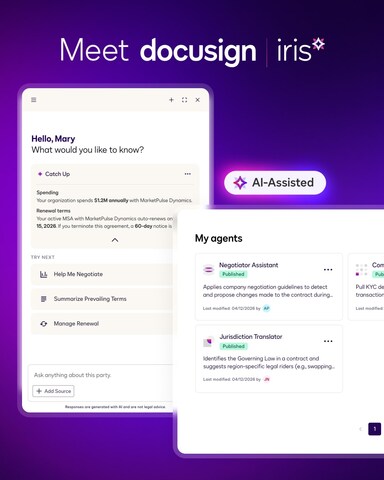
The first is the Iris assistant. Iris is presented as Docusign's agreement AI engine. Users can ask natural-language questions about agreements, find key terms and obligations, and request next actions. The important detail is that the assistant is not limited to Q&A. Docusign says Iris is designed to use tools such as agreement repositories, envelope status, approval creation, notifications, and repository search.
The second layer is agreement agents. According to Docusign, agents can check agreements against company standards, propose revisions, and automatically send the right approval requests. Background agents can monitor agreements for risk, track obligations, and trigger next steps without manual follow-up. In a May 11 announcement aimed at in-house legal teams, Docusign described agents that can recommend next steps based on negotiation history, accepted clauses, and company policy.
The third layer is Agent Studio, which is the most interesting part for developers and AI product teams. Agent Studio is a Docusign workspace for creating and testing custom agreement agents. Every organization has a different contract flow. One company may struggle with discount approval thresholds. Another may lose time on data processing addenda. Another may repeatedly process HR contracts and I-9 verification. Agent Studio points toward bundling those domain rules into "our company's agreement agent."
The fourth layer is MCP and the external ecosystem. Docusign says MCP will connect its agreement layer to frontier models such as Claude, Gemini, and ChatGPT. It also emphasized integrations with Coupa, Microsoft Copilot, Salesforce, SAP, and Slack, along with legal AI platforms such as Harvey, Legora, and Thomson Reuters CoCounsel. In other words, Docusign is not trying to sell only a single chatbot UI. It is trying to become an agreement platform that external models, work apps, and legal AI tools can call.
| Layer | What Docusign announced | Operational meaning |
|---|---|---|
| AI assistant | Iris handles agreement questions, term search, and action requests | The agreement repository becomes a natural-language work surface, not only a search UI |
| Agents | Review, redlines, approval requests, obligation tracking, and risk flags | Manual follow-up and policy comparison move into workflow automation |
| Agent Studio | Build and deploy organization-specific deal, renewal, and approval agents | Domain rules and approval structures become agent design assets |
| MCP | Connect Docusign to external models such as Claude, Gemini, and ChatGPT | Agreement data becomes available as a tool layer for outside agents |
Why MCP matters in contract work
MCP now appears in almost every agent announcement, which can make the term feel overused. In contract management, however, its role is relatively clear. Agreement data is not something a general-purpose LLM can simply know from training. Access differs by company and user. Versions change. Signing status, approval status, and business context are spread across systems. Reading the text of a contract is not enough. The model must know which agreement is current, who can approve it, which system must be updated, and whether a clause conflicts with company policy.
MCP is part of the attempt to standardize those tool calls. If Docusign MCP matures, a user could ask Claude or ChatGPT to find next-quarter renewals with price increase clauses and notify the relevant account owners. The model would need to search Docusign, inspect the terms, and pass work to a CRM or messaging system. The actual product's capability will depend on permissions, integrations, and tool scope. But the direction is clear: the agreement platform becomes a safe action surface for agents.
This puts Docusign's announcement in line with the broader agent strategies from OpenAI, Anthropic, and Google. Frontier model providers want to sell agents that can do longer-running work. But enterprise agents need permissioned tools from domain systems. Contracts, payments, customer records, HR data, and procurement data cannot be handled through scraping and hope. They need explicit APIs, audit logs, approval policies, and permission models. Docusign MCP is one candidate for the contract domain.
Contract agents are small automation with real risk
TechTarget interpreted the announcement as Docusign moving deeper into markets adjacent to e-signature, where it will compete with Salesforce, Oracle, ServiceNow, Adobe, and contract lifecycle management vendors. The most useful part of that coverage was not the competitive map, but the analyst framing. Alan Pelz-Sharpe of Deep Analysis argued that while some vendors talk about replacing SAP or cutting large teams, real customers often want more grounded automation, such as turning PDFs into fillable forms or reducing repetitive follow-up work.
That captures the realistic starting point for contract agents. The first step is not replacing the legal department. It is reducing small, repetitive, expensive bottlenecks. An agent can check whether an NDA contains terms outside company standards. It can send a reminder 90 days before renewal. It can route contracts that exceed discount thresholds to a manager. It can identify missing fields in HR onboarding paperwork. It can turn a PDF form into an interactive web form. These jobs are less spectacular than AGI demos, but they sit closer to real organizational cost.
Small does not mean safe. Contract agents are risky if permission boundaries are vague. An agent may misread a clause and skip an approval, miss a renewal condition, or expose sensitive contract data to the wrong person. MCP connections add convenience, but they also create a path for external models and tools to access agreement data. Practical adoption therefore starts less with "what can the agent do?" and more with "what must the agent never do alone?"
Human oversight is not a decorative control in contract workflows. It is part of the architecture. Docusign has also emphasized keeping human oversight and control where needed. Material contract changes, legally significant redlines, pricing and liability terms, and privacy-related conditions should be approved by people even if an agent drafts the recommendation. A strong agreement-agent platform should not only raise automation rates. It should let teams define which work is auto-approved and which work is sent into a review queue.
How to read the 30 percent ROI claim
Docusign cited a 2026 Deloitte report to argue that organizations using AI-driven workflows on an end-to-end agreement platform see roughly 30 percent higher ROI than those that do not. That kind of number appears often in launch materials, so it should not be treated as a direct conclusion. ROI depends heavily on industry, company size, process maturity, and baseline tooling. Research involving customers and prospective customers can also overstate the effect of adopting the vendor's own product category.
Still, the number is not meaningless. Contract work has obvious bottlenecks. Repeated review, approval waiting time, duplicate data entry, missed renewals, failed obligation tracking, status checks, and legal-sales handoffs all create cost. If contracts gate revenue, hiring, supply-chain commitments, and partnerships, the ROI logic for automation is straightforward. Value appears when cycle time drops, misses decline, and humans spend more time on expensive judgment rather than routine chasing.
The cost side matters just as much. Someone must build and maintain agents in Agent Studio. Someone must formalize company policy, manage approval matrices, review failures, update prompts, and maintain tool permissions. MCP and external model connections add token cost, log retention, data residency questions, and vendor risk. The economics of contract agents should be judged by whether the whole workflow becomes simpler after policy management and audit cost are included, not only by how many minutes an AI assistant saves.
SaaS platforms are turning domain documents into executable data
If viewed only as a Docusign product update, this announcement may look narrow. Viewed across the 2026 SaaS agent race, it fits a broader pattern. Each SaaS platform is trying to turn its core domain object into something an agent can execute against.
Salesforce's core objects are customers and opportunities. ServiceNow's are tickets and workflows. Notion's are documents and databases. GitHub's are issues, pull requests, and codebases. Docusign's core object is the agreement. Platform competition in the agent era is shifting from "our chatbot is smarter" to "our domain object can be read, judged, changed, and recorded safely."
For Docusign, that shift is both defensive and offensive. Defensively, it must avoid e-signature commoditization. Offensively, it can use agreement data to connect sales, HR, legal, procurement, and finance workflows. If a contract is the most accurate ledger of what a company has agreed to, then the company that makes that ledger usable by agents can sit near the center of workflow automation.
This matters for developers too. When building enterprise agents, "which model is smartest?" will be only one part of the decision. Equally important will be which SaaS platforms provide which MCP servers, permission models, and action surfaces. Attaching a contract agent to internal systems requires more than an API key. It needs role-based access, document-level permissions, clause-level redaction, action approvals, rollback behavior, and audit trails. Those capabilities come from domain platform design, not from the model API alone.
The open questions
The first open question is how much abstraction Agent Studio really provides. Even if non-developers can create agents in natural language, contract workflows have many exceptions. Discount rates, regional laws, customer tiers, standard clause versions, negotiation history, and internal approval policies all become conditions. We need to see whether Agent Studio is closer to a simple workflow builder or to an agent development platform with policy logic and test environments.
The second question is the permission model for the MCP beta. When external Claude, Gemini, or ChatGPT sessions read agreement data and request actions, what tools does Docusign expose and what approvals does it require? Does it delegate the user's own Docusign permissions? Does it use agent-specific service accounts? Can sensitive clauses be masked? How detailed are the tool-call logs?
The third question is the boundary with legal AI partners. Harvey, Legora, and CoCounsel are strong in legal research and document analysis. Docusign is strong in agreement lifecycle, signature, workflow, and repository systems. Connecting the two can be powerful, but responsibility becomes more complex. If a clause interpretation fails, teams must know whether the error came from the legal AI layer, the Docusign workflow, or the customer's own approval policy.
The fourth question is cost. Docusign did not fully explain the long-term pricing structure for Agent Studio and the MCP beta in this announcement. If agent workflows monitor contracts in the background and call external models, seat count alone may not explain cost. Contract volume, tool-call volume, model invocation volume, workflow execution volume, and audit-retention volume could all matter.
Docusign after electronic signatures
Docusign's announcement is not a flashy model launch. There is no new LLM benchmark to parse. But it shows a practical layer that enterprise agents need before they can move real company work. Contracts are among the most important documents in a business. They are also among the slowest, most copied, and most status-checked work objects. If that object becomes part of the agent tool layer, the automation effect could be significant.
The success condition is not the assistant's fluency. It is structured agreement data, system integration, permission design, approval policy, auditability, exception handling, and predictable cost. Docusign's "system of action" language is a strong slogan, but in contracts it is also a serious promise. The moment a static PDF becomes an execution layer, convenience and responsibility move together.
That is why the core news is not simply that Docusign added AI agents. It is that an e-signature company is redefining its survival strategy around agent runtime. Contracts will not remain only files that people sign and store. The next contest is over who can make agreements the safest and most useful tools for enterprise agents.