Real-Time Context Engine Goes GA, Opening a New Front in Agent Data
Confluent Intelligence GA shows the AI agent race shifting from model scores toward real-time data context, MCP operations, and governance.
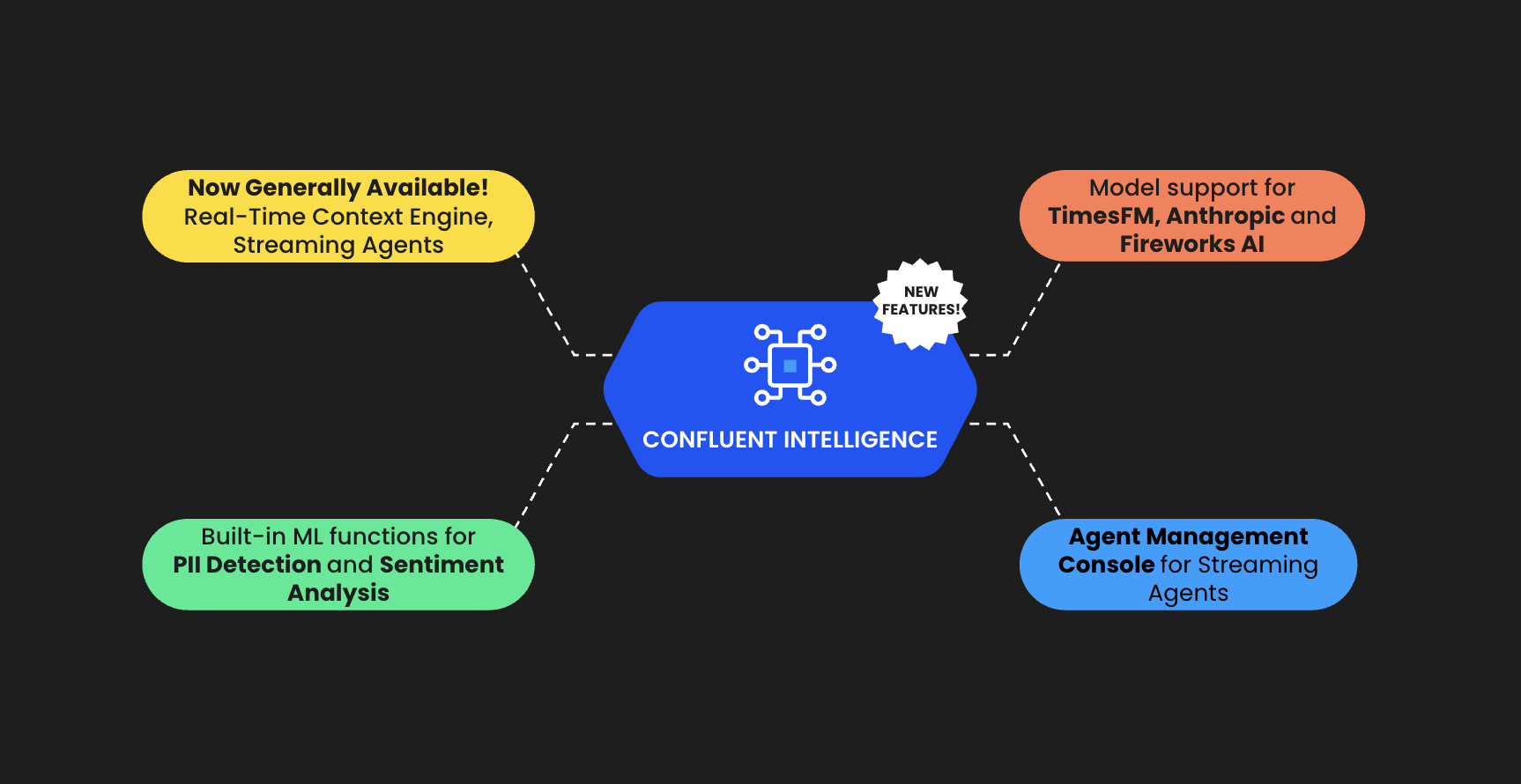
- What happened: Confluent moved
Real-Time Context EngineandStreaming Agentsto GA.- The Q2 update was announced on May 19, 2026, with the managed MCP server and Agent Skills also GA in Confluent Cloud.
- Why it matters: The agent bottleneck is moving from benchmark scores to fresh operational data and governed action rights.
- Builder impact: Kafka and Flink teams now need to treat natural-language operations, dbt workflows, PII redaction, and private model access as one design surface.
- Watch: PII detection is still
Early Access, and community validation around the new control plane remains thin.
Confluent announced its Q2 updates for Confluent Intelligence and Confluent Cloud on May 19, 2026. At first glance, the release reads like a list of platform features. The more important move is narrower: Confluent is trying to pull the question of what an AI agent knows, and what it is allowed to do, into the real-time data layer built around Kafka and Flink.
In the official announcement, Confluent says Real-Time Context Engine, Streaming Agents, and Agent Management Console are now generally available. Its press release bundles that with a managed MCP server, Agent Skills, PII detection and redaction in Flink SQL, Azure Private Link, a dbt adapter, and support for Anthropic, Fireworks AI, and TimesFM models. The important part is not any single feature. It is the combination. Confluent is not launching a new foundation model. It is trying to put the path for reading live data, fixing streaming pipelines, filtering sensitive information, and calling private model endpoints into one platform surface.
Recent AI infrastructure news has mostly focused on larger models, longer context windows, faster coding agents, and safer sandboxes. Confluent is touching the other side of the system. Even a strong agent is hard to deploy into production if the data it reads is stale, if private information leaks into the context, or if operational privileges are opened too loosely. So the right question is not simply whether Confluent added AI features. The sharper question is whether a real-time data platform can become the context server and operations console for agents.
Fresh Context Beats A Smarter Model
Confluent Intelligence is a managed service for building real-time AI workflows on Kafka and Flink. In the current product shape, it has four main pieces. Streaming Agents are continuously running agents inside Flink SQL. Real-Time Context Engine supplies data from Kafka topics to external AI agents through MCP. Built-in ML functions run tasks such as forecasting, anomaly detection, sentiment analysis, and PII detection inside Flink SQL. Model inference gives Flink SQL a path to call remote or managed AI models.
That can sound similar to RAG, but the starting point is different. Traditional RAG began with querying documents or vector indexes. Confluent is emphasizing operational events: order status, failed payments, shipping delays, security events, customer tickets, sensor readings, and other state that keeps changing. If an agent reads this kind of data from an old snapshot, the answer may look plausible while the action is wrong. Real-Time Context Engine is Confluent's attempt to shrink that gap.
In this Q2 update, Real-Time Context Engine reached GA and gained low-latency enhanced querying. Confluent lists filters, ranges, compound queries, projections, and ordering as examples. Those sound like ordinary query options, but they matter from an agent perspective. If an agent needs "regions where payment failures increased in the last 10 minutes," "the latest state for this customer segment," or "only the highest-risk events sorted by score," it needs more than a topic dump. It needs a queryable real-time state layer.
Kafka topics: business events and state changes
Flink SQL: cleaning, joins, PII detection, ML functions
Real-Time Context Engine: fresh context over MCP
AI agents: queries, decisions, operations, external model calls
The position Confluent wants in this architecture is hard to explain with vector databases alone. Vector databases are strong at semantic retrieval. Production agents need more than semantically similar documents. They need the latest order state, account permissions, event sequence, retention policy, network path, and audit trail. Confluent is framing that layer as an extension of the data streaming platform.
MCP Moves Into The Operations Plane
For developers, the most direct part of the announcement is Confluent MCP. The press release describes the managed MCP server as a control plane. The claim is that AI can build, manage, and debug streaming operations through natural language. The documentation follows the same pattern, grouping the managed MCP server, open source MCP server, and Agent Skills as tools that connect to the AI assistants and coding agents teams already use.
MCP is often introduced as a tool-connection protocol. Confluent's use case is more operations oriented. An AI tool can inspect Confluent Cloud resources, examine topics and schemas, debug connectors, and help create streaming applications. For a developer, that means an agent inside an IDE or CLI might handle requests such as "figure out why this topic lag is growing," "check this connector configuration," or "draft a Flink SQL pipeline."
Agent Skills are the important complement. Natural-language operations are convenient, but handing operational standards entirely to model inference is risky. Confluent describes Agent Skills as a second layer that encodes best practices and workflows. In other words, it is a way to put process between "the agent can do this" and "the agent should do it our way." This is part of the same broader competition we are seeing across AI coding tools with skills, rules, playbooks, and runbooks. The difference is that the target is not only application code. It is Kafka and Flink operations.
| Capability | Status | Meaning for agents |
|---|---|---|
| Real-Time Context Engine | GA | Supplies current Kafka topic state to external agents through MCP. |
| Streaming Agents | GA | Creates event-driven agents that keep running on Flink and Kafka. |
| Managed MCP Server | GA | Lets AI tools explore and debug Confluent Cloud operations through natural language. |
| PII detection/redaction | Early Access | Reduces sensitive data inside Flink SQL before it moves to warehouses or outside services. |
| Azure Private Link | GA | Keeps calls to Azure OpenAI, Azure SQL, and Cosmos DB off the public internet. |
The line to watch most carefully in that table is PII detection and redaction. Confluent says the feature can detect and redact sensitive fields automatically inside Flink SQL. For regulated industries such as finance, healthcare, and insurance, this can be close to a prerequisite for AI adoption. But the status is Early Access. Unlike the GA labels around MCP and the Context Engine, real accuracy, false positives, false negatives, and auditability still need to be tested by each team.
Why dbt Is In This Release
The dbt adapter is another notable piece. Confluent says the free open source dbt adapter brings Flink SQL on Confluent Cloud into dbt. Teams can define, test, and deploy streaming pipelines with existing dbt commands and project structure. This is not the flashiest AI demo, but its operational impact may be large.
For an AI agent to work on data pipelines, it needs two things. First, it needs a work unit that humans already use. Second, that work unit needs to pass through tests and review. dbt has already played that role in batch analytics pipelines. Connecting Flink SQL to dbt workflows lowers real-time pipelines into a code shape that agents can handle and teams can inspect.
This is directly connected to the coding-agent race. Once coding agents move beyond editing files, they eventually touch data models, pipelines, schemas, connectors, permissions, and monitoring. Operations teams will not accept "the agent handled it" as a deployment explanation. The dbt adapter, Agent Skills, and managed MCP server all address the same problem from different points in the workflow. Agents can act, but the result still has to live in structures that organizations understand and review.
The Security Boundary Of Real-Time AI
The security message in the press release has two sides. One is data protection. PII detection and redaction aim to detect and remove sensitive information inside Flink SQL before the data is moved into a warehouse or external service. The other is the network boundary. Azure Private Link support lets Flink jobs connect to Azure-hosted services such as Azure OpenAI, Azure SQL, and Cosmos DB without crossing the public internet.
Both sides address problems that frequently collide in real agent deployments. Agents need fresh data. Fresh data is more likely to include personal or business-sensitive information. Agents may also need to call external models. External model calls affect networking, authentication, logging, and data movement policy. Confluent is effectively saying this should be solved through stream processing and private connectivity, not only through model selection.
That does not make the problem disappear. The Early Access status for PII detection is especially important. Privacy work does not end with one detection model. Teams still need to decide which fields count as sensitive, whether redacted data can still be reidentified, what downstream consumers receive, and where audit logs live. Confluent's direction is clear, but production deployments will still carry the data-protection burden.
Competition Is Moving Toward Data Gravity
Confluent's announcement is not an isolated event. It is one scene in the 2026 AI infrastructure race. Databricks and Snowflake are pushing AI data platforms. Google is tying BigQuery into an agentic data cloud. Cloudflare and AWS are extending infrastructure for agent execution, security, and tool calls. In that field, Confluent's position is real-time events and streams.
That position has both strength and limits. The strength is obvious. As agents move into operations, state changes often appear in event streams before they appear in batch tables. Fraud detection, customer-service routing, fleet operations, incident response, and personalization all depend on knowing what is happening now. Confluent is trying to translate the language of Kafka and Flink into a surface that AI agents can use.
The limit is also clear. Most enterprise data already lives across lakehouses, warehouses, SaaS applications, vector indexes, and object stores. Confluent is unlikely to become the single source for every kind of context. So the value of Real-Time Context Engine should be judged less by whether all data moves into Confluent, and more by whether time-sensitive data becomes safe and useful for agents.
Community Signals Are Still Small
Right after the announcement, community reaction looked limited. I did not find a large Hacker News or GeekNews discussion focused on this release. A short Reddit post in r/apachekafka mentioned Confluent's mcp-confluent update and the possibility of managing Kafka through AI tools, but there was not much response yet. That does not necessarily make the news less important. It suggests that the validation point is not a launch demo. It is production operations.
Kafka operators may see natural-language management as convenient, risky, or both. Topics, schemas, connectors, and Flink jobs can all cause incidents when changed incorrectly. The key question for a managed MCP server is not only whether the model understands Kafka. It is whether permissions, approvals, dry runs, audit trails, rollbacks, and change reviews fit naturally around the agent. Confluent emphasizes procedural operations through Agent Skills, but every organization will still have to decide which guardrails are acceptable.
What Builders Should Watch Now
This announcement does not need to be read as an immediate adoption checklist. It is more useful as an architecture signal. First, agent context is expanding from static document retrieval into real-time state querying. Second, MCP is moving from connector protocol into operations control plane. Third, privacy protection and private networking are becoming front-door requirements for AI features, not cleanup work after the demo. Fourth, existing data-engineering tools such as dbt are being reinterpreted as agent work units.
If your team already uses Kafka or Flink, the questions are direct. Which topics are safe context for agents? Which fields must be removed before an agent sees them? Which operations can be opened to natural-language requests? Which operations still need a pull request or approval flow? Can external model calls stay off the public internet? Confluent's new features are one product answer to those questions.
Teams that do not use Kafka or Confluent can still take the signal seriously. Production AI agents do not become reliable through model-call code alone. They need a data layer that supplies fresh context, skills that describe working procedure, processing layers that reduce sensitive information, private connectivity, and an auditable operations surface. In practice, an agent is not just a reasoning model. It is an operating system with data and permissions.
That is why Confluent's Q2 update is interesting. This is not a story about a smarter AI model. It is a real-time data infrastructure company defining the agent bottleneck as context, operations, and governance, then placing MCP and Flink SQL into that slot. Whether the strategy works will depend less on the GA label and more on whether operations teams trust this control plane. But the direction is clear. The agent infrastructure fight is moving outside the model, toward the place where data is actually flowing.