Collibra AI Command Center moves agent audits into real time
Collibra AI Command Center turns agent sprawl into a real-time governance problem spanning registry, validation, traceability, and regulatory evidence.
- What happened: Collibra launched
AI Command Center, positioning it as a real-time control layer for agentic AI.- The announcement landed on May 6, 2026 and included a validation partnership with Giskard.
- Why it matters: Agent governance is moving from after-the-fact audit work toward registries, trust signals, and traceability.
- Operational impact: Enterprises now have to connect agents, data lineage, policies, approvals, and compliance evidence across one lifecycle.
- Watch: A real command center only matters if it connects to actual tool calls, permissions, and enforcement points.
Collibra launched AI Command Center on May 6, 2026. The company describes it as a real-time automated control layer for agentic AI. At first glance, that can sound like another enterprise AI governance product. The more interesting signal is where Collibra is trying to move AI audit work. Instead of reviewing outputs after deployment and filling regulatory checklists later, the company wants enterprises to register, trace, validate, and govern agents while those agents are operating.
Two phrases in the announcement are worth watching. The first is agent sprawl. Different teams create agents, connect them to tools, and let them touch data, while the organization struggles to explain which agents exist, who owns them, and what they can do. The second is hallucination tax. Collibra uses that phrase for the hidden cost of manual review, rework, and risk that grows as agents multiply. The problem is not only that a model may hallucinate. The bigger enterprise cost is discovering the error, correcting downstream work, and producing audit-ready evidence about what happened.
This message fits a broader shift in enterprise AI. Microsoft talks about Agent 365 as a way to inventory organizational agents and discover shadow agents. ServiceNow presents AI Control Tower as an operations layer for workplace agents. Glean frames its Agent Development Lifecycle as a way to treat agents more like software assets. Honeycomb's Agent Timeline tries to rewind production agent behavior. Collibra's angle is different because it begins from data governance. It pulls agentic AI into the language of data lineage, AI use cases, model and agent registries, policy dependencies, and compliance evidence.
Why after-the-fact audit is late
Traditional AI governance often looks like post-deployment review. A model is registered, its purpose is documented, its risk level is classified, approvers are assigned, and performance or bias is checked on a schedule. That approach can work reasonably well when the model is mostly recommending, classifying, summarizing, or drafting. Even when an output is wrong, a person usually decides what happens next.
Agents change the timing. An agent does not stop at generating an answer. It can close a ticket, update a CRM field, create a document, query a database, call an external API, or start an approval workflow. In that context, "we will review it later" can be too late. A bad action may already have executed. Sensitive data may already have entered the wrong context. A human may believe they approved one narrow step while the agent inherited broader authority and acted through several systems.
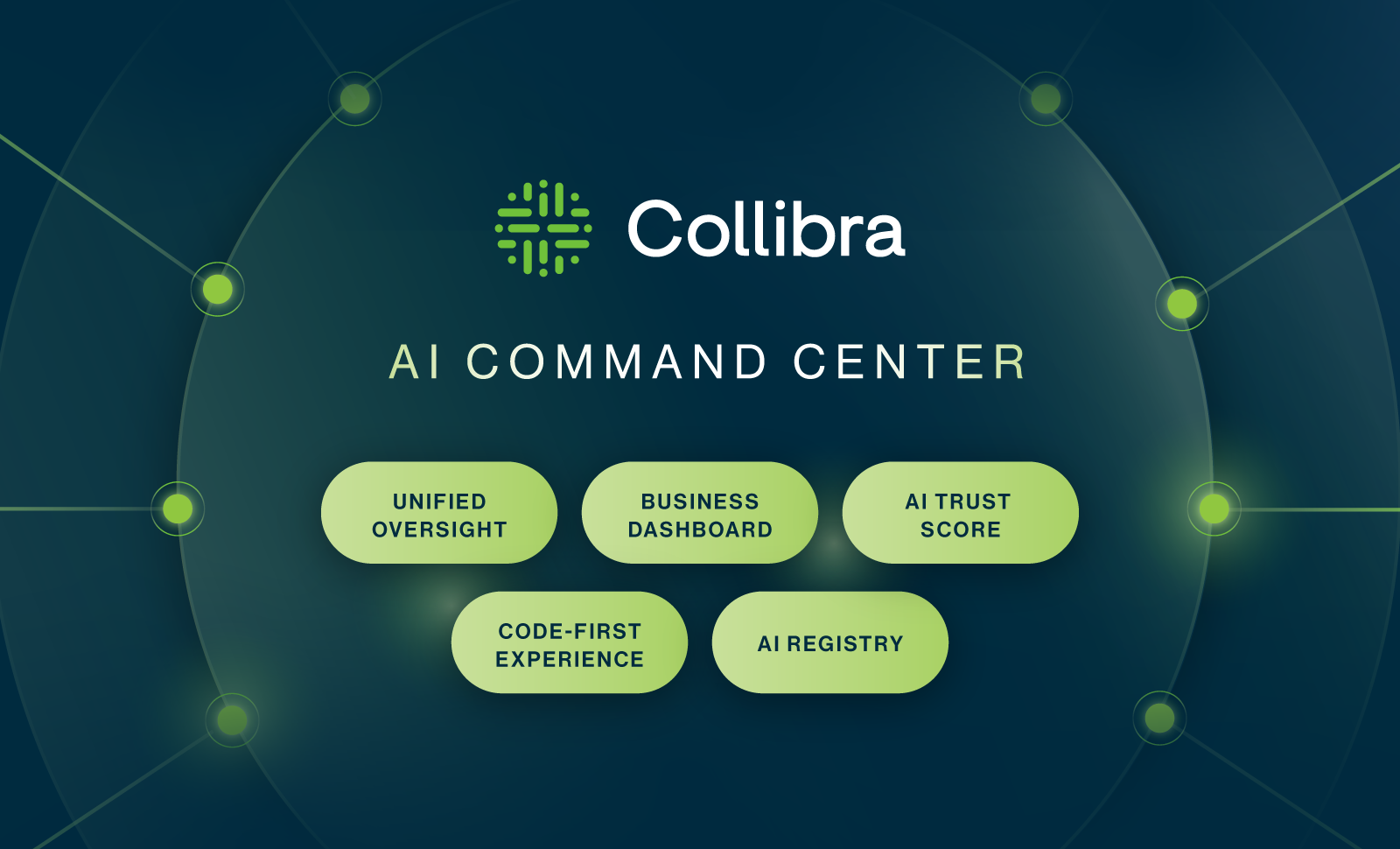
That is why Collibra positions AI Command Center as a single system of record. The product page says it manages AI use cases, models, and agents in one registry, while connecting data, policies, and use case dependencies across the full lifecycle. The important part is not the list itself. A list is only the starting point. The harder work is tracking which data products an agent uses, which policies apply, which risk assessments and approvals exist, and which trust signals change during operation.
Four layers Collibra wants to connect
Collibra's announcement breaks down into four practical layers. The first is registry. AI use cases, models, and agents are recorded with owners, purposes, status, and scope. The second is traceability. Agents are connected to data, policies, approvals, and risk assessments. The third is validation. Through its partnership with Giskard, Collibra says model behavior, agent performance, and potential risks can be tested and connected back into governance. The fourth is compliance. AI UC-1 assessment templates, EU AI Act templates, and NIST AI RMF templates are meant to pull evidence and approvals into the same workflow.
Each layer is weak if it stands alone. A registry gives a current list, but it does not necessarily reduce risk. Validation produces test results, but those results may not be attached to the production systems where the agent acts. Compliance templates can fill documents without stopping unsafe behavior. The "command center" framing matters because Collibra is trying to join these pieces into one operating view rather than sell them as separate governance artifacts.
Why Giskard and AI UC-1 matter
The Giskard partnership is not just a partner logo. Agent governance cannot be solved only with documentation. Organizations need to test how models and agents behave under real inputs and risky operating conditions. Collibra's official blog post, The end-to-end control plane for AI has arrived, says Giskard connects execution-level testing and validation to AI Command Center. The idea is that model behavior, agent performance, and potential risks are continuously captured and routed back into governance.
The AI UC-1 template points in the same direction. Collibra says it will provide a ready-to-run assessment template for agentic AI compliance, alongside EU AI Act and NIST AI RMF templates. For enterprise teams, this is not a minor feature. AI agent compliance does not end with a policy document that says "we govern AI." Teams need evidence. Which use case carries which risk level? Which data entered the system? Which validation passed? Who approved deployment? Which trust signal changed in production?
Templates are still only the beginning. Real control has to sit close to execution. If an agent tries to query customer data, the registry policy and the actual permission check need to meet. If an agent calls an unapproved tool, the difference between sending an alert and blocking the call is material. Collibra's phrase "real-time automated control" becomes differentiated only if the distance between evidence management and runtime enforcement gets short.
MCP Server is a clue about context control
Another thread in Collibra's message is its MCP Server. The company blog says more than 100 customers are using Collibra MCP Server in production and that it reached a leading position on Databricks Marketplace. Those numbers should be treated as Collibra's own claims, but the direction is important. Agents need good context to make good decisions, and enterprise context is not just document search. It includes data definitions, owners, quality rules, lineage, policies, and sensitivity labels.
MCP is becoming a standard interface for agents to access external tools and context. As MCP servers multiply, a new management problem appears. Which server is trusted? Which metadata is current? Which agent is allowed to call which context source? For Collibra, MCP Server is not simply a developer convenience. It is a channel for supplying governed metadata into the agent runtime. That is where AI Command Center and MCP Server fit together. The command center defines what should be allowed, while MCP Server supplies the context agents actually use.
For development teams, that distinction is practical. Many agent failures are not caused by the model being incapable. They happen because the context is incomplete, stale, or mixed with data the agent should not have used. A data catalog term changes, but the agent still uses the old definition. A customer segment owner moves, but automated reporting still targets the wrong department. A sensitive field should not appear downstream according to lineage, but it is included in a summary. Production agents need metadata hygiene as much as they need prompt engineering.
The advantage of a data governance company
Collibra enters this market differently from OpenAI, Anthropic, Google, or Microsoft. Model companies push stronger reasoning, tool calling, and autonomous execution. Workplace platforms place agents inside their own applications. Collibra starts from data and governance. The strength of AI Command Center should therefore not be model intelligence. It should be the ability to explain which data and policies an agent acted on.
That position matters most in regulated industries. Financial services, insurance, healthcare, public sector, and manufacturing organizations often care less about an agent's final answer than the evidence behind its action. Which dataset did it read? What was that dataset's quality state? What was the lawful basis for processing personal data? Which approval happened? When was the risk assessment refreshed? Existing data governance systems already hold some of that evidence, so extending them into agentic AI governance is a logical move.
There is also a weakness. Agent control is not solved by documents and registries alone. It has to integrate with execution environments, identity systems, credentials, tool gateways, browser automation, and API gateways. Microsoft has Entra, Microsoft 365, and GitHub. AWS has AgentCore and IAM. ServiceNow has workflow and ITSM. If Collibra wants AI Command Center to become a true runtime control plane, the depth of those integrations will matter more than the dashboard.
The questions teams should ask now
The bigger question raised by Collibra AI Command Center is not whether a team should buy this specific product. It is how the organization should treat agents as governed assets. The first question is whether agents are registered at all. Who created each one? Whose authority does it exercise? Which data and tools can it reach? Can anyone see that in one place?
The second question is what counts as a trust signal. A simple success rate is not enough. Teams need to watch data quality, tool-call failure rates, human overrides, policy exceptions, user feedback, and drift. The third question is whether compliance evidence is generated continuously. Rebuilding documents during audit season will not keep up with agentic systems that change behavior and context quickly. The fourth question is whether a command center can touch actual blocking points. A dashboard that cannot affect execution is observability, not control.
This market is likely to keep growing. As agents multiply, organizations will ask less often for model scorecards alone and more often for agent inventory, data lineage, policy enforcement, and evaluation history. Developers may experience that as process overhead, but high-risk work will increasingly require it before deployment. The defensible statement is not "AI answered." It is "a registered agent acted in an approved context under a known policy, with evidence attached."
Collibra's announcement is quiet but important for that reason. Once AI agents begin acting, audit has to move closer to action time. After-the-fact review is not enough. Registry, validation, traceability, compliance, and metadata context have to become one operating loop. Whether AI Command Center can push that promise all the way into runtime enforcement remains to be seen. The direction is clear: in the agent era, governance is moving from a document archive toward an operational control room.