Cloudflare Cut 1,100 Jobs, and Agent Usage Became an Org Chart
Cloudflare tied a 600% jump in internal AI use to a 1,100-person workforce reduction. The important story is how agent metrics are entering operating models.
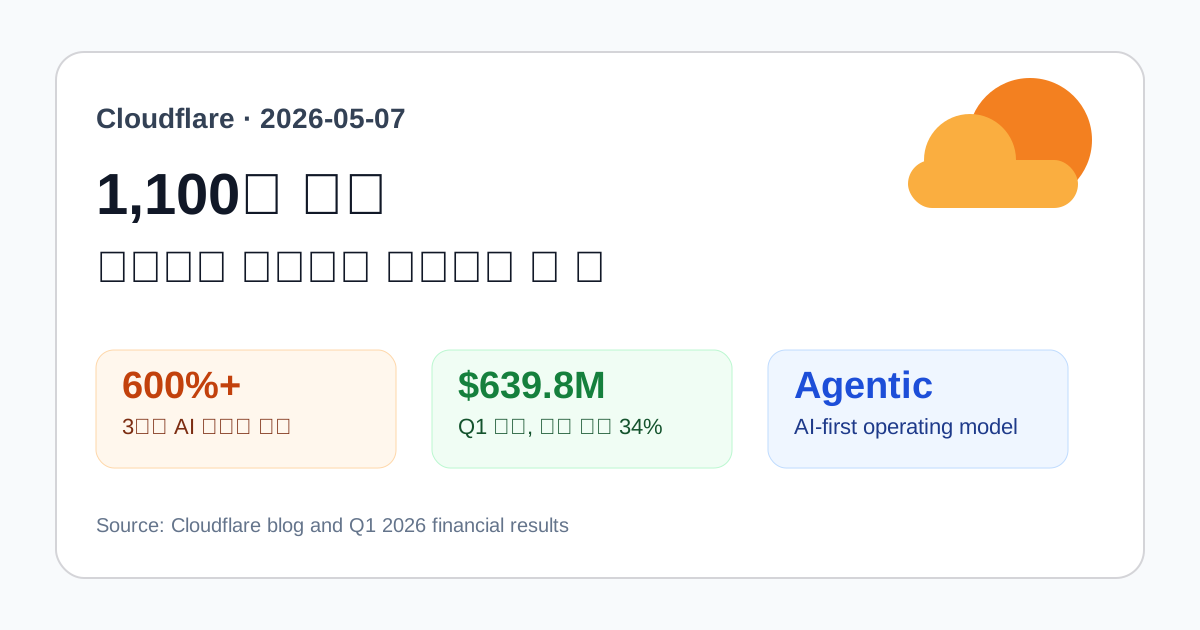
- What happened: Cloudflare announced a global workforce reduction of
more than 1,100 employees.- The company said internal AI usage rose by more than 600% over the past three months, with thousands of AI agent sessions running every day.
- Why it matters: Agent adoption is moving beyond product strategy into the language of org design and headcount planning.
- The numbers: On the same day, Cloudflare reported Q1 revenue of
$639.8M, up 34% year over year.- The restructuring is expected to cost
$140M-$150Mand to be substantially complete by the end of Q3 2026.
- The restructuring is expected to cost
- Watch: Higher AI usage can be a productivity signal, but it is not the same as proof of replacement, quality, or durable operational leverage.
On May 7, 2026, Cloudflare published a post titled Building for the future and announced that it would reduce its global workforce by more than 1,100 employees. At first glance, that could read like a familiar cost-cutting memo. But the part AI builders should pay attention to is different. Cloudflare did not frame the move only as a response to near-term financial pressure or individual performance. It described the decision as a redesign of processes, teams, and roles for what it called the agentic AI era.
Two numbers carried the weight of that message. First, Cloudflare said internal AI usage had increased by more than 600% over the previous three months. Second, it said thousands of AI agent sessions now run every day across engineering, HR, finance, marketing, and other functions. Those figures were not presented as generic product marketing. They appeared inside the explanation for a workforce reduction. That is what makes this more than another layoff story.
Cloudflare's Q1 2026 financial results, released the same day, make the context sharper. Revenue reached $639.8 million, up 34% year over year. GAAP loss from operations was $62 million, while non-GAAP income from operations was $73.1 million. The company said the plan would reduce current headcount by roughly 1,100 roles and generate restructuring costs of $140 million to $150 million. Most of those costs are expected in Q2 2026, with the plan substantially complete by the end of Q3.
That combination is hard to explain with a simple "business is weak" story. Cloudflare reported strong revenue growth and, on the same day, argued that AI and agents had changed how the company should operate. Expect this pairing to show up again across the industry. "How much AI are we using?" is starting to move from a personal productivity question into a management metric for structure, capacity, and hiring plans.
The Agent Cloud Vendor Becomes Its Own Customer
To understand the May 7 announcement, it helps to look back at Cloudflare's Agents Week in April. In its Agents Week 2026 recap, Cloudflare argued that agents are quickly changing how people work and that some knowledge workers may soon run multiple agents in parallel. At that scale, the company said infrastructure may need to handle tens of millions of simultaneous agent sessions. The old cloud assumption, one application serving many users, is no longer enough by itself.
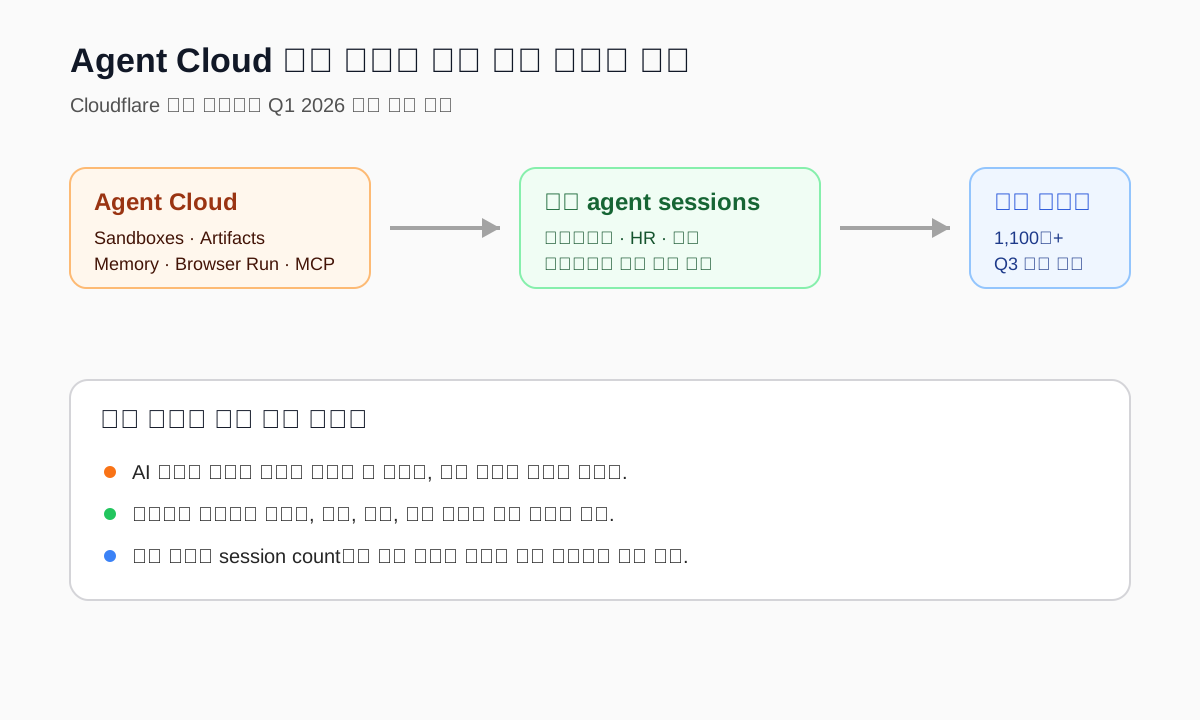
The product list from that week was broad. Cloudflare announced Git-compatible Artifacts for code and state handoff, Sandboxes as isolated persistent execution environments, Workflows control plane updates, Mesh for private network access, OAuth and scoped permissions, MCP governance, Agent Memory, AI Search, Browser Run, Email Service, and an Agent Readiness Score. This was not just a "build a chatbot faster" pitch. It was closer to a stack for agents that execute code, remember context, use browsers, access internal services, pass through security policy, and stay observable.
The workforce announcement is where the external product story and internal operating story met. Cloudflare is selling Agent Cloud to the market while saying it runs thousands of internal AI agent sessions every day as part of how the company works. It is normal for an infrastructure company to dogfood its own platform. What is unusual is that Cloudflare made internal agent usage part of the public rationale for workforce redesign. That turns the signal into something stronger.
For developers, this connection matters because agent infrastructure is not just model calls. It requires execution environments, file systems, browsers, long-running workflows, private networking, OAuth, scoped permissions, logging, cost measurement, and human approval paths. The pieces Cloudflare announced during Agents Week map directly onto those needs. The restructuring memo then shows what language an organization starts to use when agents become an internal operating unit rather than an experimental tool.
What 600% Usage Says, and What It Does Not
A 600% increase in AI usage is a powerful number. It is also easy to overread. It can signal that more employees are using AI more often. Thousands of agent sessions can indicate that AI has entered real business workflows. But it does not automatically mean work output rose by 600%, productivity rose by 600%, or that 1,100 specific roles were fully automated away.
Agent usage can rise for many reasons. A newly rolled-out tool often produces a burst of experimentation. If internal goals reward usage, session counts can climb quickly. If teams split one task into many smaller agent runs, the number grows again. Failed sessions can also be retried. The opposite can happen too: substantial automation may exist, while human review and approval still limit the realized productivity gain.
So the metric that matters for engineering teams is not session count by itself. The important questions are about verified outcomes. Which task categories saw higher completion rates? Did cycle time fall? Did rework decline? Did security incidents, customer-impacting failures, or escalations increase? Where do humans still approve, review, or repair the output? Cloudflare disclosed usage growth, but it did not disclose detailed task-level replacement rates or quality metrics. That gap is why the community reaction split.
Reddit discussions in r/technology and r/CloudFlare were skeptical. Many commenters saw AI usage growth as a convenient management narrative for a restructuring decision and pointed to the gap between "we used AI more" and "people are no longer needed." Others interpreted Cloudflare's move as a serious internal dogfooding case and a sign that agent-centered operations are arriving earlier at infrastructure companies. Both readings are worth holding at once. The event is not a finished proof that AI replaced the work. It is a clear example of how companies are beginning to package AI adoption in management language.
The More Direct Question for Development Teams
The wrong takeaway is to ask, "Can we cut 20% too?" A more useful question is narrower: which repeatable tasks can agents already handle in our team, and what happens when they fail? Are those tasks easy to roll back? Are agent permissions limited to the minimum needed data and tools? Are session logs and decision trails auditable? Does increased usage map to delivery metrics? Most importantly, which steps can be removed from human hands and which steps must remain human-controlled?
Cloudflare's Agent Cloud pitch is an infrastructure answer to that question set. Sandboxes give agents isolated computers. Mesh, OAuth, and scoped permissions control access to internal resources. MCP governance manages the tools an agent can see and call. Browser Run and Email Service let agents act through real web and email channels. Agent Memory and AI Search handle long-term context and retrieval.
But infrastructure does not automatically produce good organization design. As agent infrastructure becomes more capable, governance becomes more important. That is especially true in HR, finance, customer support, and security operations, where access and accountability are sensitive. In those domains, session counts should come after approval policy, audit logging, separation of duties, and rollback paths. Cloudflare's public statements do not reveal how mature those operational controls are inside the company. For readers, the lesson is not "use AI faster." It is "if AI usage becomes an operating metric, what else must be measured beside it?"
New Operating Metrics for the Agent Era
Traditional SaaS adoption metrics focused on active users, seats, usage frequency, and feature adoption. Agents need a different measurement system. More useful metrics include completed agent tasks, escalation rate after failure, approval latency, permission denial rate, cost per session, test pass rate per change, customer-impacting rollback count, and tool-call error rate. "How many times did we call AI?" is only a starting point.
Cloudflare's 600% usage number points to the need for this richer metric layer. As the number gets larger, management can explain change more easily. But if headcount reductions are justified only by a bigger usage number, missing tacit knowledge, review capacity, and customer context can reappear later as cost. If the people who validate agent output disappear too quickly, productivity gains can turn into quality debt.
AI coding tools already show a version of this problem. An agent can open many pull requests. If reviewers are overloaded, tests are weak, or requirements are vague, more pull requests are not more throughput. They are a larger queue. The same is true for back-office agents. If they process more tickets but escalation quality falls or customer trust declines, the long-term cost can grow. Agent operating metrics need to capture both volume and quality.
Competitors Are Moving Into the Same Language
Cloudflare is not alone. Microsoft emphasizes organization-level agent management, auditing, and shadow-agent discovery through Agent 365 and the Copilot ecosystem. Google Workspace has been turning workplace agent control and policy into product language through AI Control Center. ServiceNow's AI Control Tower frames AI deployed across systems as something to discover, observe, govern, secure, and measure. AWS AgentCore bundles runtime, browser, identity, memory, and payments into a cloud layer for agents.
Cloudflare's differentiator is its position in internet infrastructure and edge runtime. Workers, Durable Objects, WAF, Access, Gateway, Browser Rendering, and AI Gateway give it a credible story at the boundary between agent execution and network security. That was exactly the Agents Week message. Agents execute code, browse the web, call internal APIs, and maintain long-running state. A company that already owns runtime, network, and security primitives has a natural route into agent infrastructure.
Whether the restructuring announcement strengthens that product story or creates a trust problem is still unresolved. "We sell agent infrastructure and used it internally to change our operating model" is a strong dogfooding narrative. But if the market reads it as "more AI usage means fewer workers," customers and developer communities may become more guarded. An AI infrastructure company earns trust not only with a productivity story, but also with a detailed safety and accountability story.
What to Watch Now
The most important shift in Cloudflare's announcement is that AI moved from "tool" to "operating model." This is no longer just about whether an employee uses AI. It is about agents receiving work as sessions, executing tasks, leaving records, waiting for human approval, and connecting to other systems. For developers, that is an infrastructure and workflow design problem.
Teams running agents should start with three questions. First, what permission model controls the tools and data each agent can access? Second, which quality metrics decide whether agent output is acceptable? Third, where did increased usage actually reduce human time, and where did it increase review cost? Without those answers, session count is a risky metric.
Cloudflare has created a controversial precedent. It showed that a company can report strong revenue growth while using AI and agents as part of the language for redrawing its organization. Whether this becomes remembered as a real productivity transition or as an early, overconfident AI-first restructuring is still open. But one thing is clear: the next phase of the agent economy will not be decided by model performance alone. It will be decided by which companies can turn agent usage into responsible operating metrics, and which ones use the numbers as a dangerous shortcut for organization design.