Claude Platform on AWS brings native agents outside Bedrock
Anthropic and AWS made Claude Platform on AWS generally available, giving AWS customers a native Claude agent stack alongside Bedrock.

- What happened: Anthropic and AWS made
Claude Platform on AWSgenerally available.- AWS customers can reach Anthropic's native Claude Platform through AWS accounts, IAM, CloudTrail, and Marketplace billing.
- The distinction: Bedrock is the AWS-managed Claude route, while this is an Anthropic-operated native API route.
- Builder impact: Managed Agents, code execution, Skills, MCP connectors, and Claude Code now fit into AWS procurement and audit workflows.
- Teams with strict data-boundary requirements still need to compare this path with Claude on Amazon Bedrock.
Anthropic and AWS announced the general availability of Claude Platform on AWS on May 11, 2026. At first glance, that can sound like another way to say "Claude is available on AWS." The actual product boundary is more interesting. This is not a new Claude model listing inside Amazon Bedrock. It is a separate route that lets AWS customers use Anthropic's native Claude Platform through AWS account controls, IAM permissions, CloudTrail logging, and AWS Marketplace billing.
That distinction matters for AI product teams and platform teams. Until now, when a company said it used Claude on AWS, many people assumed Amazon Bedrock. Bedrock gives customers a Claude model path inside an AWS-managed foundation model platform. Claude Platform on AWS is different: the account, access, audit, and billing layers are tied into AWS, but the API and Console experience are Anthropic's native platform. The underlying requests and data processing happen on the Anthropic-operated side rather than inside the Bedrock service boundary.
So this announcement is less about a model benchmark and more about where an agent runtime lives. Once AI agents move from demos into internal workflows and products, model quality alone is not enough. Teams also need to know who operates the API, which account model controls access, how usage is tracked, where audit events appear, how quickly beta features arrive, and how the toolchain fits procurement rules. Claude Platform on AWS is AWS and Anthropic's answer for customers who want the native Claude agent stack without leaving their AWS operating model behind.
Native Claude through an AWS account
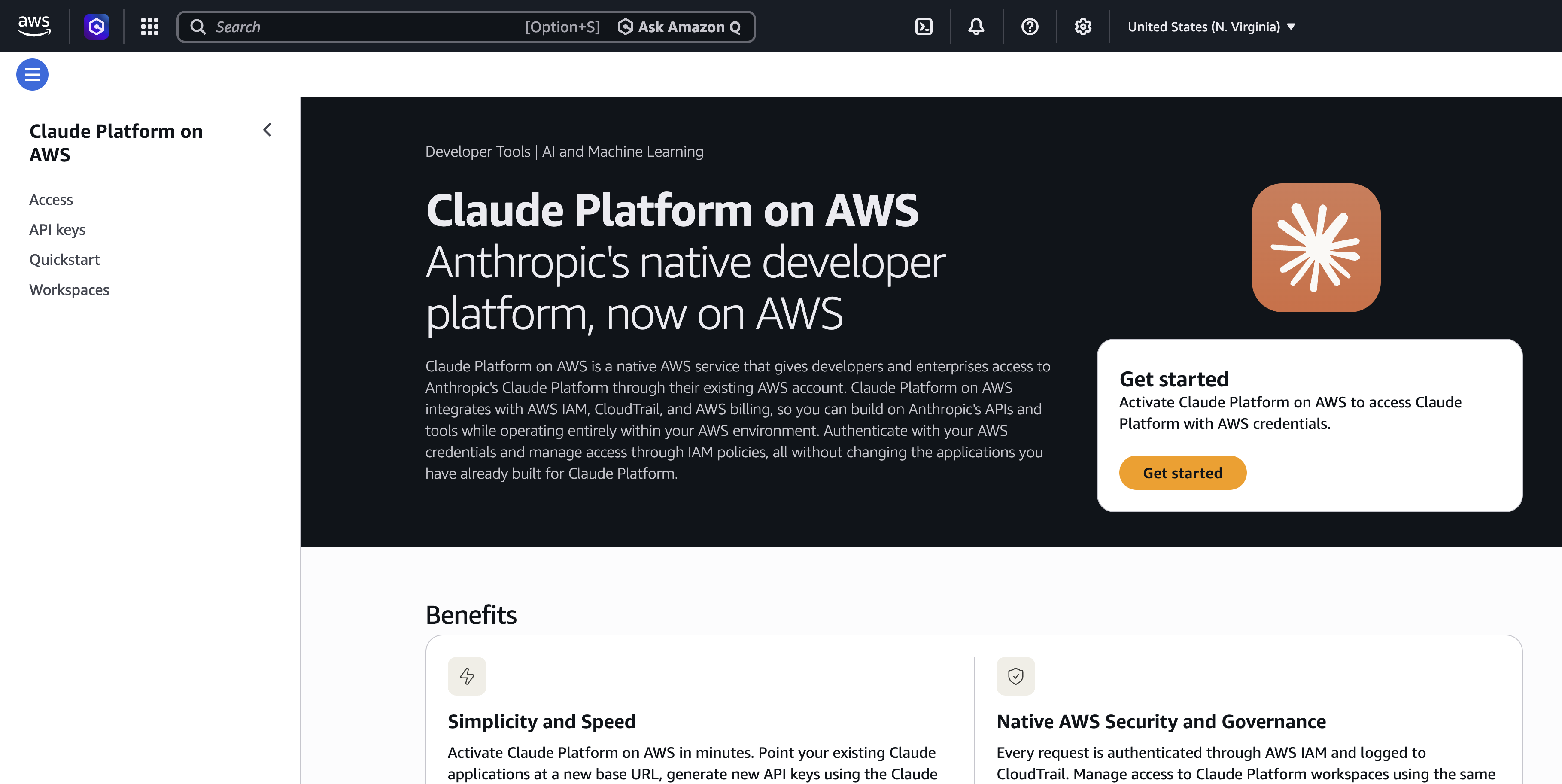
Anthropic describes Claude Platform on AWS as a new way for AWS customers to access the full Claude Platform. AWS goes further and says it is the first cloud provider to offer Anthropic's native Claude Platform experience through an AWS account. Developers and organizations can use Claude API, Claude Console, and early-access beta capabilities without setting up a separate Anthropic account, independent contract path, or disconnected billing trail.
The word "native" is doing real work here. Bedrock is AWS's integrated model platform. It wraps multiple foundation model providers in AWS interfaces and offers AWS-native features such as guardrails, knowledge bases, regional residency options, and Bedrock Agents. Claude Platform on AWS points in the other direction. Customers use Anthropic's Claude Platform itself, while AWS IAM, Marketplace, and CloudTrail sit at the access and operations layer.
The feature list reflects that orientation. The official announcement includes Claude Managed Agents beta, advisor strategy beta, web search, web fetch, code execution, Files API beta, Skills beta, MCP connector beta, prompt caching, citations, batch processing, and Claude Console. The Console also includes prompt improver, prompt generator, and evaluation tools. Anthropic says Claude Opus 4.7, Sonnet 4.6, and Haiku 4.5 are available, with future models arriving on their normal release cadence.
This is not just a bundle of convenience APIs. It shows how Anthropic has been moving from API provider to agent platform provider. The focus is expanding from a single model call toward a runtime that can handle files, execute code, fetch from the web, apply reusable skills, connect to MCP servers, and run longer-lived managed agents. The AWS product gives that first-party stack a route into existing enterprise cloud operations.
Why it is separate from Bedrock
AWS and Anthropic are unusually explicit about the difference between the two Claude paths. Claude Platform on AWS is operated by Anthropic, and data is processed outside the AWS security boundary. Customers use AWS accounts, IAM, and CloudTrail, but Anthropic runs the service. Claude on Amazon Bedrock is the AWS-managed path where AWS acts as the data processor and organizations can keep the model route inside AWS infrastructure and Bedrock controls.
That is not a small footnote. It is the core adoption decision. Some teams need the newest Claude Platform features as soon as they are available. If Managed Agents, MCP connectors, Skills, code execution, and the Files API are central to the product design, the native platform route is more direct. Other teams care more about data boundary, region posture, internal security policy, and existing Bedrock controls. For those organizations, Bedrock can remain the better fit even if some native platform features arrive there later or differently.
| Area | Claude Platform on AWS | Claude on Amazon Bedrock |
|---|---|---|
| Operator | Anthropic operates the native Claude Platform. | AWS provides Claude models through the Bedrock service path. |
| Data boundary | Requests and data are processed outside the AWS security boundary. | AWS is the data processor and emphasizes the AWS infrastructure boundary. |
| Feature access | Native features such as Managed Agents, Skills, MCP connectors, and code execution are central. | Bedrock guardrails, knowledge bases, agents, and AWS integrations are central. |
| Operations layer | IAM, CloudTrail, and Marketplace billing act as the access and governance layer. | Teams operate inside Bedrock resources and the broader AWS account model. |
For that reason, it is only partly accurate to call this a Bedrock alternative. A better reading is that AWS customers now have two official Claude routes. One is an AWS-native model platform route. The other is an Anthropic-native agent platform route accessed through AWS account infrastructure. They overlap, but they optimize for different operating requirements.
Why IAM, CloudTrail, and Marketplace matter
For an individual developer, the change may look like a different API endpoint. In enterprise adoption, account, billing, and audit controls can matter as much as the model. An AI team can build an impressive agent workflow and still get blocked if the platform and security teams cannot answer basic questions: who called the model, which permission allowed it, which cost center owns the usage, and where the audit trail lives.
AWS describes a three-step setup flow. First, the customer activates Claude Platform on AWS through AWS Marketplace and creates a workspace. That workspace becomes a boundary for projects, environments, and teams, and it can be referenced by IAM policy. Second, the team authenticates with IAM SigV4 or a workspace API key. Third, Anthropic SDKs or clients such as Claude Code call a regional endpoint with the workspace ID.
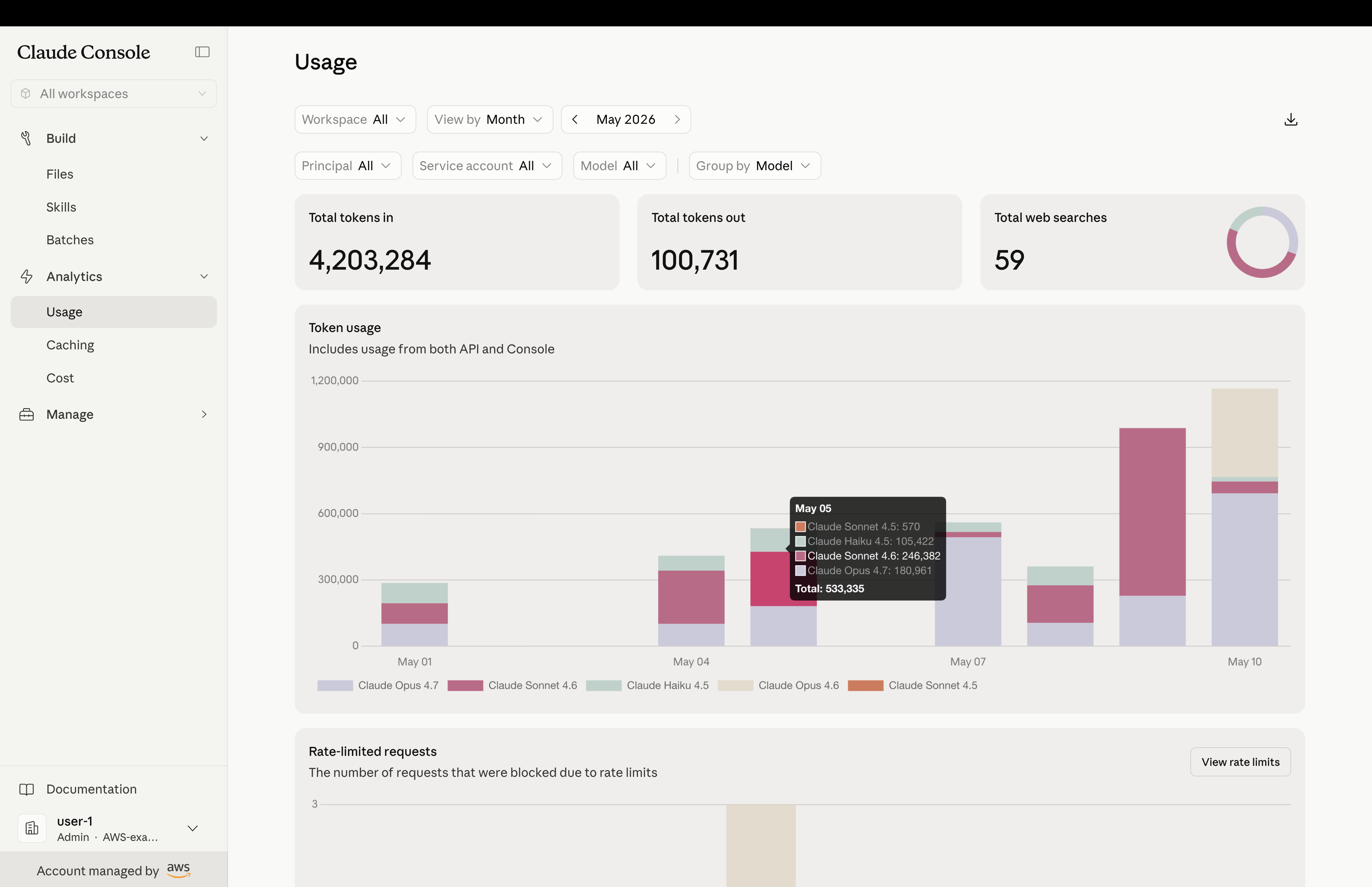
Billing flows through AWS Marketplace as usage-based consumption. That means AI spend can be tracked alongside other AWS services. CloudTrail can capture Claude Platform on AWS requests from the Anthropic SDK, Claude Code, and Claude Cowork. Workspace operations are management events by default, and inference activity can be captured in more detail by enabling data event logging.
These details rarely appear in model leaderboards, but they are often buying criteria in real organizations. If a company already runs on AWS Organizations, IAM roles, Cost Explorer, CloudTrail, and Marketplace private offers, Claude Platform adoption becomes easier to explain. It also makes unsanctioned shadow AI usage harder to defend when a governed AWS route exists.
Claude Code can use this route too
The most direct developer impact is the Claude Code and Agent SDK connection. The Claude Code documentation has a dedicated page for Claude Code on Claude Platform on AWS, including AWS authentication, IAM access control, and AWS Marketplace billing for the Anthropic-operated Claude API. The core environment variables are straightforward.
export CLAUDE_CODE_USE_ANTHROPIC_AWS=1
export ANTHROPIC_AWS_WORKSPACE_ID=wrkspc_01ABCDEFGHIJKLMN
export AWS_REGION=us-east-1
According to the documentation, ANTHROPIC_AWS_WORKSPACE_ID is attached to every request as the anthropic-workspace-id header, and the base URL is derived from AWS_REGION. If Bedrock or Foundry provider routing variables are also configured, provider resolution can change, so teams that want Claude Platform on AWS need to clear conflicting provider settings. Claude Code's /status command is presented as the quick way to confirm the resolved provider, workspace ID, region, and base URL override.
The Agent SDK follows the same direction. A program that launches Claude Code as a subprocess can pass CLAUDE_CODE_USE_ANTHROPIC_AWS, ANTHROPIC_AWS_WORKSPACE_ID, and either AWS credentials or a workspace API key. That means internal automation, pull request bots, migration runners, and evaluation pipelines can target Claude Platform on AWS while still fitting AWS procurement and permissions.
The operational work does not disappear. Workspace API keys are long-lived secrets, so production systems may be better served by federated AWS credentials or IAM role access. SSO credentials can expire during a session, which makes refresh handling important. Model aliases can also move a whole team to a newer model unexpectedly, so the docs recommend pinning explicit model IDs such as claude-opus-4-7, claude-sonnet-4-6, and claude-haiku-4-5 where stability matters.
Native feature access is becoming the agent stack battleground
The feature list is the most revealing part of the announcement: Managed Agents, advisor strategy, web search, web fetch, code execution, Files API, Skills, and MCP connectors. Each one can be seen as an API feature. Together, they look like an agent runtime.
An agent is not just a long prompt sent to a large language model. To handle meaningful work, it needs to read and write files, call tools, fetch fresh information, remember organization-specific practices, connect to external systems, evaluate outputs, and keep cost and usage visible. Anthropic is packaging more of those pieces as first-party Claude Platform features. AWS is connecting that package to an enterprise cloud account model.
That combination competes with LangGraph, Bedrock Agents, OpenAI's agent stack, and internal orchestration platforms. The question is how much a team wants to delegate to a first-party agent platform and how much it wants to own inside its own platform team. Claude Platform on AWS offers one answer: use Anthropic's first-party agent stack, but keep AWS account governance and procurement in the loop. Bedrock offers another answer: keep Claude inside AWS's managed model platform and compose with Bedrock-native services.
For developers, the practical result is more choice. Fast prototypes and beta-feature experiments may fit the native Claude Platform route. Workloads that require strict data residency, Bedrock Guardrails, or deep Bedrock knowledge base integration may fit Bedrock more naturally. The two paths can also coexist inside one company. A low-sensitivity developer productivity workflow might use Claude Platform on AWS, while an agent that touches regulated customer data might remain on Bedrock.
The community confusion is understandable
Early community reactions on AWS and Claude forums focused on the same question: how is this different from Bedrock? Some users welcomed direct access to the native Claude API and beta features through an AWS account. Others immediately noticed the data-boundary statement and pointed out that Bedrock remains necessary for organizations that need AWS to be the data processor.
That confusion is natural. The product names all contain AWS and Claude, so the difference can look small from a distance. But when a platform engineer has to roll out Claude Code to a team, the relevant questions are concrete. Which IAM role can call it? What appears in CloudTrail? Can usage be separated by workspace? Can model aliases be pinned? How does this connect to an LLM gateway or proxy? Claude Platform on AWS directly addresses those operating concerns.
In legal, healthcare, finance, and other regulated contexts, feature parity is not enough. Anthropic and AWS both state that Claude Platform on AWS processes data outside the AWS security boundary. If that condition does not fit the organization's requirements, Bedrock remains the safer architectural answer. The trade-off between rapid native feature access and security-boundary requirements is the center of this announcement.
What changes for teams building on AWS
For teams already standardized on AWS, the first change is procurement friction. Instead of creating a separate Anthropic billing relationship and vendor workflow, they can use AWS Marketplace and existing IAM patterns. AWS says the Asia Pacific Seoul region is included among the available regions, although each team still needs to validate its own endpoint, latency, contract, and data-processing requirements.
The second change is that Claude Code and Claude Agent SDK workflows become easier to describe as team-operated systems. CLI-based coding agents often still look like personal developer tools. Once workspaces, IAM principals, CloudTrail, and Cost Explorer are attached, they become easier to explain in platform-team language. A team can ask not just "does the agent work?" but "who used which agent, in which workspace, under which permission model, and with which spend profile?"
None of that guarantees a successful agent rollout. Claude Platform on AWS provides an access route and a feature bundle. The organization still has to decide which tasks agents should perform, who owns failures, how outputs are verified, and how cost spikes are controlled. Code execution, web fetch, and MCP connectors are powerful precisely because they cross boundaries. They need deliberate permission and data-flow design.
The cloud AI fight is moving from model hosting to agent platform distribution
Claude Platform on AWS is not just a convenience update for using Claude from AWS. It is a distribution decision for Anthropic's native agent platform inside an AWS customer operating model. Bedrock places Claude models inside an AWS-managed model platform. Claude Platform on AWS connects Anthropic's own platform to AWS IAM, CloudTrail, and Marketplace.
That distinction will likely become more important. AI teams increasingly need agent runtime, tool use, file handling, code execution, evaluation, audit, and cost control in one operating picture. Model providers are packaging those pieces as first-party platforms. Cloud providers are trying to place those platforms inside existing enterprise control planes. Claude Platform on AWS sits directly at that junction.
The immediate question for developers and platform teams is clear. Is faster access to native Claude Platform features more important, or is the AWS security boundary and Bedrock-native control model more important? If a team wants to operate Claude Code and Managed Agents at organization scale, how will it design IAM, workspaces, model pinning, logs, and cost tracking? The importance of this announcement is that those questions are no longer abstract architecture debates. They are now product choices.
Sources: Anthropic announcement, AWS What's New, AWS Machine Learning Blog, Claude Code Docs