Camunda ProcessOS puts AI agents inside the business process layer
Camunda ProcessOS is a closed-beta orchestration layer for discovering, redesigning, approving, and improving enterprise workflows with AI agents.
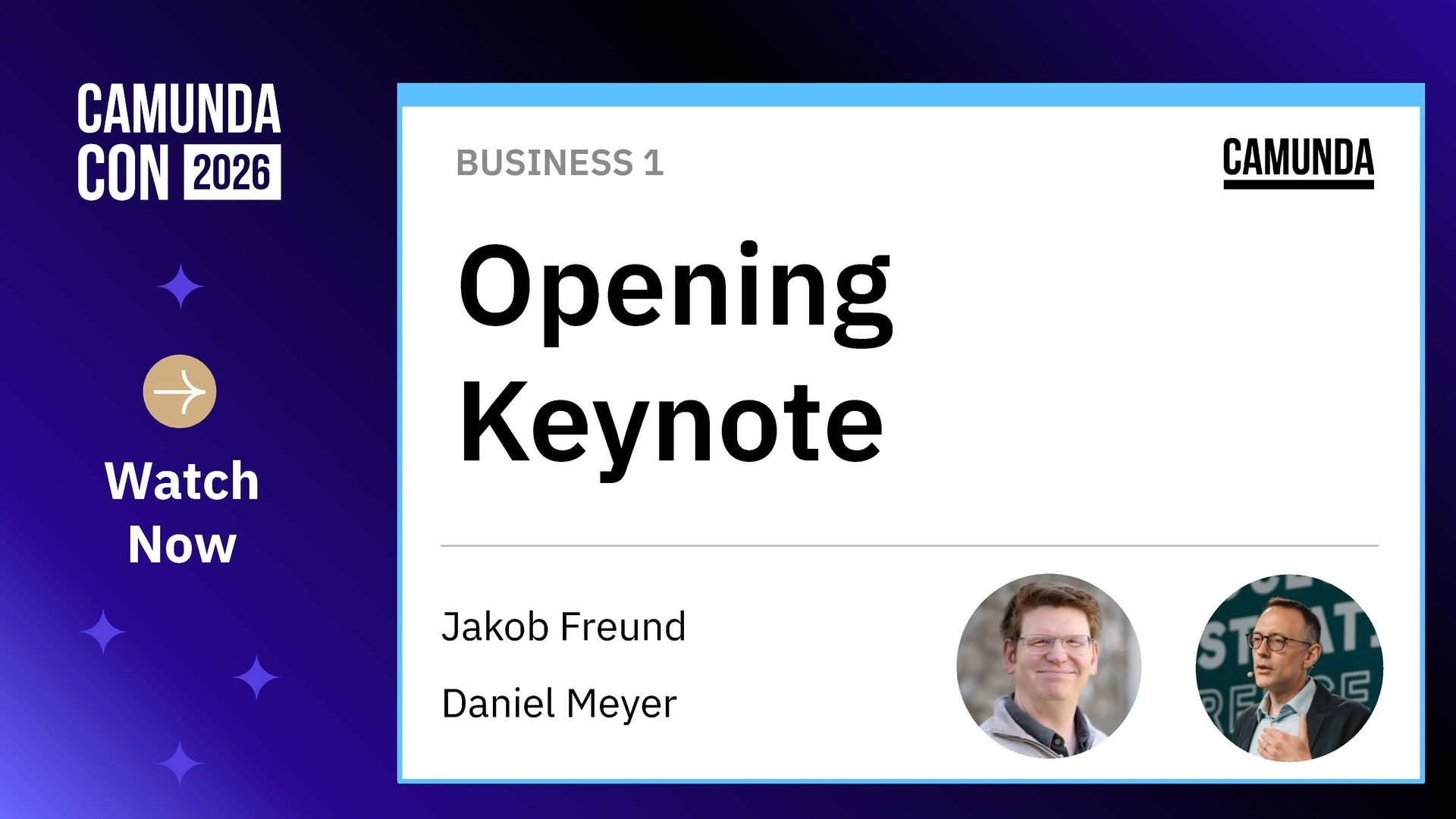
- What happened: Camunda announced ProcessOS in closed beta at CamundaCon in Amsterdam on May 20, 2026.
- The new intelligence layer is meant to discover existing workflows, redesign them for AI-native execution, and suggest KPI-based improvements after deployment.
- Why it matters: The product points to a shift from AI as task assistance toward AI agents that generate
processes, integrations, decisions, and UI forms. - Developer impact: Enterprise agent work now depends less on model calls alone and more on approvals, audit logs, deterministic workflows, and ERP or CRM boundaries.
- ProcessOS is still a closed beta, so the claims to watch are human-in-the-loop control, fitness functions, and production recoverability.
- Watch: The hard question is no longer only what an agent can generate, but what it is allowed to change inside a business.
Camunda announced ProcessOS on May 20, 2026, at CamundaCon in Amsterdam. The name sounds like another attempt to claim the phrase "AI operating system." The more important signal is not the branding. It is that the AI agent race is moving past chat windows, coding tools, and isolated tool calls into the business process layer itself.
According to Camunda, ProcessOS sits on top of its existing agentic orchestration platform as an intelligence layer. Its job is to discover how work actually moves through an organization, redesign those flows around AI-first execution, and continuously propose improvements based on business KPIs. The announcement says ProcessOS can generate or modify agentic processes, integrations, data mapping, agent prompts, decisions, and UI forms.
That list can read like ordinary product scope, but for developers and AI platform teams it marks a meaningful change. Many enterprise AI deployments still attach a chatbot or assistant to an existing application screen. The assistant searches, summarizes, drafts, or recommends while the human keeps driving the process. Camunda is aiming at the layer after that. It wants the organization to define the desired business outcome first, then decide which steps should be performed by an AI agent, which steps should stay deterministic, and which steps still require human approval.
Why process is becoming the next agent battleground
Recent AI agent infrastructure news has often centered on execution environments. OpenAI and Anthropic emphasize code execution, file access, managed agents, MCP, sandboxes, and developer-facing agent runtimes. Google is widening Gemini through APIs, Search, and Workspace. SAP, ServiceNow, Microsoft, and UiPath are building control planes inside enterprise work systems. Honeycomb is turning agent behavior into timelines. AWS is packaging policy, identity, memory, and evaluation around Bedrock AgentCore.
The common lesson is simple: smarter models do not automatically automate enterprise work. If an agent reads a customer record, approves a refund, routes an insurance claim, touches a banking workflow, or resolves a supply-chain exception, an API key is not enough. The system needs to know which records the agent may read, which state transitions it may trigger, when it must hand off to a human, how failures roll back, and what an auditor can reconstruct later.
Camunda already lives near that problem. BPMN, workflow orchestration, human tasks, and process modeling existed long before the current agent boom. What makes ProcessOS interesting is that Camunda is re-framing that older process discipline as an advantage rather than legacy baggage. Existing workflows are slow, complex, and different across organizations. But that is exactly why agents cannot simply roam through enterprise systems alone.
Camunda's message is not "throw away process and let AI handle it." It is closer to "let AI understand and redesign process, then execute inside a controlled orchestration layer." That is a pragmatic position. Long-running agent work is inherently less predictable than a classic workflow. Enterprise operations still need predictable boundaries.
| Adoption model | Traditional AI assistance | ProcessOS-style redesign |
|---|---|---|
| Starting point | Current application screens and human steps | Business outcomes and KPI targets |
| AI's role | Search, summarization, recommendation, and draft generation | Agentic steps, decisions, integrations, and form generation |
| Control model | App-level permissions and after-the-fact logs | Visual process models, human approval, and approved patterns |
| Main risk | AI speeds up the same old bottlenecks | The authority to redesign process becomes too broad or unclear |
Four points in the announcement matter most
First, ProcessOS is presented as a process redesign tool, not just an automation tool. The official product page calls ProcessOS an intelligence layer for the Camunda platform. It describes four specialized agents covering process discovery, design, build and deployment, and optimization. The key words are discovery and design. In many enterprises, the documented process and the real operating process are not the same thing. Before AI can safely change a workflow, it has to understand both the intended path and the exceptions that people handle in practice.
Second, ProcessOS is a closed beta. This is not a product that any developer can immediately test. Camunda says it is available to selected enterprises, and the product page points to a closed beta and a Process Zero engagement. That means this news should not be read as "the tool has proven itself in the open." It is better read as a signal about where enterprise agent products are trying to compete.
Third, Camunda puts human-in-the-loop review in the center of the message. The press release says every process modification is reviewed and approved by humans before reaching production. That distinction matters. There is a large gap between an AI agent suggesting a process improvement and that improvement automatically changing a production workflow where customer data, money, claims, or compliance obligations are involved. ProcessOS is positioning itself on the safer side of that gap: AI proposes, humans approve, orchestration executes.
Fourth, Camunda says ProcessOS does not replace existing enterprise systems. The announcement frames it as an open orchestration and intelligence layer above ERP, CRM, core banking, and claims systems. That is a realistic position. A single AI product is unlikely to rip out the core systems of a bank, insurer, manufacturer, or public agency. The faster path is to control how agents read, write, and coordinate across those systems.
Existing operational data and process traces
ProcessOS: discover, design, generate, and propose improvements
Human approval and visual process model review
Execution through ERP, CRM, banking, and claims systems
The dangerous part of "AI creates the process"
Camunda CTO Daniel Meyer compares the shift in business operations to what has already happened in software development. Developers are moving from writing every line by hand to working with AI systems that generate more of the code. In Camunda's framing, business process owners should similarly be able to describe the result they want in natural language and let ProcessOS build, deploy, and optimize the process.
The analogy is powerful, but it should be handled carefully. Code generation and process generation are similar, but not identical. Bad code can fail tests or cause an outage, which is serious enough. A bad business process can approve the wrong customer, deny the wrong claim, send the wrong bill, mishandle a regulated record, or trigger a financial transaction under the wrong conditions. Legal and regulatory responsibility attaches quickly.
That is why the validation and approval layer matters more than the generation layer. A natural-language message saying "I improved the process" is not enough. Operators need to see which steps are performed by AI, which conditions route work to a human task, which integrations change external state, and which decision rules control the flow. This is where process modeling culture, including BPMN-style thinking, becomes newly relevant in the agent era.
The other risk is organizational memory. Camunda says ProcessOS can build organizational memory around systems, integration patterns, edge cases, and process decisions in a private Git repository, without using that data for shared model training. That direction is useful because each enterprise's exceptions are highly specific. If an AI system does not learn those exceptions, it mostly produces generic advice.
But organizational memory also increases dependency. If process variants, connectors, approval patterns, KPI scoring, and operating history accumulate inside one platform, switching platforms later becomes expensive. That is not a reason to reject the approach. It is a reason to ask early how portable the process models, logs, connectors, and approval artifacts are.
The target customer is not the generic chatbot buyer
This announcement is closer to enterprise architecture than to a developer tool launch. Camunda says it serves more than 700 organizations and 9 of the top 10 U.S. banks. That customer base explains the first likely market for ProcessOS: not simple SaaS back-office tasks, but core banking, claims, compliance, insurance, supply chain, and other processes where workflows are long, exceptions are common, and accountability matters.
ComputerWeekly's CamundaCon coverage points in the same direction. It described the need for safe customer-data agents to involve high levels of human approval and deterministic behavior. That captures the tension around enterprise agents. The more autonomous an agent is, the more value it can create. The more autonomous it is in core operations, the more expensive control and audit become. Camunda is trying to absorb that tension through orchestration.
That means Camunda's competitors are not only developer-first frameworks such as LangChain or CrewAI. SAP is connecting Joule Studio and Business Data Cloud to ERP processes. ServiceNow is pushing AI Control Tower and agents into IT and operations workflows. Microsoft is building organizational agent inventory and control surfaces through Agent 365 and Copilot Studio. UiPath is linking RPA, orchestration, and coding agents. Salesforce has Agentforce around CRM and customer workflows.
Camunda's differentiator is that it is not the owner of a single application domain. It wants to be the process orchestration layer across systems of record. The strength is neutrality: it can sit between ERP, CRM, banking cores, claims platforms, and custom services. The weakness is the same point. SAP, Microsoft, or ServiceNow may already own the system where work begins. Camunda has to convince customers to put a central control layer across those systems.
Why AWS and Bedrock AgentCore appear in the story
The announcement also includes an AWS integration. Camunda says ProcessOS is designed to run natively on AWS and uses Amazon Bedrock and Amazon Bedrock AgentCore for foundation models, agent memory, identity, and gateway services. It also mentions production-ready reference architectures for Amazon EKS, ECS, and EC2, plus AWS Marketplace availability.
This is more than partner boilerplate. Agent orchestration needs at least three resources. It needs models. It needs agent memory and tool gateways. It also needs identity, networking, and policy boundaries that connect to existing enterprise systems. AWS is strong in that third category. Many enterprise workloads already live inside AWS VPC, IAM, EKS, ECS, and EC2 boundaries. If ProcessOS runs there, customers may avoid sending sensitive operational data into a separate AI SaaS environment.
That does not make the workflow automatically safe. Bedrock AgentCore and IAM can govern access, but they cannot prove that a redesigned business process is correct. If the process design is wrong, infrastructure can merely execute the wrong process securely. That is why the more important test is not cloud integration by itself. It is the fitness function and approval workflow around the generated process.
Camunda describes a fitness function as a weighted scoring model for an outcome goal. A process variant might be evaluated against cycle time, resolution rate, cost per case, compliance rate, and similar metrics. For developers, this is one of the most important details in the product story. When AI proposes a workflow change, "faster" is not enough. Teams need to know whether speed increased at the cost of compliance exceptions, customer experience, human review, or downstream failure recovery.
The quiet community response is also a signal
At the time of the Korean article's research, the author did not find a front-page Hacker News discussion about ProcessOS. GeekNews also did not appear to be discussing ProcessOS directly, while developer-facing topics such as agent virtual filesystems, Gemini 3.5 Flash, and Cursor Composer 2.5 were getting more visible attention. That does not mean the Camunda news is unimportant. It says the audience is different.
Enterprise process orchestration rarely becomes an instant developer-community spectacle. But it is where large budgets, operating authority, and real production risk sit. When AI agents leave personal terminals and browser sessions and enter approvals, claims, contracts, customer data, invoices, and supply-chain exceptions, the vocabulary changes. Prompt length, benchmark scores, and context windows matter less than process owners, audit trails, approval matrices, rollback, and segregation of duties.
ProcessOS is an attempt to translate AI agents into that vocabulary. That is also why skepticism is warranted. "AI discovers and redesigns business process" is compelling in a demo, but real workflows are not fully captured in documents and system logs. People handle exceptions verbally, work around legacy system limits, and fill the gap between written policy and field reality through experience. ProcessOS has not yet been publicly tested enough to show how well it captures that tacit knowledge.
Closed beta status is a real limitation. Camunda's customer base and AWS partnership are trust signals, but they do not answer questions about usability, pricing, model choice, integration difficulty, failure handling, or the effort required from process owners. The most attractive AI agent demos usually show a happy path. Enterprise process automation is proven in the unhappy paths: incomplete data, conflicting policies, legacy system outages, delayed approvals, and customer disputes.
Questions developers and AI teams should ask now
Even if ProcessOS is not immediately available to every team, the announcement leaves a useful checklist for anyone building business agents.
First, what state can the agent change, and what state can it only read? A single broad API key that mixes read and write permissions is a bad foundation for high-risk work. Second, what tests and backtests does an AI-generated process change go through before production? Third, is approval just a button, or can the responsible person understand the process diff, likely impact, and failure mode? Fourth, are execution logs sufficient for both auditing and debugging? Fifth, do the KPIs reflect the actual business goal, or only the easiest metric to optimize?
Those questions are not specific to Camunda. Every enterprise agent platform has to answer them. Camunda's answer is rooted in process orchestration, which is an old discipline now being applied to a new class of system. That is a sensible move. AI agents introduce uncertainty, but enterprise work demands accountable boundaries. Modeling agentic steps and deterministic workflow together is more practical than pretending one can fully replace the other.
The implementation details matter. If a system records only that "AI approved a workflow," it is not enough. It should record the inputs, proposed process changes, affected integrations, policy checks, approval identity, rollout path, and rollback plan. If a system optimizes only for cycle time, it may silently make compliance or customer outcomes worse. If generated process artifacts are not portable, the organization may gain automation while giving up strategic flexibility.
What this news means
ProcessOS does not prove who will win the enterprise agent race. It is a closed-beta product with limited public validation, no open benchmark, and few public customer details. But it does show where the competition is moving. Agents need authority to create value. Authority requires controls, auditability, approval, observability, and clear operating boundaries. The contest is becoming less about who can build the most autonomous agent and more about who can put autonomy inside a system of responsibility.
Camunda's answer is process. It treats existing workflows not only as slow legacy machinery, but as the execution map and accountability ledger that agents need in order to act safely. Whether that answer works in the field remains open. The signal for AI teams is already clear: the next generation of agent infrastructure is likely to look less like a model API wrapper and more like a layer that combines process design, system integration, human approval, KPI evaluation, and audit evidence.
That is the real news value of ProcessOS. It is not simply that Camunda is adding AI. It is that enterprise AI cannot transform work from a chat window alone. To change the work, it has to change the process. To change the process, it needs more than a capable model. It needs a disciplined answer to a harder question: what is this agent allowed to change?