AWS opened partner sales forms to MCP agents
AWS Partner Central agents turn opportunity creation into natural language, file analysis, MCP access, IAM permissions, and explicit approval for writes.

- What happened: AWS added natural-language
opportunity creationto Partner Central agents.- Partners can describe a deal, upload meeting notes, proposals, or call transcripts, and let the agent extract, enrich, and recommend field updates.
- Why it matters: The feature is exposed not only through Amazon Q chat, but also through an AWS-hosted
MCP Server. - Watch: AWS documents verification warnings, IAM boundaries, and explicit human approval before write operations.
- The real story is not sales copy generation. It is how enterprises control agents with write access to business systems.
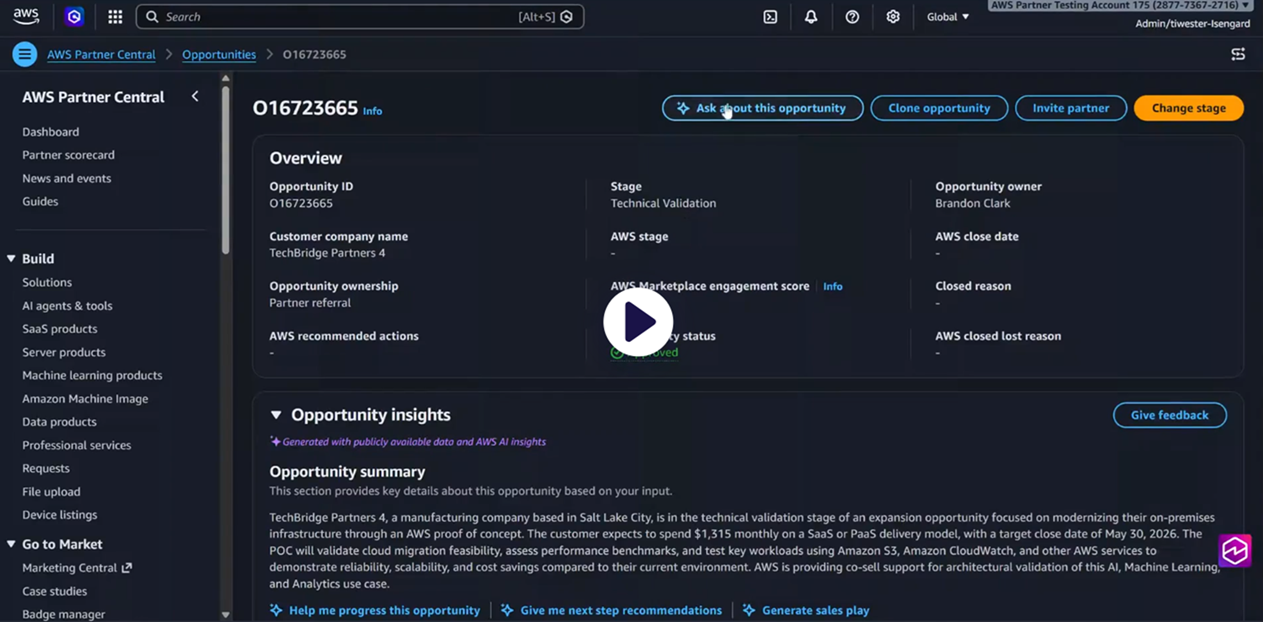
AWS said on May 15, 2026 that Partner Central agents now support natural-language opportunity creation. On the surface, this is a productivity update for AWS partner sales teams. A partner can describe a deal in a conversation or upload meeting notes, proposals, or call transcripts. The agent extracts opportunity information, enriches customer details, and recommends fixes for missing context, incorrect fields, or a weak business problem statement. The pitch is simple: replace a multi-step form with a shorter conversation.
For developers and AI product teams, the more interesting part sits one layer down. This feature does not stop inside Amazon Q chat in the AWS console. AWS also documents a Partner Central agents MCP Server. Through the Model Context Protocol, AI clients and external tools can reach Partner Central opportunity management, customer insights, and funding programs through a fully managed AWS-hosted service. The protocol is JSON-RPC 2.0 over HTTPS. Authentication uses SigV4. Streaming responses use Server-Sent Events. Write operations require explicit user approval before execution.
That makes the news bigger than "AI fills out sales forms." It is a concrete example of MCP entering the action layer of a real business system. Partner Central is not a demo app. It handles co-sell pipeline, funding requests, customer profiles, solution recommendations, and partner revenue workflows. Once an agent enters that surface, the hard questions are less about chat UX and more about permissions, file analysis, approval, auditability, and data scope.
This is workflow execution, not form automation
Partner Central agents first appeared in an AWS APN Blog post on March 16, 2026. AWS described the experience as being built on Amazon Bedrock AgentCore. The message then was about reducing fragmented data, scattered expertise, and manual coordination when partners sell with AWS. The agent could provide pipeline insights, customer and pipeline intelligence, funding recommendations, next-step intelligence, and start relevant workflows with prefilled data.
The May update makes that direction more specific. Instead of filling opportunity fields manually, partners can now describe a deal in natural language. They can also upload documents such as meeting notes, proposals, and call transcripts, or clone an existing opportunity. The agent maps extracted information to fields, enriches customer details and business problem statements, and suggests improvements before submission.
That may sound like input automation, but it changes the execution surface. In the old form model, the human has to understand each field, know what information is required, find the relevant detail in documents, and move it into the right place. In the agent model, the human provides context and source material while the system interprets fields and validation requirements. The human shifts toward review and approval.
This resembles the direction of many enterprise agent products. Docusign is turning agreements into an execution layer. ServiceNow and Freshworks are making tickets and incidents into agent runtimes. GitHub and OpenAI are turning repositories and pull requests into workspaces for coding agents. AWS Partner Central agents apply the same pattern to partner sales. The fields, states, permissions, and validation rules that already existed in the business system become tools for the agent.
The MCP server changes the question
AWS's MCP Server documentation is the most interesting part of the announcement. It describes Partner Central agents MCP Server as an AWS-hosted service that connects MCP-compatible AI clients to Partner Central agents. Its capabilities include pipeline insights, opportunity summaries, sales play generation, customer profile creation, solution recommendations, funding recommendations, next-step recommendations, and opportunity progression.
Technically, the server uses JSON-RPC 2.0 over HTTPS, supports SigV4 authentication, and streams responses through SSE. It also supports multi-turn conversations and file attachments. AWS documents analysis for files such as PDF, DOCX, XLSX, CSV, and images. This is not just an API endpoint. It is an integration surface where an agent client can carry conversation state, files, permissions, and approval flow into actual partner operations.
CRM, automation tools, and MCP-compatible AI clients
Partner Central agents MCP Server
Partner Central agents
Opportunity, funding request, sales play, next step
Once MCP is attached, the product changes shape. If this were only a console chat feature, users would go into an AWS screen, ask questions, and press buttons. With an MCP server, partners can call the same capabilities from the CRM, revenue operations workflow, internal sales tool, or automation platform they already use. The AWS APN Blog makes that point directly: the MCP server lets partners connect existing tools and systems to the agents.
That is useful for an obvious reason. Sales teams already work across Salesforce, HubSpot, WorkSpan, Labra, internal CRMs, document stores, and collaboration tools. Re-entering fields inside AWS Partner Central is slow and error-prone. MCP lets an AI client bring AWS co-sell context into those existing workflows and prepare the required action.
It is also risky for an equally obvious reason. If an external tool can create and progress opportunities through natural language, the system needs a clear answer for which user acted, which permissions applied, which customer information was read, and which write operation was approved. If an AI-generated funding recommendation or sales play reaches a customer conversation, accuracy and freshness matter. That is why AWS repeats approval, IAM, and verification warnings in the documentation.
Writes stop until a human approves
The Partner Central agents MCP Server documentation says the server handles authentication, session management, and human-in-the-loop approval for write operations. Write operations require explicit consent before execution. That line matters in enterprise agent design.
Many agent demos emphasize automatic execution: ask in natural language and the agent does it. In production business systems, the stopping point is often more important than the automatic step. Updating or submitting an opportunity, creating a funding request, or progressing a stage has downstream effects. It can affect partner performance, AWS review processes, customer communication, funding eligibility, and marketplace transactions.
So an agent drafting a record, identifying missing information, and suggesting a next step must be separated from the agent changing system state. AWS documents that boundary. Multi-turn conversation and file analysis can be fast, but writes require explicit approval. That is more operationally concrete than a vague statement that humans remain responsible. The approval event becomes part of the product flow.
IAM plays the same role. The Partner Central prerequisites include permissions such as partnercentral:List*, partnercentral:Get*, partnercentral:UpdateOpportunity, partnercentral:SubmitOpportunity, partnercentral:AssignOpportunity, partnercentral:StartEngagementFromOpportunityTask, and partnercentral:UseSession. AWS Marketplace read permissions such as DescribeEntity, SearchAgreements, and ListEntities also appear. Without the right permissions, the server returns access denied.
That list is a blunt map of what the agent can do. Read-only summary permissions differ from permissions that progress an opportunity. Marketplace agreement lookup is separate again. AI product teams should not hide this behind one "enable AI" switch. They need to separate whether a user can view pipeline insights, update opportunity fields, create funding requests, or perform the same action from an external tool.
Generated insights still need verification
AWS promotes the feature, but it also adds important caveats. The documentation says opportunity insights are generated by AI for informational purposes and that accuracy or completeness is not guaranteed. Partners should verify all AI-generated insights before using them in customer engagements. Customer profiles may use publicly available third-party data and may not reflect the latest business developments.
That warning may look like routine legal language. In a business workflow, it is actually a design requirement. In partner sales, an incorrect customer profile, compliance requirement, or budget projection is not just a bad answer. It can damage customer trust and pipeline quality. The APN Blog's KXC Tecnologia example says SDR teams can prepare around customer pain points, compliance requirements, and budget projections. Those are exactly the kinds of claims that need verification.
Data provenance also matters once the agent reads documents and fills fields. Did a piece of information come from uploaded meeting notes, an opportunity record, a public third-party source, or AWS best practices? Telling users to verify is necessary but not sufficient. The UI and API response should expose source, confidence, last updated time, and human review state whenever possible.
AWS has not publicly shown every detail of the provenance UI. Still, the documentation is careful about data scope. Opportunity insights consider only opportunities submitted to ACE from the partner account. They do not access other partners' or accounts' data. Customer profile information is described as publicly available third-party information rather than data taken directly from partner or AWS systems. That separation is important.
AgentCore gets a practical workload
AWS has been attaching Amazon Bedrock AgentCore to more work surfaces in 2026. AgentCore Payments opened a path for agents to pay for API or MCP server usage. AgentCore Identity handles access to external services and OAuth flows. Partner Central agents are less flashy, but arguably more practical. They agentize repetitive internal work, field validation, document extraction, and permissioned writes.
This kind of product can look distant from frontier model benchmarks. In real AI adoption, though, this is where bottlenecks often live. Companies already have forms, CRM fields, approval stages, state transitions, eligibility rules, document attachments, and customer profile lookups. People move between these systems, copy data, chase missing fields, and ask what to do next. Agents can enter first where the work is repetitive but still full of rules and exceptions.
Partner Central agents show that pattern clearly. Pipeline insight is analysis work. Sales play generation is generation work. Opportunity progression is write work. Funding recommendation and request creation involve policy and money. Put those in one product, and a simple chatbot architecture is not enough. You need data access, tool schemas, permissions, approvals, logs, and evaluation.
| Capability type | Partner Central agents example | Operational risk |
|---|---|---|
| Read and summarize | Opportunity summary, pipeline insights | Stale data, missing context, excessive compression |
| Recommend | Sales play, solution match, next step | Incorrect customer profile, wrong eligibility interpretation |
| Analyze files | Meeting notes, proposals, call transcripts | Sensitive data handling, source ambiguity, extraction errors |
| Write to systems | Opportunity update, stage progression, funding request | Permission abuse, missed approval, weak audit trail |
Why developers should still pay attention
Because this update targets AWS partner sales teams, it may not look like mainstream developer news. For teams building with MCP and AgentCore, it is a useful reference case. Many AI apps now say that once they expose an MCP server, agents can use their SaaS product. As soon as the tools can do meaningful work, a harder set of questions appears.
Which operations should remain read-only? Which operations should create drafts but not submit them? Which operations require explicit approval? How is session state maintained? Who authenticates? Does the same permission model apply when the call comes from an external AI client? If file attachments are accepted, which formats and sizes are allowed, and how are customer information or personal data stored and retained? If a recommendation is wrong, how can the user verify it quickly?
The Partner Central agents MCP Server documentation gives a minimum skeleton for those questions. It uses SigV4 authentication and AWS IAM permissions. The server handles session management. It supports streaming responses with SSE. Write operations require human-in-the-loop approval. File analysis is supported, but AI-generated insights come with verification warnings. This does not mean the design is complete, but it does mean AWS is treating MCP as an operational surface rather than a novelty endpoint.
That structure is likely to become more common. CRM, ITSM, ERP, contract management, cloud consoles, security operations, and development platforms already have UIs and APIs. AI agents will try to bind them together with natural language. The competitive advantage will not come only from prettier chat bubbles. It will come from preserving existing permission models, approval flows, and audit records while making the work faster.
What still needs watching
First, the real MCP client ecosystem matters. A documented MCP Server is useful only if configuration, authentication, tool schemas, and error handling work cleanly inside the CRM and automation platforms partners already use. MCP is moving toward standardization, but enterprise integration still tends to spend most of its time on identity and permissions.
Second, approval UX matters. Requiring approval for every write is the right principle, but excessive confirmation can train users to approve mechanically. A workflow that is too heavy will erase the automation benefit. The practical design question is which field updates can be approved in bulk, which sensitive actions such as funding requests need extra checks, and how approval prompts appear in external tools.
Third, generated insight provenance matters. AWS states that users should verify outputs, but sales teams often consume recommendations quickly. Customer profiles, compliance requirements, budget projections, and sales plays should make their sources visible in the UI and API. This is especially important when a customer profile depends on third-party public data whose freshness can vary.
Fourth, pipeline quality must be measured separately from speed. AWS says the goal is to help partners submit higher-quality opportunities, improve pipeline hygiene, and shorten sales cycles. The test is whether the agent improves quality or simply creates more opportunities faster. Better metrics would include approval rate, fewer rejection reasons, funding utilization, customer response quality, and the percentage of fields humans later edit.
The next MCP battleground is permission behind the form
This AWS Partner Central agents update is not a spectacular model launch. There is no new benchmark score and no new developer IDE. It is still practical AI news because it shows where agent products are going. Much of enterprise work is made of forms, fields, states, documents, approvals, and permissions. Agents entering that world need more than natural-language understanding. They need tool protocols, IAM, sessions, file analysis, human approval, and generated-insight verification.
The most important line in the announcement is not simply that opportunity creation can happen through natural language. It is that Partner Central agents expose an AWS-hosted MCP endpoint to external tools and AI clients. MCP is moving beyond developer-tool demos and knowledge retrieval. It is entering the path where agents prepare and request approval for writes in live business systems.
That makes the update relevant beyond AWS partner sales. SaaS teams, internal automation teams, and developers exposing MCP servers face the same questions. What can the agent read? What can it write? Who approves? How are wrong recommendations verified? AWS Partner Central agents place those questions on top of a concrete co-sell pipeline. That is why this quiet product update is worth watching.
Sources: AWS What's New, AWS APN Blog, AWS Partner Central agents guide, AWS Partner Central agents MCP Server docs.