HTTP 402 is back, AWS tests wallets for AI agents
AWS AgentCore Payments previews a runtime layer where AI agents pay for APIs and MCP servers through x402, Coinbase, and Stripe wallets.
- What happened: AWS previewed
Amazon Bedrock AgentCore Payments.- It lets agents discover paid APIs, MCP servers, web content, and other agents at runtime, then pay directly within a configured budget.
- Core mechanism: The first payment protocol is
x402, a revival of HTTP402 Payment Required.- Coinbase CDP wallets and Stripe Privy wallets are the first connections, while AWS emphasizes per-session spend limits and observability.
- Why it matters: The bottleneck for agent economies is moving from model inference to payments, budgets, and audit logs.
- Watch: This is still a preview, and buyer-intent checks plus cost control for large concurrent agent runs remain unproven in production.
AI agents calling external APIs no longer feels unusual. Developers are wiring them to MCP servers, opening sandboxes, using search APIs, and handing off subtasks to other agents. One question has remained underdeveloped in that flow: when the resource an agent needs is paid, who pays, when, and under which controls?
AWS addressed that question directly with Amazon Bedrock AgentCore Payments, announced on May 7, 2026. The product is in preview, but the direction is clear. AWS wants agents to discover paid APIs, MCP servers, web content, and other agents while they are running, then continue the task by paying from an approved wallet within a defined budget.
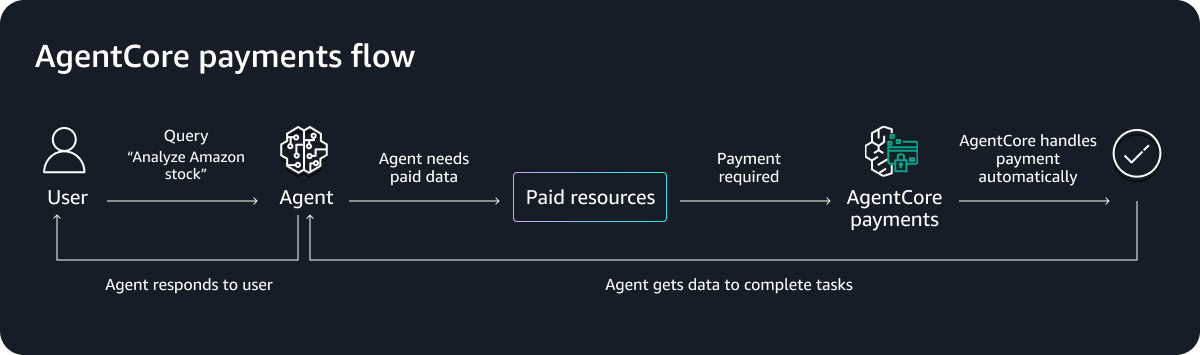
The interesting word here is less "wallet" than "402." HTTP 402 Payment Required has existed for years, but it never became a mainstream part of the web. Coinbase-led x402 reinterprets that empty status code for machine-to-machine micropayments. An agent requests a paid endpoint. The server returns a 402 response with payment terms. AgentCore Payments handles wallet authorization, stablecoin payment, and proof delivery. The user does not click through a checkout screen every time, and the agent does not have to stop its reasoning loop.
That means the story is not simply "AWS gave agents a wallet." The more important shift is that a cloud agent runtime is starting to pull payments, budgets, permissions, and audit logs into the execution layer. Once an agent can move real money, generating a good answer and making a safe transaction are no longer separate engineering problems.
Why payments became an agent infrastructure problem
AWS frames the problem simply. As agents do more work, they will increasingly need to consume paid resources directly. A financial research agent may need real-time market data and premium reports. A coding agent may call a private package registry, a sandboxed execution environment, or a specialist MCP server. In a multi-agent workflow, one agent may pay another agent that is better at a particular task.
With the old integration model, that gets messy quickly. Developers need separate contracts with each API provider, registered payment methods, API keys and wallet credentials, custom usage limits, and separate cost logs. That can work when there are only a few paid resources. It breaks down when an agent is expected to discover the right paid resource during execution instead of relying on a hardcoded billing relationship.
This is why AWS put payments inside AgentCore rather than shipping them as a checkout widget. AgentCore already groups agent runtime, identity, gateway, and observability. Payments now enter the same control plane as identity, logs, metrics, and traces. AWS describes this as infrastructure-layer security that agents cannot bypass. The wording is broad, but the direction is right: payments should be enforced outside the model's natural-language promises, not merely requested inside a prompt.
For developers, that changes the shape of tool permissioning. Once an agent is allowed to call a paid API, tool access is no longer just read versus write. Teams need to decide which endpoints an agent may pay, how much it can spend, which user request authorizes that spend, which vendors are forbidden, how failed or duplicate payments are handled, and where the audit trail lands.
x402 revives Payment Required
AgentCore Payments initially supports x402. Based on AWS's blog and documentation, the flow looks like this:
Agent requests a paid API or MCP server
Server returns HTTP 402 Payment Required and pricing terms
AgentCore Payments authenticates the wallet, checks limits, and executes payment
Agent retries the resource request with payment proof attached
Content, data, or tool output returns to the agent loop
The key point is that payment becomes closer to a protocol-level tool call than a human checkout flow. Human web payments are built around carts, card entry, 3-D Secure, receipts, and confirmation emails. That does not fit an agent that may call an API many times per second or combine several paid endpoints inside one task. x402 puts the payment requirement into the HTTP response and attaches payment proof to the request flow.
Coinbase says x402 is designed for USDC settlement on Base in about 200 milliseconds with transaction costs at a fraction of a cent. It also cites ecosystem numbers from the x402 Foundation: more than 169 million payments, 590,000 buyers, and 100,000 sellers. Those are Coinbase's figures, so they should not be treated as neutral evidence of total market adoption. Still, AWS choosing x402 as the first AgentCore payment protocol matters. Agent payments are moving from crypto-native experiments into a major cloud runtime's product surface.
AWS also says it does not want to be locked to x402 alone. Its official post mentions early protocols such as x402, ACP, MPP, and AP2, while the preview currently supports x402 and plans to add additional protocols at the platform level. That is important for builders. If agent payments are still in a standards race, embedding a different protocol SDK into every agent will become expensive to maintain. If the cloud runtime absorbs protocol negotiation, agent code can focus more on the policy question: how much may this task spend?
The Coinbase and Stripe roles
The first payment connections in the preview are Coinbase CDP wallets and Stripe Privy wallets. AWS's documentation describes the components in fairly concrete terms. PaymentManager coordinates account-level payment configuration. PaymentConnector links to external payment providers. Credentials are stored through AgentCore Identity and AWS Secrets Manager paths. A payment session has a maximum spend amount, currency, and expiry time. Once a session expires or reaches its limit, additional payment requests are denied.
This is not the same as an agent carrying a private key around in its context. Coinbase also emphasizes that the agent does not access the private key. A developer connects the wallet provider, the user explicitly authorizes wallet access, and AgentCore handles payment processing and observability. That does not automatically prove production-grade safety, but it does define the intended boundary: wallet credentials, session budgets, transaction logs, and payment proof sit outside the model's natural-language judgment.
Stripe's presence is also notable. In AWS's announcement, Stripe provides a preview payment connection through Privy wallet infrastructure. AWS and Stripe also point toward broader commerce flows beyond micropayments, including travel booking and online purchasing. That is still closer to a roadmap than a finished product. But if agent commerce moves beyond API calls into real transactions, it inherits card networks, merchants, refunds, fraud, buyer-intent verification, and disputes. Stripe's early role suggests AWS is already looking past the narrow API-micropayment case.
What the pricing example reveals
The most practical signal is AWS's pricing example. AWS says AgentCore Payments does not add an AWS-specific charge, while wallet operations follow the provider's pricing. In the example, a financial services company deploys 200 AI agents, and each analyst uses premium data services several times. ProcessPayment calls are priced at $0.005 per operation by the wallet provider.
| AWS pricing example | Pilot | Full rollout | Signal to read |
|---|---|---|---|
| Agent count | 200 | 200 | The risk is execution volume, not only seat count. |
| ProcessPayment calls | 270,000/month | 720,000/month | Agent payments are sensitive to bursts and repeated calls. |
| Wallet operation cost | $1,350 | $3,600 | Payment-processing cost is separate from vendor spend. |
| Vendor micropayment spend | $675,000 | $1,800,000 | The real exposure is total paid-resource consumption. |
The example may look like marketing math, but it is useful because it makes the operational problem visible. The cost issue in AgentCore Payments is not the few dollars of wallet operations. It is the total spend across premium data, paid APIs, external agents, paywalled content, and specialized compute. A payment between $0.10 and $3.00 looks small until it happens hundreds of thousands of times. Unlike human-operated SaaS, agents run in parallel, retry failures, and generate subtasks.
That makes spend limits an architecture requirement, not a UX option. Teams may need per-session limits, per-user limits, per-agent-type limits, per-vendor limits, time-window limits, retry limits, and concurrency caps. Those controls need to be enforced by the payment layer, not left as prompt instructions. That is why AWS's phrase "deterministically enforced at the infrastructure layer" matters.
When MCP servers become paid products
The larger ecosystem question is MCP. Until now, MCP has mostly been framed as a standard for connecting LLMs to tools and data. Many MCP servers are open source, free, or connectors that use the permissions of an existing SaaS account. AgentCore Payments assumes MCP servers themselves can become pay-per-use resources.
Imagine a coding agent calling a specialized vulnerability-analysis MCP server that charges a few cents per scan. Another agent might need high-quality web search, legal document retrieval, real-time financial data, or a browser execution environment, each priced per call. AWS's note that Coinbase x402 Bazaar MCP is available through AgentCore Gateway points toward that marketplace shape. An agent can discover a merchant endpoint, inspect the price, pay, and receive the result.
That affects API business models. APIs for humans are usually priced through monthly plans, seats, quotas, and overages. APIs for agents may need smaller units and faster settlement. If a user asks, "do this one research task today," and the agent combines multiple data providers, task-level micropayments may be more natural than a monthly subscription. Providers also have less room for unlimited free tiers, because agent traffic can create costs much faster than human browsing.
This does not mean every MCP server becomes paid. The market is more likely to split. MCP servers that call internal systems will focus on authorization and audit. MCP servers that provide external data, computation, or expert work will focus on pricing and service levels. AgentCore Payments targets the second category. The developer question is not simply "should our MCP server charge money?" It is "when agents call this server repeatedly, who tracks cost and accountability?"
How far the guardrails go
AWS's announcement includes several meaningful controls. End users must explicitly authorize wallet access. The runtime applies per-session spending limits. Agents are not described as having open-ended access to funds. Every transaction is observable through AgentCore logs, metrics, and traces. PaymentConnector credentials are stored through AWS Secrets Manager and AgentCore Identity paths.
That is a reasonable baseline for a preview. But agents that move real money still raise harder questions.
The first is buyer-intent verification. A user approving "spend up to $10 for this report" is not the same as proving that every vendor and endpoint the agent chooses is consistent with the user's intent. A prompt injection could push the agent toward an expensive endpoint. A malicious MCP server could repeatedly trigger 402 responses. Spend limits reduce blast radius, but they do not prove intent.
The second is approval granularity. If every payment requires a human click, the agent experience falls apart. If every payment is automatic, cost and security risk increase. In practice, teams will need policies based on vendor allowlists, resource categories, amount thresholds, task types, and user roles.
The third is audit-trail independence. An agent saying "I only bought the data I needed" is not evidence. The payment log has to stand apart from the model output. A reviewer should be able to reconstruct which session, which user intent, which endpoint, which amount, which proof, and which result were involved.
The fourth is concurrency and retry behavior. A $5 session cap may be reassuring for one execution. It looks different when the same agent runs 500 sessions in parallel. If the agent retries failed requests automatically or decomposes work into sub-agents, cost prediction gets even harder. Session caps need to be backed by global budgets, rate limits, concurrency controls, and anomaly detection.
The community split
The reaction to this announcement is divided in a useful way. Crypto and agentic-commerce communities focus on AI agents holding wallets and paying APIs with USDC. Many developers focus on the revival of HTTP 402 and the possibility that x402 becomes a standard for API marketplaces, paid MCP servers, and agent-to-agent services.
The cautious reaction is just as important. Some developers argue that agents still struggle to reliably operate Gmail, CRMs, and enterprise SaaS, so automating payment may be early. Others say the headline should not be "agent wallet" at all. The harder parts are budget enforcement, audit trails, reputation, buyer intent, rollback, and recovery. That is the more useful enterprise lens.
AgentCore Payments is not immediately necessary for every AI app. An internal document bot, support-draft assistant, or code-review helper may consume few external paid resources. But once an agent starts combining market data, specialized search, sandbox runtime, paid crawling, legal or financial databases, and external agent services, the payment layer becomes unavoidable. The announcement shows a competition over who will own that control plane.
What builders should watch now
The first question for AI product teams is not "should we add payments to our agent?" It is "which paid resources can our agent consume?" Without that inventory, any payment infrastructure will be unstable.
The second question is the cost model. Human SaaS is often budgeted through seats and monthly active users. Agents vary by tasks, tool calls, paid endpoints, retries, sub-agents, and concurrency. The pricing page should be read by runtime engineers and finance teams, not only product managers.
The third is permission design. One API key or wallet for every payment is convenient, but risky. Teams may need user-level payment rights, organization wallets, project budgets, and agent-type allowlists. Some resources may be paid from a personal budget, some from a team budget, and some blocked without compliance approval.
The fourth is observability and testing. A payment-capable agent needs more than normal agent evals. It needs tests for prompt-injection scenarios, malicious 402 endpoints, duplicate payment proof, retry after timeout, partial failure, budget exhaustion, and audit reconstruction. "Did the agent answer correctly?" becomes less important than "how did the agent spend money?"
The control plane matters more than the wallet
AWS AgentCore Payments is still a preview. Region support is limited, x402 is the first protocol, and broader commerce flows remain future work. Not every development team needs to adopt it now. As news, though, it matters because a cloud platform is starting to treat AI agents as economic actors, not just execution units.
Saying that an agent "spends money" can be misleading if it implies human-like economic judgment. The more precise version is that software can automatically consume paid digital resources within a human-approved goal and budget. As that pattern grows, payment becomes a core primitive of agent runtime rather than an add-on.
The point to watch is not the wallet itself. It is who standardizes budget, audit, and permissioning when agents consume paid APIs, MCP servers, data, and other agents. AWS is trying to put that answer inside AgentCore identity, gateway, and observability. Coinbase is pushing x402 and USDC settlement as a candidate standard. Stripe is positioning for the point where agent commerce crosses into broader purchasing flows.
HTTP 402 coming back is symbolically useful. The web has long had a status code for "payment required," but human checkout and ad-funded pages left it underused. In the agent era, that empty slot is reopening. This time, the response is not shown to a person clicking a button. It is received by an agent carrying a budget and policy. At that point, good agent infrastructure has to do more than call models well. It has to prove why money moved, where it went, and which limits held.