The SDK Generator Shut Down, and Claude Took the Connection Layer
Anthropic’s Stainless acquisition shows Claude’s moat expanding from model quality into SDKs, MCP servers, and reliable API connectivity.
- What happened: Anthropic acquired
Stainless, a company that generates SDKs and MCP servers from API specs.- Stainless said new signups, projects, and SDK generation for its hosted product are no longer available.
- Why it matters: Agent competition is moving from model answers toward the quality of API connections.
- Builder impact: OpenAPI specs, SDK releases, docs, and MCP servers are becoming part of the Claude Platform execution surface.
- Watch: Anthropic did not disclose the deal price or detailed long-term terms for existing Stainless customers.
Anthropic announced its acquisition of Stainless on May 18, 2026. The announcement was short, but the strategic sentence inside it was unusually direct: the AI frontier is moving from models that answer to agents that act, and agents are only as useful as the systems they can reach. That is the logic Anthropic used to explain why it bought a company that builds SDK and MCP server tooling.
Read narrowly, this looks like a small developer-tools acquisition. Stainless did not build a flashy chatbot or a new foundation model. It took API specifications and generated SDKs, CLIs, docs, and MCP servers across several languages. On the surface, that is developer experience automation. In the agent era, however, this layer becomes much more sensitive. A model can be excellent, but if it misunderstands a business API, waits on stale SDKs, or calls an unreliable MCP server, the agent cannot finish the job.
The stronger signal came from Stainless itself. In its joining announcement, Stainless said its hosted product, new SDK generator signups, new projects, and new SDK creation were shutting down. Existing generated SDKs remain owned by customers and can still be modified and extended, but Stainless as an independent hosted product no longer appears to be on the same expansion path.
What Stainless Actually Sold
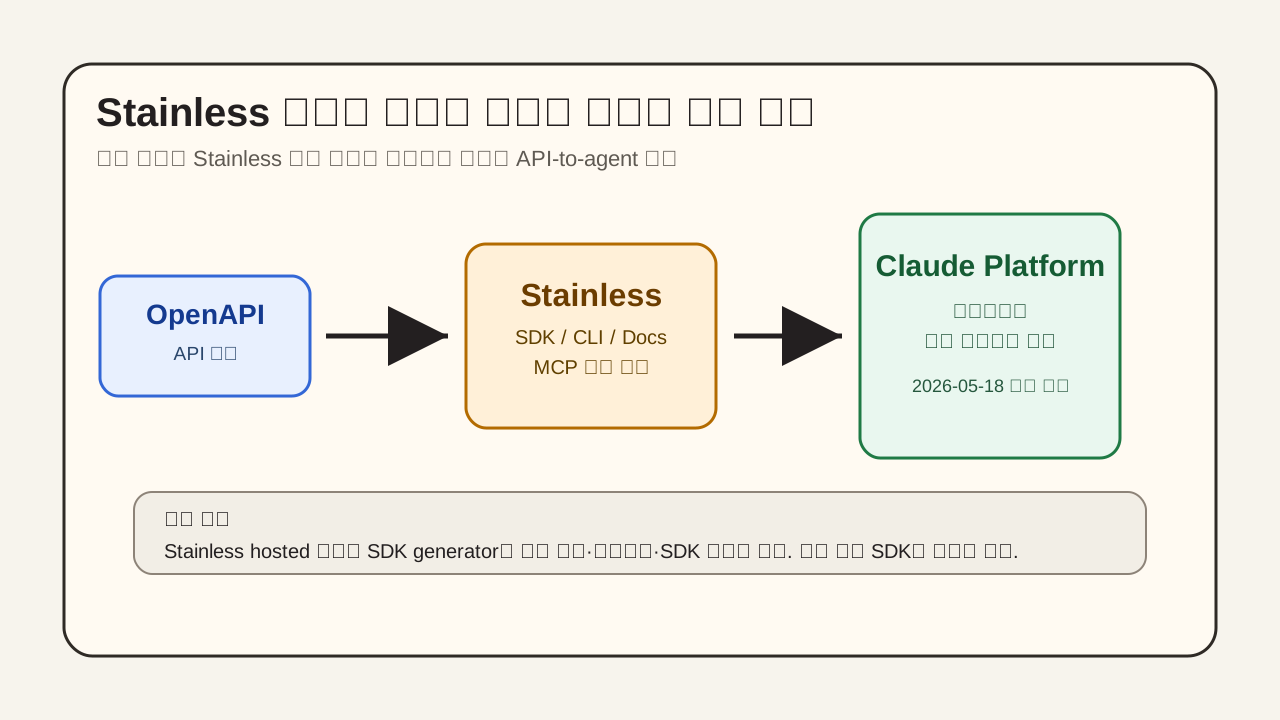
To understand Stainless, it is not enough to stop at the phrase "SDK generator." Stainless provided a pipeline that starts from an OpenAPI specification and produces TypeScript, Python, Go, Java, and other language SDKs, along with docs, a CLI, and MCP servers. When an API team changed its spec, Stainless could surface SDK-specific diffs and diagnostics, then help prepare release pull requests.
Anthropic’s announcement says Stainless has powered all official Anthropic SDK generation since the early days of the Anthropic API. That one detail explains much of the acquisition. Anthropic had already been operating its developer experience through Stainless-generated artifacts. Now it is pulling the team and system inside the Claude Platform.
Stainless’s own post frames the story more broadly. The company started in 2022 with the goal of reinventing the API layer of the internet. By 2026, it argues, AI is changing how software and APIs are created and used, and the meaning of good developer experience is changing with it. Stainless says it will now focus on Claude Platform capabilities and the problem of connecting agents to APIs.
That wording matters because the subject is changing. The old story was SDKs for developers. The new story is connectivity for agents. Historically, an SDK was a library a person imported into an IDE, read through documentation, and called from application code. In an agent system, SDKs and MCP servers become execution interfaces through which a model discovers tools, fills parameters, recovers from failures, and stays inside permission boundaries.
Why This Is Also an MCP Story
Anthropic created the Model Context Protocol, or MCP. MCP is now used as a standardized channel between models and external tools or data sources. Claude Desktop, Claude Code, and many agent frameworks rely on MCP servers to access file systems, databases, SaaS tools, and internal systems.
This is where Stainless fits. Many companies already have OpenAPI specs, but a spec does not automatically become a good agent tool. Endpoint names can be vague. Schemas can be loose. Auth and permission behavior can be underdocumented. Error responses can be inconsistent. A human can often read between the lines, but an agent is more likely to turn those gaps into incorrect tool calls.
Stainless worked directly in that gap. If the same API spec can generate language SDKs, documentation examples, and MCP servers, then human developers and models are closer to sharing the same contract. By internalizing Stainless, Anthropic can design new API features, SDKs, docs, and MCP connectivity in a tighter loop.
This is a different kind of model advantage. A higher reasoning benchmark score is useful, but enterprise agent adoption often stalls on a more operational question: can the system connect to real work systems accurately enough? As Claude connects to customer CRMs, payment systems, document stores, code repositories, and data warehouses, Anthropic starts to look less like a model provider alone and more like an execution environment provider.
The Signal Behind the Hosted Product Shutdown
The part of the deal that developers reacted to most sharply was the product shutdown. Stainless said that, starting immediately, new signups, projects, and SDKs would no longer be available. It also provided transition guidance and said customers retain rights to the SDKs already generated for them.
That statement says two things at once. One is a customer protection line: previously generated SDKs are not being taken away. The other is that Stainless is no longer growing as the same independent SaaS product. For API companies, SDK generation and docs automation can be part of the software supply chain. That supplier has now moved inside a specific model company.
Community reaction reflected both congratulations and unease. In the Hacker News discussion, many comments tried to pin down what Stainless actually did. A participant who appeared to be from Stainless described a pipeline that turns OpenAPI specs into language SDKs, docs, MCP servers, a CLI, and release automation. Other comments asked whether Anthropic was buying talent, buying infrastructure, or putting pressure on competitors that depended on the same developer tooling layer.
It would be too strong to claim more than the public record supports. Anthropic did not say it was cutting off competitors. It did not officially disclose the deal price. Techmeme linked to TechCrunch coverage that described discussions around a deal above $300 million, but that is not an official Anthropic number. The confirmed fact is the hosted product shutdown. That alone is enough to send a large signal through the API developer experience market.
Agent Platforms Are Buying API Contracts
The acquisition shows what Anthropic now treats as platform infrastructure. A model, an app, a coding agent, and an enterprise console are not sufficient on their own. Agents need to read and write the contracts between systems. Those contracts usually appear as API specs, SDKs, docs, permission models, and tool schemas.
Enterprise AI teams run into this issue quickly. A model may understand a request such as "process a customer refund." But the precise refund API parameters, amount limits, approval policy, audit log requirements, retry behavior, and rollback path are separate execution contracts. If those contracts are loose, the agent can look convincing in a demo while remaining dangerous in production.
That is why a company like Stainless is interesting. It helps turn those contracts into machine-readable and developer-usable artifacts. A good SDK is not just packaging for developer convenience. Types, exceptions, names, pagination conventions, authentication patterns, and examples all become hints that help a model understand a tool. MCP server generation moves those hints one step closer to the agent runtime.
From Anthropic’s perspective, Stainless is an investment in Claude’s ability to use external systems. OpenAI and Google are moving in similar directions. OpenAI is expanding tool connectivity across Codex and ChatGPT. Google is packaging agent execution through Antigravity and Managed Agents. Model companies are shifting from "how well can the model answer?" toward "how far can the system execute?"
The Questions Developers Should Ask
The first question is migration cost. Teams that used the Stainless hosted product need alternatives. Speakeasy, Fern, Mintlify, Scalar, and internal code generation systems are possible paths, but this is not a simple tool swap. SDK generation settings, custom code, docs builds, release automation, CI integration, and MCP server generation can all be connected.
The second question is supply-chain neutrality. SDK generation tooling is developer experience infrastructure. When that tooling moves inside a model vendor, how much dependency will other AI platforms and API companies tolerate? Even if the public announcement does not mention blocking competitors, platform and procurement teams still have to price the risk. In a competitive AI model API market, "our SDK generation supplier now sits inside a rival’s strategy" is not a trivial fact.
The third question is API specification quality. This acquisition makes clear that agent readiness is not solved by standing up one MCP server. If OpenAPI docs are stale, internal auth flows are underdocumented, or error responses differ endpoint by endpoint, no model can reliably compensate forever. High-quality API contracts now affect not only human developer experience but also agent execution quality.
The fourth question is release velocity. Model APIs change faster than typical SaaS APIs. New models, tool-call formats, streaming events, cache policies, and file-handling flows arrive in short cycles. When SDKs and docs lag, developers cannot use new capabilities, and agents keep operating against old contracts. Anthropic likely wants to reduce that latency. If API design, SDK generation, MCP server generation, and documentation ship inside the same loop, consistency and speed become easier to tune together.
The fifth question is auditability. When an agent calls an API, the system needs to know not only what was called, but why the call was allowed. If SDKs and MCP servers clearly express permissions, scopes, and parameter validation, audit logs become easier to interpret. If the connection layer is loose, incident analysis becomes harder: was the failure caused by model reasoning, tool description, API permissions, or missing validation?
What AI Teams Should Take From This
For teams building with AI, this news is less about Anthropic buying another company and more about a practical question: can your APIs be read and used by an agent? Most internal systems were designed for human developers. Docs drift out of date. API specs exist only partially. Operational rules live in chat threads, wikis, and tribal memory. In that environment, model quality may not be the first limit. Connection quality usually is.
The checklist is broader than model selection. Teams should ask whether OpenAPI specs for core business APIs match production behavior, whether SDK releases are automated, whether permissions and audit logs are visible at the tool-call level, and which MCP operations should require confirmation rather than immediate execution. Anthropic bought Stainless because this layer matters. Once an agent touches external systems, it becomes part of operations, not just a product feature.
Another useful framing is "agent experience." Developer experience made APIs easier for people to use. Agent experience makes APIs safer and more precise for models to use. The two overlap, but they are not identical. Good code examples can still leave tool descriptions ambiguous for agents. Human-readable docs can still be too vague for a model choosing parameters. Conversely, tight schemas and type systems help both humans and models.
Why a Quiet Acquisition Matters
The Stainless acquisition may look smaller than a keynote model launch. For developers and AI platform teams, it is sharper than it first appears. Anthropic is not only competing on model performance. It is buying the path through which Claude reaches real systems. One independent hosted product on that path is closing.
This does not immediately overturn the market. The announcement was brief, deal terms were not disclosed, and the long-term transition path for Stainless customers still needs to be watched. But the direction is clear. Agent platforms no longer treat API contracts, SDKs, MCP servers, documentation, and release automation as peripheral tools. They are becoming core infrastructure for execution quality.
The next agent race will not be decided only by which model is smarter. It will also be decided by which model can use a company’s systems accurately, safely, and auditably. Anthropic’s Stainless acquisition is a signal that this question has become valuable enough to buy.