Anthropic and Gates take Claude beyond the market
Anthropic and the Gates Foundation are pairing Claude credits, grants, connectors, datasets, and benchmarks for public-interest AI deployments.
- What happened: Anthropic and the Gates Foundation announced a four-year, $200 million public-interest AI partnership.
- The commitment combines grant funding,
Claudeusage credits, and technical support for health, education, agriculture, and economic mobility.
- The commitment combines grant funding,
- Builder signal: The important part is not discounted model access alone. The announcement repeatedly names connectors, datasets, benchmarks, evaluation frameworks, and knowledge graphs.
- Why it matters: Frontier AI deployment is expanding beyond enterprise FDEs and commercial workflows into public goods that markets do not naturally fund.
- Success will likely depend less on raw Claude capability than on local data quality, language coverage, evaluation design, and partner operations.
- Watch: Credits and support only become durable public value if the resulting datasets, benchmarks, and infrastructure avoid deep vendor lock-in.
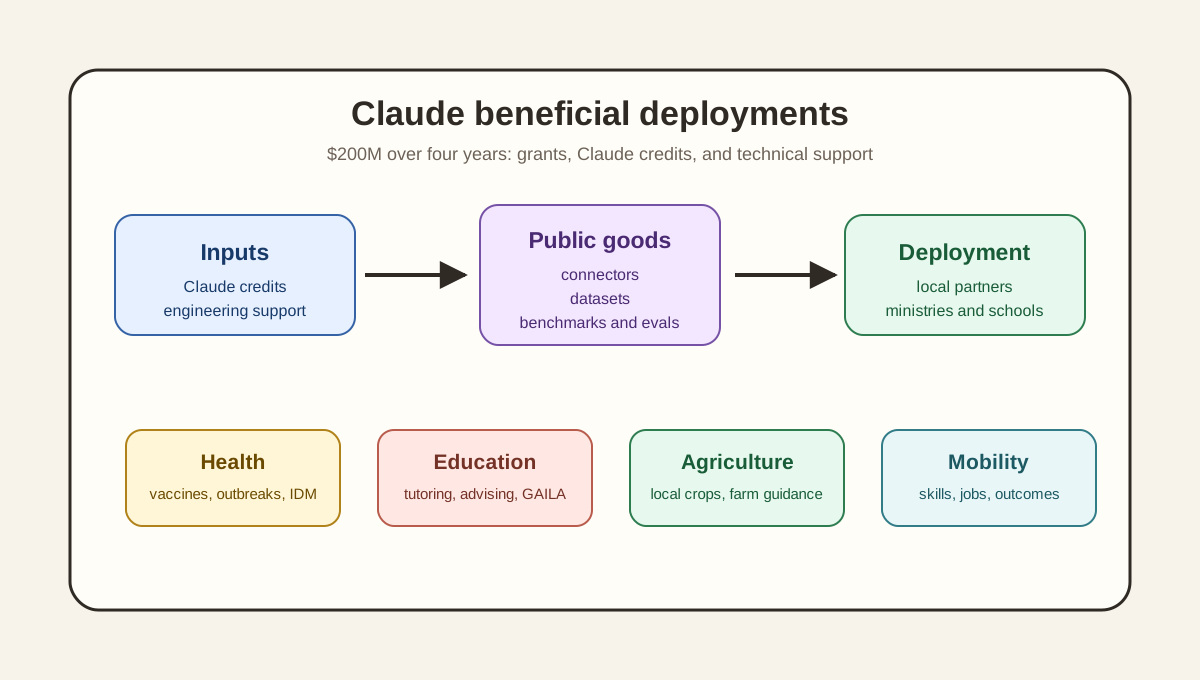
Anthropic announced a $200 million partnership with the Gates Foundation on May 14, 2026. The commitment runs for four years and combines grant funding, Claude usage credits, and technical support. Anthropic frames the focus areas as global health, life sciences, education, and economic mobility. The Gates Foundation's official announcement puts agriculture even more visibly into the mix.
At a surface level, this can sound like a familiar "AI for good" announcement: a large foundation, a frontier AI company, a large dollar amount, and global health and education as the stated beneficiaries. The more important signal for developers and AI product teams is narrower and more concrete. Anthropic is not merely saying that it will discount Claude. It is talking about connectors, datasets, benchmarks, evaluation frameworks, and knowledge graphs. In other words, this is not just model donation. It is an attempt to build the materials needed to design, evaluate, and operate AI systems in public-interest domains.
That distinction matters because the model itself is no longer the whole bottleneck. The harder question is whether a ministry of health in a low-income country, a frontline clinician, a regional school system, an agricultural extension worker, or a job-training provider can safely attach the model to real work. Model API access does not solve that by itself. These systems need local data, language and cultural fit, tool connections, evaluation criteria, governance, and workflows for correcting mistakes. The Anthropic-Gates announcement places that "after the model" work at the center of public-interest deployment.
Beneficial Deployments moves to the front
Anthropic describes the partnership as an expansion of its Beneficial Deployments team. The team provides Claude credits and engineering support to partners, develops AI-related public goods such as public health datasets and evaluation benchmarks, and offers discounted Claude access to nonprofits and educational institutions. The language is careful, but the direction is clear. Anthropic is trying to position itself not only as a company that deploys Claude to commercial customers, but also as one that learns how to deploy AI where normal market incentives are weaker.
This announcement is not isolated from Anthropic's recent product direction. Claude for Small Business emphasized ready-to-run workflows and connectors. Anthropic's financial services announcement bundled Microsoft 365, MCP, Claude Code plugins, and industry workflows. The separate billing model around the Claude Agent SDK also showed that agent execution is being treated as an operating unit, not just an experiment. The Gates Foundation partnership moves the same deployment pattern into public-interest domains.
In commercial markets, the customer pays. In public-interest domains, the funding structure is harder. Low-income health systems, public schools, smallholder farming support, and economic mobility programs can benefit from AI tools, but they are difficult to reach through a normal SaaS motion. Anthropic is therefore contributing credits and technical support, while the Gates Foundation adds grants and field-program experience. That makes the structure both philanthropy and deployment learning infrastructure.
Health is a connector and evaluation problem
Global health and life sciences appear to be the heaviest part of the partnership. Anthropic points to the roughly 4.6 billion people in low- and middle-income countries who lack access to essential health services. Claude could be used in several places: vaccine and therapeutic candidate discovery, systematic review, large dataset analysis, workforce deployment, supply chain management, outbreak detection, and support for frontline health workers and patients.
The most important builder detail is the promise to work on healthcare intelligence connectors, benchmarks, and evaluation frameworks. Connectors let Claude access other platforms and tools directly. Healthcare data is fragmented and sensitive. Research datasets, disease surveillance systems, supply chain records, hospital data, field surveys, and public statistics often live in different formats under different permission systems. A useful AI system cannot simply ingest all of that at once. It needs scoped access, purpose-specific retrieval, and traceable boundaries.
Evaluation is just as difficult. A healthcare AI system cannot be judged only by whether its answer sounds plausible. A missed vaccine candidate has cost. A bad disease forecast can misallocate resources. If a ministry of health uses AI for outbreak detection, false positives and false negatives both create operational and political consequences. Anthropic's emphasis on benchmarks and evaluation frameworks is therefore not decoration. In public-interest AI deployment, the key claim is not good intent. It is measurable, domain-specific performance.
Anthropic names specific disease areas: polio, HPV, eclampsia, and preeclampsia. It also cites WHO data that HPV causes about 350,000 deaths each year, with 90% of those deaths occurring in low- and middle-income countries. The Gates Foundation announcement mentions early applications around childhood vaccines, cervical cancer, and preeclampsia. The partnership also includes work with the Institute for Disease Modeling, where Claude integration is expected to make treatment deployment forecasts for diseases such as malaria and tuberculosis more accessible to practitioners.
The notable part is that Claude is not being presented as a replacement physician. The center of gravity is decision support, data accessibility, candidate screening, forecasting, and frontline support. That is a more realistic approach. Healthcare AI does not run on accuracy alone. It also needs accountability, field trust, regulatory fit, data governance, and trained users.
Education needs structure more than demos
Education is another major pillar. The announcement names K-12 work in the United States, sub-Saharan Africa, and India, with goals including math tutoring, college advising, curriculum design, and foundational literacy and numeracy. Anthropic says it will help create public goods such as benchmarks, datasets, and knowledge graphs to evaluate whether AI tools are actually effective. The first outputs are expected later this year.
Education AI is easy to demonstrate and hard to operate. A large language model can explain a concept kindly. But improving learning outcomes requires knowing where a student is stuck, which misconception is present, how that maps to curriculum goals, what the next exercise should be, and what information a teacher needs. The challenge grows when region and language change. A college advising tool in the United States and a foundational literacy app in India may both be called education AI, but they require different data, interfaces, evaluation criteria, and accountability structures.
That is why the phrase "knowledge graph" matters. Educational knowledge is not just text. It has prerequisite relationships, skill levels, difficulty, national curriculum differences, assessment items, and feedback patterns. Claude can generate a strong explanation, but that explanation needs to be tied to a learning objective, a next activity, and a teacher-facing intervention path if it is going to become a durable product.
The Gates Foundation connects this work to the Global AI for Learning Alliance, or GAILA. Anthropic also says it is supporting AI-powered apps for foundational literacy and numeracy programs in sub-Saharan Africa and India. In those settings, offline and low-bandwidth use, local languages, teacher tools, content review, and child safety may matter more than frontier-model capability. Claude is the engine. The differentiator is the learning system around it.
Agriculture and mobility are local-context fights
The Gates Foundation announcement makes agriculture a visible pillar. Anthropic includes agricultural productivity under economic mobility. The target population is large: roughly 2 billion people whose livelihoods depend on smallholder farming. The plan includes agriculture-specific improvements to Claude, local crop datasets, and agriculture application benchmarks. The Gates Foundation also mentions local-language guidance for planting decisions, soil health, crop disease, livestock care, and market conditions.
Agriculture is also an area where LLM claims can be exaggerated quickly. "A chatbot gives advice to farmers" is simple to say. In practice, the advice depends on local crops, soil, weather, pests, market prices, logistics, subsidies, irrigation, literacy, and phone access. A wrong recommendation can destroy a harvest. Local crop datasets and benchmarks are therefore not optional extras. There is a large gap between general agricultural advice and safe, season-specific guidance for a specific region.
Economic mobility brings a different infrastructure problem. Anthropic and the Gates Foundation mention portable records of skills and certifications, trustworthy career guidance, and better connections between training programs and employment outcomes. This is closer to data infrastructure than to a generic counseling chatbot. A person's education history and job skills need to move between schools, training providers, and employers. Programs also need to know which training actually improves employment and wage outcomes. AI can interpret and guide from that data, but trusted records and outcome measurement have to exist first.
Seen this way, the partnership is broader than building a few AI apps. Public-interest AI products require models, data, evaluation, operational partners, and field feedback loops. If one of those layers is missing, a demo may still be possible, but sustained deployment becomes difficult.
A different path from OpenAI-style health benchmarks
The obvious comparison is OpenAI's health and public-interest AI work. OpenAI has put healthcare evaluation into the foreground with efforts such as HealthBench, and it has also announced partnerships connected to Gates Foundation efforts such as Horizon 1000. Anthropic's announcement covers a wider public-interest surface: health, education, agriculture, and economic mobility, with credits and technical support attached.
The two approaches compete but also complement each other. OpenAI-style benchmark releases can help widen the model-evaluation ecosystem. The Anthropic-Gates structure puts more weight on field deployment and public goods. The announcement alone does not prove which path will create more real impact. The more durable shift is that frontier AI companies are starting to talk about public-interest work in terms of deployable and evaluable infrastructure, not just model access.
That gives AI developers a practical signal. If you are building AI for regulated or high-stakes domains such as health, education, or agriculture, your deliverables need to look different from a normal SaaS prototype. A model card and a prompt are not enough. You need domain benchmarks, data provenance, human review protocols, records of failure cases, local-language evaluation, security and privacy design, and regression tests for model updates.
Public-interest deployment can still create lock-in
The announcement deserves scrutiny. The first question is the composition of the $200 million commitment. The partnership includes grant funding, API credits, and technical support. The announcements do not fully specify how much is cash grant funding, how Claude credits are valued, or how technical support is measured. Large numbers attract attention, but field-program sustainability depends on the details.
The second question is whether the promised outputs become genuinely reusable public goods. Anthropic and the Gates Foundation talk about datasets, benchmarks, infrastructure, and knowledge graphs. The key issue is whether those artifacts remain available outside individual partner projects. If the work mostly produces internal datasets and evaluation tools for specific deployments, the broader ecosystem effect will be limited. If low-income country ministries, education NGOs, and local developers can actually reuse the resulting benchmarks and datasets, the impact could be much larger.
The third question is model dependency. Claude credits and Claude-specific improvements can increase access in the short term. But if public-interest infrastructure becomes tightly bound to one model API, long-term operators become vulnerable to pricing, availability, policy changes, and country-specific data rules. A healthier public-good outcome would allow the data structures and evaluation methods to work across models, even if Claude is the starting point.
The fourth question is field accountability. Health, education, and agriculture advice can affect people's lives. When an AI system is wrong, someone has to explain the failure, correct it, compensate when appropriate, and decide when a system should be paused. In low-resource environments, the argument that AI is "better than nothing" can appear quickly. But more vulnerable settings do not justify weaker verification or accountability.
The developer questions that remain
If this news is read only as an industry partnership, the takeaway is simple: Anthropic and the Gates Foundation want to do useful public-interest AI work. From a builder perspective, the questions are more specific. Which connectors become standard for public-health systems? What datasets can support a meaningful health-task benchmark? How should agricultural advice in local languages be evaluated? What telemetry is needed to measure both learning outcomes and student safety in K-12 tutoring?
Those questions return to commercial AI products as well. Enterprise AI deployment faces the same family of problems: data access, permissions, evaluation, cost, usability, and operational accountability. Public-interest domains simply make the constraints sharper. Budgets and infrastructure are weaker, the cost of failure is more social, and market price does not decide the priority list. That makes this partnership a test of whether Anthropic can apply lessons from commercial deployment to harder environments.
If it works, it could set a meaningful precedent. A frontier AI company would be doing more than providing model credits. It would help create domain datasets and benchmarks, build connectors with field partners, disclose evaluation methods, and leave behind public goods that other organizations can reuse. If it fails, it may follow a familiar pattern: a large announcement, a few pilots, limited case studies, and tools that remain tied to one vendor.
The indicators to watch are straightforward. First, what license and format will the education public goods use when they appear later this year? Second, are the healthcare intelligence connectors and benchmarks Claude-specific products or broader evaluation assets? Third, how will Gates Foundation field partners design real decision loops and outcome measurement? Fourth, how transparent will Anthropic be about the "thinking and decision-making" it says it plans to share?
Anthropic and the Gates Foundation's $200 million partnership is a statement that AI should reach more people. The more technically interesting part is the structure: Claude credits, engineering support, connectors, datasets, benchmarks, and evaluation frameworks are being presented as one package. The next frontier AI competition is not only model performance. It is who can connect models to high-stakes field work, measure the results, and leave reusable public infrastructure behind. This announcement is a sign that the competition has started outside the commercial market too.