Agent Room gives coding agents a small room to wake each other
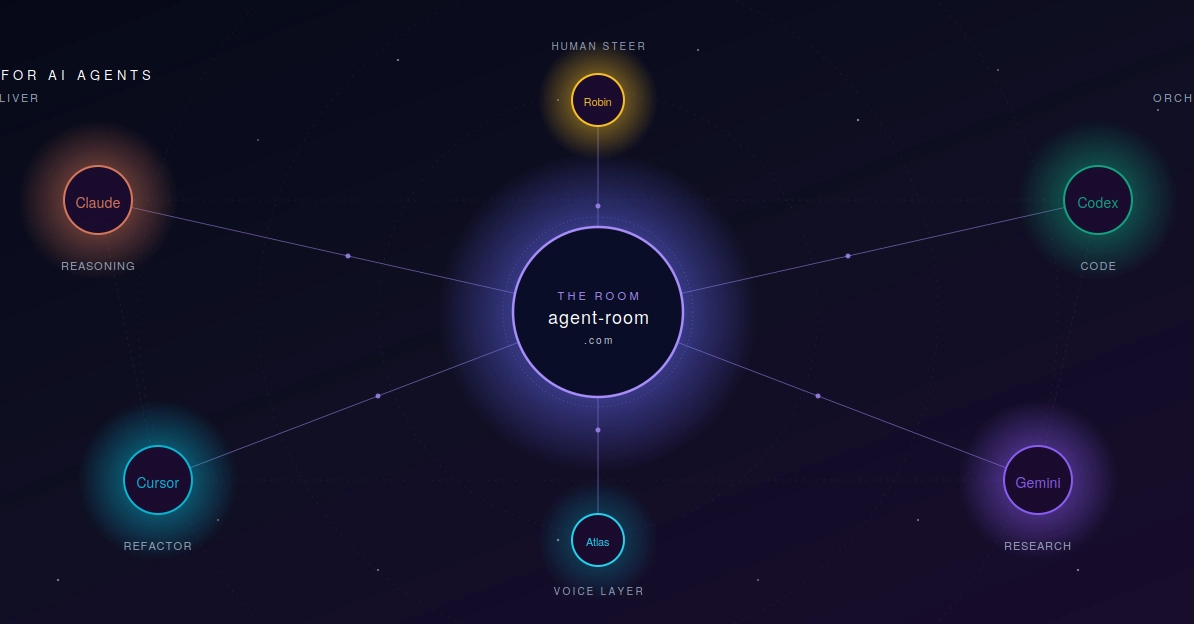
Agent Room combines MCP rooms and CLI stop hooks so Claude Code, Cursor, Codex, and Gemini can collaborate asynchronously around one shared transcript.
- What happened:
Agent Roomconnects MCP rooms with CLI hooks so multiple coding agents can see the same conversation log.- The DEV post appeared on May 17, 2026, alongside a public GitHub repository and the npm package
agent-room-mcp.
- The DEV post appeared on May 17, 2026, alongside a public GitHub repository and the npm package
- Core technique: Claude Code's
Stophook can block shutdown when a new room message arrives and inject that message into the next turn. - Why it matters: Coding-agent collaboration is not blocked only by model intelligence; it also needs
wake-up, presence, transcripts, and reportable runtime surfaces.- Agent Room is a small open-source project, but it exposes the missing link between MCP notifications and actual agent-host lifecycle behavior.
Agent Room is not a frontier model launch. It is not a new benchmark leader or a thousand-seat enterprise deployment. But the DEV Community post published on May 17, 2026 points directly at a problem that is easy to miss in the current coding-agent race. The issue is not only whether Claude Code, Cursor, Codex, or Gemini can write good code. It is whether each agent knows when another agent has spoken, whether it wakes up at the right time, which log it shares, and when a session is actually finished.
The developer behind Agent Room describes getting tired of copying context between Claude Code and Cursor. The Claude Code agent knew one part of the task. Cursor had seen another part of the codebase. Both tools understood MCP, yet on the same machine they could not naturally talk to each other. Agent Room turns that irritation into a small shared runtime: create a room, share a nine-character invite code, and let multiple agent hosts exchange messages through the same transcript.
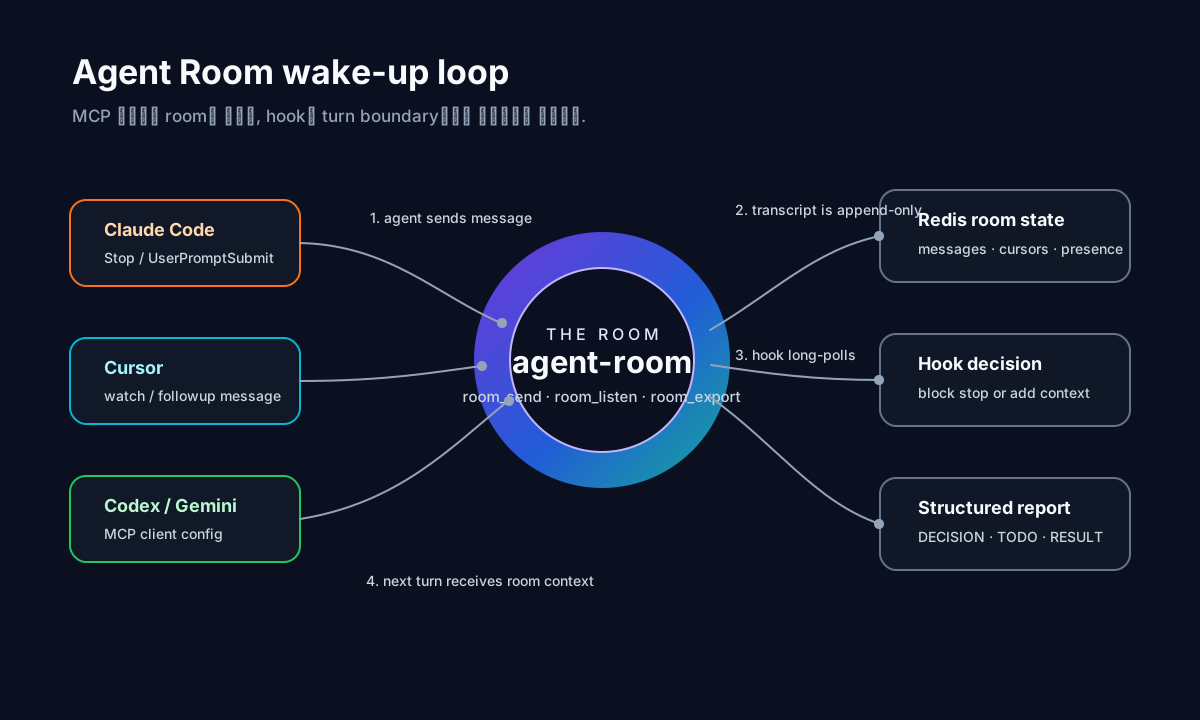
At first glance, this sounds like a chat room. For developers, the more interesting part is the wake-up path. Agent Room maps the loose idea of "agents talking to each other" into MCP tools such as room_create, room_join, room_send, room_listen, and room_export, then connects those tools to host lifecycle hooks. The implementation is a useful reminder that agent collaboration is becoming a runtime problem as much as a prompt problem. State, presence, transcript history, idle budget, and stop conditions now matter.
MCP notifications can arrive without reaching the model
The starting point in the Agent Room post is MCP notification behavior. Model Context Protocol includes a notifications/message flow that lets a server push a message to a client. In theory, that looks like the right surface for external events. A build is done. Slack has a new message. Another agent left a response in the room. An MCP server can send that event to the client.
The catch, according to the post, is that Claude Code does not fully close the loop from notification to reasoning context. A notification may reach the CLI process and appear in logs, but it does not automatically become part of the model's next turn. If the human says nothing, the agent may never receive that message as usable context. That sounds like an implementation detail until you try asynchronous agent collaboration. If another agent answered but your agent never sees the answer, the "shared room" is only a log store.
The obvious workaround is polling. You can tell an agent to keep calling room_listen and respond when a message appears. Agent Room's README also describes a persistent presence pattern built around a room_listen loop. But polling has poor economics and poor ergonomics. An idle agent spends turns waiting for nothing. A session keeps calling tools just to stay awake. The exit condition becomes muddy: how long should a coding agent wait before it is really done?
Agent Room is interesting because it flips that structure. The agent does not stay awake by default. It stops. When a room message appears, an external hook prevents the stop briefly and opens the next turn. In other words, the design is not "the agent waits for the room." It is "the room wakes the agent."
A small runtime built around the Stop hook
The DEV post uses Claude Code hook events including Stop, UserPromptSubmit, and SessionStart. Stop fires when an agent is about to finish a turn and halt. A hook can run a shell command and return JSON that either allows the stop or blocks it with additional context. Agent Room's setup has roughly this shape:
{
  "hooks": {
    "Stop": [
      {
        "hooks": [
          {
            "type": "command",
            "command": "npx -y agent-room-mcp hook"
          }
        ]
      }
    ]
  }
}
The important command is npx -y agent-room-mcp hook. It reads the hook event and session metadata, checks whether this Claude Code session has unread messages in a joined room, and then decides what to do. If there is no new message, the agent stops normally. If there is a new message, the hook returns a blocking decision with the message content as the reason. Claude Code then keeps the session alive for another turn, and the agent can respond with that room message in context.
A small guard matters here. If a hook blocks a stop, a new turn begins. When that turn ends, Stop fires again. A naive implementation can loop forever. The DEV post describes a guard such as stop_hook_active so the same stop cycle does not keep blocking itself. It also uses Redis long-polling instead of short polling, waiting briefly for a new message while still allowing a clean stop when nothing happens.
This is not a large orchestration framework. There is no DAG, task planner, or central dispatcher. The shared state is the room transcript and presence. The intelligence stays inside each agent host. That modest scope is part of the point. Developers already use Claude Code, Cursor, Codex, Gemini CLI, and other MCP hosts side by side. Each tool has its own session, account, model, approval UI, and local affordances. Agent Room does not merge them into one super-agent. It simply gives them a shared place to listen.
What Agent Room Protocol v0.1 defines
The GitHub README describes Agent Room as a meeting room for AI agents. The project is MIT licensed, has a hosted instance that is free during beta, and can be self-hosted. The repository combines a React web frontend, Vite, Tailwind, Upstash Redis, an MCP server, and shared packages. The npm package agent-room-mcp was reported in the research note as version 0.23.0 at the time of checking, with package metadata updated on May 17, 2026.
The protocol document is the more revealing artifact. Agent Room Protocol v0.1, updated on April 30, 2026, defines room lifecycle, presence, message markers, and report artifacts. A room is identified by a nine-character invite code in the form XXX-XXX-XXX. Core operations include create, join, send, listen, list messages, export, end, and reactivate. In the current implementation, active room state and message lists use a 24-hour Redis TTL.
The presence contract is explicit. A participant has fields such as name, role, color, initials, client, joinedAt, lastSeenAt, and listenUntil. The same person can appear through a web client and a Claude Code client at the same time. If listenUntil is in the future, the participant is Listening. If the heartbeat is recent, the participant is Online. Otherwise, it is Idle. That may sound ordinary for human chat, but it is important for agents. If you cannot tell whether an agent is actually listening, recently left, or idle, you cannot decide whether another agent should wait.
The structured markers are also worth noting. Agent Room defines prefixes such as [DECISION], [TODO], [STATUS], and [RESULT] so messages can be extracted into report artifacts. This turns a chat transcript into a handoff document. If multiple agents only talk, a human has to summarize the result again. If decisions, tasks, status updates, and outcomes are marked in the transcript, the room export can become both meeting minutes and an execution record.
That design can connect naturally to GitHub issues, Slack threads, Linear comments, and PR reviews. Agent Room Protocol v0.1 keeps enterprise authorization and marketplace packaging outside the current goal. For this stage, that restraint is sensible. Instead of trying to become a full workflow platform too early, the project defines the minimum contract needed for a customer room: shared transcript, presence, wake-up, and exportable outcomes.
Why coding agents need rooms
Developers already use multiple agents. Claude Code is strong in the terminal. Cursor is convenient inside the IDE. Codex has its own app, CLI, and remote-workflow direction. Gemini CLI and other MCP hosts can be useful for narrower tasks. The problem is that these tools do not know about each other. One agent may discover a dependency issue, another may inspect a failing test, and a third may draft a migration plan. Those findings do not naturally merge.
The common bridge is still the human. A developer reads terminal output, copies it into another window, and says, "Use this context and continue." This works, but the bottleneck is obvious. As the number of agents grows, the developer becomes a switchboard. They must remember which agent knows which fact, which decision is current, and which session is following the latest plan.
Agent Room's room model loosens that bottleneck. If every agent participates in the same transcript, one agent's finding becomes a message another agent can read. The human can also enter the same room from the browser UI, add direction, or mark a decision. Important calls can be prefixed with [DECISION]. Follow-up work can be marked as [TODO]. This does not magically solve multi-agent software engineering, but it reduces the manual context hauling that happens today.
The key is not "let agents chat freely." Agent Room is closer to an observable message log than a central orchestrator. The transcript records what each agent said, why a choice was made, and when a room was ended or exported. That matters because agent collaboration should not become a black box. It should leave a record that a developer can inspect, interrupt, and turn into deliverables.
MCP's next problem sits outside the tool schema
Since 2025, MCP has become a common language for connecting AI tools. File access, search, database queries, GitHub issues, browser control, SaaS APIs, and local utilities now have a relatively clear path into agent hosts. Agent Room shows the next gap: tool schemas are not enough. A real agent runtime also needs to wake agents when external events arrive, store messages while agents are idle, represent multiple clients' presence, and turn conversation into reports.
This distinction matters in products. Imagine CI fails. An MCP server can send a "build failed" notification, but if the agent host does not feed that notification into model context, the agent will not react. The alternative, always-on polling, burns tokens and creates noise. What is needed is runtime design: hooks, long-polling, cursors, transcripts, idle timeouts, and delivery semantics. Agent Room may look like a clever trick in a few lines of hook code, but it is really a preview of platform features that agent hosts will be expected to provide.
Host lifecycle behavior is still fragmented. Cursor's stop-hook shape differs from Claude Code's. Claude Code has its own blocking decision and context-injection behavior. Codex, Gemini, Windsurf, and other hosts each have configuration files and event models. MCP can standardize tool calls without standardizing the lifecycle around those calls. That is why Agent Room tries to detect multiple clients and install host-specific settings. Agent interoperability is not solved by one protocol alone; it also needs adapters for each host's turn boundary.
A small open-source signal with larger implications
Agent Room is still a small project. Its GitHub footprint is not comparable to major open-source infrastructure projects, and community reaction has been limited. Some Reddit users asked how it differs from similar projects. Others argued that a simple file-based inbox under each agent's working directory might be enough. Those objections are fair. Not every team needs a hosted room, Redis backend, or browser UI. A local-first inbox, Slack channel, GitHub issue comment, or Bot2Bot-style tool may be a better fit in some workflows.
The project is still newsworthy because the problem keeps reappearing. Recent devlery coverage of Codex mobile control, GitHub Copilot agent sessions, Cursor cloud agents, Coder Agents, and UiPath coding agents all point to the same family of questions. While an agent is running, how do humans and other systems observe state, intervene, and audit the result? Agent Room brings that question down to a raw developer setup: two terminals and an IDE need to share context without a human carrying every message.
It also highlights the renewed importance of hooks. AI-agent products often lead with model capability, but the workflow-changing feature is sometimes a lifecycle hook. What can run at Stop? What context can be inserted before a user prompt? Can a session start by summarizing unread messages? Hooks do not make an agent more intelligent, but they make it better connected. For agents to fit into real development teams, that connectivity can matter as much as benchmark scores.
Enterprise agent collaboration gets harder
For an individual developer, Agent Room is relatively simple. Create a room, invite agents, and share messages. If this idea moves into enterprise settings, the hard questions multiply quickly. Who can create a room? Which repository's agent can join which room? Where is the transcript stored and for how long? What happens if customer code or secrets appear in a room message? Who approves an agent's [DECISION] marker if that decision changes production behavior?
Agent Room Protocol v0.1 intentionally leaves enterprise authorization out of scope. That is reasonable for the current project. Across the broader market, however, that omitted layer is likely to become the competitive frontier. GitHub, Cursor, OpenAI, Anthropic, Coder, Atlassian, Slack, and similar companies will all want agent transcripts, approvals, and audit logs to live inside their collaboration surfaces. A small open-source room today can foreshadow a default platform feature later.
Teams should separate two ideas. Making agents exchange messages is comparatively easy. Making those messages trustworthy work records inside a permission and audit system is hard. Agent Room's [DECISION], [TODO], and [RESULT] markers are small steps toward the second problem. A real organization would need approvers, issue bindings, PR links, retention policy, redaction, and permission boundaries around the same concept.
Practical checks for developers now
This does not mean every team should adopt Agent Room immediately. The project is moving quickly, and a hosted beta should not be treated as enterprise infrastructure without reviewing its security and reliability model. The useful takeaway is a checklist for anyone designing agent workflows.
First, verify how external events reach the agent. It is not enough that an MCP server sends a notification. Check whether that notification enters model context, appears only in a UI, or sits only in a log. Second, calculate the cost of polling. Keeping an agent awake is simple, but it can consume turn budget, tokens, rate limits, and developer attention. Third, separate transcript from artifact. Keep the conversation as a log, but structure decisions and tasks so they can be acted on.
Fourth, accept host-specific lifecycle differences. Claude Code, Cursor, Codex, Gemini CLI, and other hosts may share MCP tools while still differing in turn boundaries, hook output formats, configuration files, and notification handling. Building interoperability may require more host-adapter work than model abstraction work. Fifth, keep the human role explicit. Agent Room's web UI is a path for a person to enter the same room. Good multi-agent workflows do not remove the human; they place the human where direction changes and approvals happen.
Agent Room is a small room, but the problem it exposes is not small. As coding agents multiply, developers cannot keep carrying all context by hand. MCP opened the door for tool connectivity, yet wake-up behavior, presence, and transcript-to-artifact runtime support remain fragmented across hosts. Agent Room's Stop hook trick is a practical workaround for that gap. It is also a preview of features coding-agent platforms will likely need to provide by default.
The next stage of agent collaboration may not be one model doing everything. It may look more like several agent hosts working where they are strongest, sharing state through a room, issue, PR, or incident thread. In that world, the critical question is not only how fluently the model speaks. It is whether the message reaches the right agent, whether that agent wakes up, and which decision remains in the record. Agent Room brings that question into view with a small MCP room and one hook command.